 Private Money Lenders
Learning Center
Long-form guides from the underwriting desk.
Plain-English deep dives on how hard money, fix-and-flip, DSCR, and construction loans actually work — written when a question shows up enough times in borrower calls that a single canonical answer beats answering it forty more times by phone.
Dutch vs non-Dutch interest. A borrower’s guide.
Dutch interest charges you for money you have not borrowed yet. Non-Dutch charges only what you have drawn. On a typical fix-and-flip, the difference is one full percentage point. On a 24-month ground-up build, it can be the difference between a profitable project and a marginal one. Worked math, side-by-side cost comparison, and the exact phrases to look for in a term sheet.
Read the article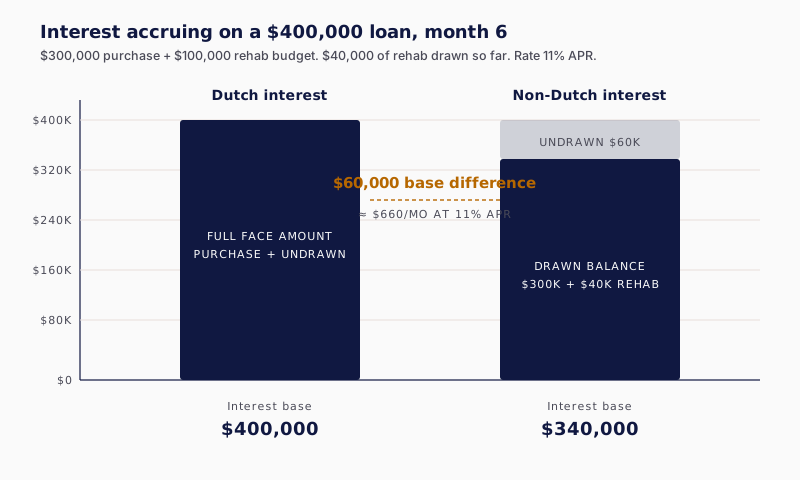
All articles
Dutch vs non-Dutch interest
How interest is calculated against drawn versus committed funds, and why the difference is hidden in the term sheet rather than the rate.
Read Fix & flip mathThe 70% rule, deconstructed
Why 70%, when to stretch to 75%, when to drop to 65%. Three worked deal scenarios across ARV bands.
Read ConstructionHow lenders verify percent-complete on construction draws
The third-party inspection process, what trips up first-timers, and how to structure your contractor agreement to keep draws moving.
Read DSCR rentalsDSCR loan calculation, with worked examples
How PITIA is built, what counts as gross rent on STR vs LTR, and the four levers that move your DSCR ratio above 1.20x.
Read BRRRR strategyBRRRR mechanics from acquisition to refinance
The full sequence: hard money in, rehab, lease, season, DSCR refinance out. Every step, with realistic timelines and capital requirements.
Read Hard money basicsHard money vs conventional: when each one is the right tool
Speed, leverage, documentation, and exit-strategy tradeoffs across the two loan types — with a decision matrix.
Read Loan structuringOrigination points vs rate: the break-even decides
When paying points to buy down your rate saves money and when it loses it — with the one-line break-even formula and a worked crossover chart.
Read Fix & flip mathThe ARV that funds your loan is not yours
How appraisers build ARV from comps, why your number gets cut, how ARV caps the loan, and the comp packet that defends a higher value.
Read Loan structuringRecourse vs non-recourse: what the guaranty covers
Non-recourse almost never means no guaranty. The carve-out schedule, the acts that spring a whole loan to full recourse, and what removing personal exposure costs in basis points.
Read Loan structuringCross-collateralization explained
One lien across several properties. How allocated loan amounts and release prices work, a worked three-property example, and the cross-default clause that turns one bad project into a portfolio event.
Read Fix & flip mathHolding cost math: what 30 days of delay costs
The six line items in a flip’s carry, the daily burn number that prices every schedule decision, and why the price cut that follows a delay costs more than the interest ever did.
Read Hard money basicsWhat ‘100% financing’ really means
Three caps run at once and your loan is the lowest of them. The real cash to close on a worked deal, how experience tiers move it, and what every route to zero down costs annualised.
Read ConstructionSchedule of values: building one that gets approved
The line-item budget your draws are scored against. The 12-to-20 line range, splitting material from labour on long-lead trades, and why front-loading always collects at the end.
Read ConstructionLien waivers and the draw release process
Why a sub you never hired can outrank your lender, the four waiver types and when to sign each, and the six clerical failures that stall an otherwise funded draw.
Read DSCR rentalsShort-term rental DSCR: AirDNA and the 75% rule
Why Airbnb income qualifies at 75% of gross, what that haircut is actually pricing, a worked 1.28x example, and the long-term-rental stress test to run before you close.
Read BRRRR strategySeasoning: what triggers a 6-month wait
Ownership versus rent seasoning, why an early refinance is sized against your purchase price instead of the new appraised value, and what that difference costs on a real BRRRR.
ReadTopic clusters
Articles group around six topic clusters. Each cluster will eventually contain a complete reference set on one subject.
Loan structuring
- Dutch vs non-Dutch interestPublished · 14 min
- Origination points vs rate trade-offsPublished · 12 min
- Recourse vs non-recourse on commercial loansPublished · 14 min
- Cross-collateralization explainedPublished · 12 min
Fix & flip math
- The 70% rule, deconstructedPublished · 13 min
- Calculating ARV that lenders will actually fund toPublished · 14 min
- Holding cost math: how 30 days of delay kills profitPublished · 11 min
- Wholetailing as a 70%-rule alternativePlanned
Construction draws
- How lenders verify percent-completePublished · 13 min
- Schedule of values: building one that gets approvedPublished · 12 min
- Lien waivers and the draw release processPublished · 13 min
- Cost overruns: what triggers a budget rerunPlanned
DSCR & rentals
- DSCR calculation with worked examplesPublished · 14 min
- Short-term rental DSCR: AirDNA and the 75% rulePublished · 12 min
- Multi-family DSCR vs commercial multifamilyPlanned
- Cash-out refinance LTV maximums by property typePlanned
Hard money basics
- Hard money vs conventional decision matrixPublished · 14 min
- What ‘100% financing’ really meansPublished · 12 min
- Soft pull, hard pull, and credit reporting on hard moneyPlanned
- State licensing and what it means for borrowersPlanned
BRRRR & strategy
- BRRRR mechanics from acquisition to refinancePublished · 15 min
- Seasoning requirements: what triggers a 6-month waitPublished · 13 min
- BRRRR vs flip-and-rent: when each makes sensePlanned
- Mid-flight pivot: turning a flip into a rentalPlanned
Have a question we have not answered yet?
Send it directly to the underwriting team. If it is asked enough, it becomes the next article. Real reply within four business hours.