 Private Money Lenders
Read time: 30 seconds
- Seasoning is a waiting period between acquiring a property and refinancing it — and it does two jobs: proving the rent is real, and earning the right to use the new appraised value.
- The second job is the one that matters. Refinance too early and many lenders use your original purchase price instead of the post-rehab value.
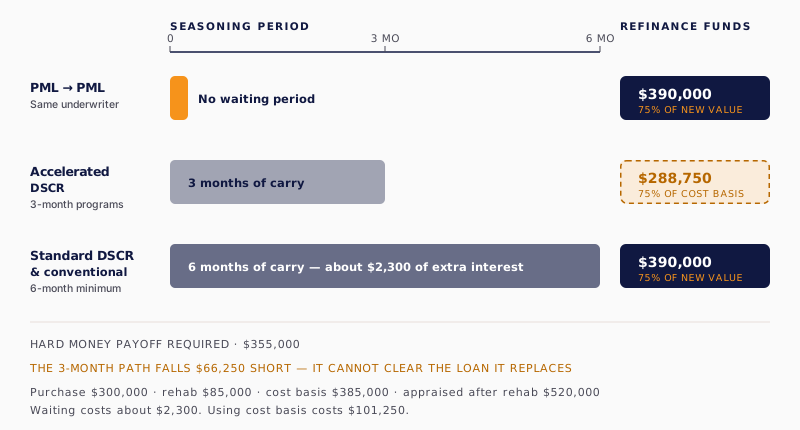
- On a worked BRRRR that is a $101,250 difference — $390,000 against $288,750 — and the smaller number does not even clear the hard money payoff.
- The ladder: conventional 6 months minimum; most DSCR lenders 3–6 months after rehab completion and lease execution; some at 3 months with rent being collected.
- PML-to-PML has no seasoning requirement — cash out at up to 75% of the new appraised value, often without a second appraisal, because the same underwriter handles both files.
- If you must season, wait. Six months of extra carry costs about $2,300 on this deal. Refinancing against cost basis costs $101,250.
Two clocks, not one
“Seasoning” gets used as though it were a single waiting period. It is really two independent clocks, and knowing which one your lender is counting explains most of the confusion in a BRRRR refinance.
Ownership seasoning counts from the date you took title. It answers a question about the transaction: has this property been held long enough that its current value reflects the market rather than a chain of quick transfers?
Rent seasoning counts from lease execution and the start of rent collection. It answers a question about the income: is this a real tenancy producing real deposits, or a lease signed to qualify a loan?
Both must be satisfied, and they do not run concurrently in any useful sense. A property you have owned for eight months but leased three weeks ago has plenty of ownership seasoning and almost no rent seasoning. This is the most common version of a borrower being surprised in month seven — they counted the clock that started first.
The practical sequencing implication is immediate: lease the property as early as the rehab allows. Every week between certificate of occupancy and a signed lease is a week the rent clock is not running while you carry hard money.
Why lenders require it
Seasoning serves two purposes: it proves the property’s rental income is stable, and it lets the refinance lender use the new post-rehab appraised value rather than the original purchase price.
Take those one at a time, because the second is worth vastly more money than the first.
Income stability is the intuitive one. A DSCR loan is underwritten against rent. A lease signed last week by a tenant who has never made a payment is a document, not an income stream. Three to six months of collected rent, visible in bank deposits, converts a claim into evidence. Reasonable, and rarely the binding constraint.
Value substantiation is where the real money sits. Lenders have long institutional memory of value fabrication through rapid resale — a property bought at $300,000, transferred between related parties, appraised at $520,000 within weeks, and financed against the inflated figure. Seasoning requirements exist to break that pattern by refusing to lend against a value the market has not had time to confirm.
The consequence for an honest investor is blunt: until you satisfy seasoning, many lenders will cap your refinance against what you paid, not what the property is now worth. Which is a direct attack on the entire premise of BRRRR, where the whole strategy is the gap between the two.
The market ladder
Requirements cluster into four tiers, and knowing where your intended takeout sits should drive your acquisition financing choice, not the other way around.
| Takeout lender | Seasoning | Value used | Notes |
|---|---|---|---|
| Conventional / agency | 6 months minimum | New appraised value after the period | Also requires full personal income documentation |
| DSCR, standard | 3–6 months after rehab completion and lease execution | New appraised value | The common market path |
| DSCR, accelerated | 3 months, rent being collected | Often the original purchase price | Faster, materially smaller loan |
| PML fix-and-flip → PML DSCR | None | New appraised value, up to 75% | Often no second appraisal — same underwriter on both files |
Row three is the trap. A three-month refinance sounds like a straightforward speed-versus-cost trade, and borrowers accept it expecting a slightly worse rate. The actual cost is usually not in the rate at all — it is that the lender uses what you paid rather than what it is worth, and that changes the loan by a different order of magnitude than any pricing adjustment.
What the value basis is worth
A BRRRR deal, sized the way these actually run. Purchase $300,000, rehab $85,000, total basis $385,000. Post-rehab appraised value $520,000. The acquisition loan is bound by the 90% loan-to-purchase cap: 90% of $300,000 plus the full $85,000 rehab equals $355,000, with $30,000 of sponsor equity going in.
Now refinance it two ways.
And then the part that turns an inconvenience into a wall. Your hard money payoff is $355,000. The unseasoned refinance funds $288,750.
The early refinance does not just return less capital. It cannot pay off the loan it was supposed to replace.Why cost-basis refinancing kills BRRRR
You would need to bring $66,250 of cash to the closing table for the privilege of refinancing into a permanent loan. That is not a smaller win; it is a capital call. And it arrives at the exact moment a BRRRR investor has the least liquidity, having just funded a down payment, a rehab overrun, and six months of carry.
The six-month wait, priced
Suppose you have no no-seasoning option and must choose between refinancing at three months against cost basis or waiting to six months. The site’s standing advice is that the wait is usually worth it. Here is the arithmetic behind that.
What waiting costs. Six more months on hard money at 8.99% on a $355,000 balance is $2,659 a month. The permanent DSCR loan at 6.99% on $390,000 would run $2,592 a month fully amortizing, of which roughly $320 is principal — equity, not expense. So the genuine additional interest cost of waiting is about $2,300 across the six months. Rent is collected either way once the lease is signed, so that side is a wash.
It is not close. Anyone advising you to refinance early to save carrying cost is optimizing the small number. The only situations where an early cost-basis refinance makes sense are ones where you bought at genuine market value and created little forced appreciation — in which case cost basis and appraised value are similar and there is nothing to wait for.
Where the threshold actually sits. Six months is the conventional minimum, not the moment the value basis flips. In practice most investors target 4 to 6 months: below month four you risk the refinance lender capping value at the original purchase price, and past month six you are burning hard money interest for no additional benefit. The usable sequence is rehab complete around month three, lease executed at month four, refinance application immediately behind it — which is another reason the lease date, not the purchase date, is the one worth managing. Confirm your specific takeout lender’s threshold before planning around it. The 44-to-1 arithmetic argues for clearing the cost-basis cap, not for waiting a single day longer than that takes.
What the seasoned refinance actually returns. On the $390,000 takeout:
Roughly 89% of the original equity recycled, with the property retained. That is the BRRRR outcome working as designed, and it is entirely dependent on the loan being sized against $520,000 rather than $385,000.
Cash-out and coverage pull against each other
One tension worth planning for: the more you cash out, the worse your DSCR, because the payment rises while the rent does not. At $3,600 of market rent:
| Cash-out LTV | Loan | PITIA | DSCR | Net to sponsor |
|---|---|---|---|---|
| 75% (maximum) | $390,000 | $3,122 | 1.15× | $26,650 |
| 70% | $364,000 | $2,950 | 1.22× | $1,190 |
Five points of leverage is worth $25,460 of recycled capital and costs 0.07x of coverage. On this deal maximum cash-out is clearly right, because 1.15x still clears comfortably above the 0.75x program minimum. On a thinner rent it would not be, and the sequencing matters: know your DSCR at the leverage you intend to take before you plan the recycle, using the method in our DSCR calculation article.
The no-seasoning path, and what it requires
PML borrowers refinancing from one of our fix-and-flip loans face no seasoning requirement. We will cash you out at up to 75 percent of the new appraised value, often without a second appraisal, because the same underwriter handles both files.
The mechanism is worth understanding rather than treating as a promotion, because it explains why the requirement can be waived honestly rather than merely waived.
Seasoning is a proxy. It exists because the refinance lender did not see the acquisition, did not see the scope, did not see the rehab, and cannot distinguish genuine forced appreciation from a manufactured value. Time is the substitute for information.
When the same underwriting desk financed the purchase, approved the schedule of values, inspected every draw, and watched the work complete, that information gap does not exist. The value is not asserted — it was funded, line by line, and physically verified by the party now lending against it. There is nothing left for a waiting period to prove.
That is also why a second appraisal is often unnecessary: the file already contains the subject-to-completion appraisal and a complete record of the work performed against it.
The resulting cycle is fast. This is the canonical BRRRR path through our book — acquisition and rehab on the fix-and-flip product, refinance into a DSCR rental on the same underwriter team, capital recycled in under 9 months, with a total cycle from cash close to stabilized DSCR typically running 9 to 14 months.
What still has to be true
No seasoning is not no underwriting, and the distinction matters if you are planning around it. Waiving the time requirement does not waive any of the conditions the time was meant to establish. Still required:
- Rehab complete. Not substantially complete. Final draw released, work finished, and the property in the condition the appraisal assumed.
- Lease executed. A signed lease at a rent the market supports. This is the item that most often delays an otherwise ready file — and it is entirely within your control to start early.
- DSCR clears at your target leverage. Program minimum is 0.75x with sub-1.0 permitted at a rate adjustment, but you should know your ratio before you size the cash-out, not after.
- Reserves. Six months of PITIA, verified liquid — on the worked deal, $18,732. Note that this comes out of the $26,650 you just recycled, which is exactly the kind of thing that should be in your model before closing rather than discovered at it.
- Credit and entity in order. A 680 FICO floor, with the soft pull running only after you accept terms.
- The appraisal supporting the value. No seasoning means no waiting period. It does not mean the $520,000 is taken on trust — the whole path depends on that number holding, which is why the ARV that lenders actually fund to is worth understanding before you buy, not after you renovate.
Plan the exit at acquisition rather than at completion. The single most expensive sequencing error in BRRRR is buying with an acquisition loan whose takeout path carries a six-month cost-basis restriction, then discovering it in month five with $101,250 riding on the answer. Tell us the acquisition and the intended exit and we will tell you what the refinance looks like before you close the purchase — which is the only point at which the information is still worth anything.
Glossary
A required waiting period between acquiring a property and refinancing it. Serves to demonstrate rental income stability and to permit the use of post-rehab appraised value.
The clock running from the date title was taken. Distinct from rent seasoning and frequently the one borrowers mistakenly count.
The clock running from lease execution and the start of rent collection. Usually the binding constraint on a BRRRR refinance.
Original purchase price, sometimes plus documented improvements. The value figure an unseasoned refinance lender may use instead of the new appraised value.
The increase in value created by renovation rather than by market movement. The entire margin a BRRRR strategy monetises, and precisely what a cost-basis refinance refuses to recognize.
A refinance for more than the existing payoff, returning the difference to the borrower. Capped at 75% of value on PML’s DSCR product.
Recovering the equity invested in a project through refinance so it can fund the next acquisition, while retaining the asset.
An appraisal of what the property will be worth once the approved scope is finished. Where the same lender funded and inspected that scope, it can support the refinance without a second appraisal.
Frequently asked questions
What is seasoning?
A required waiting period between acquiring a property and refinancing it. It does two jobs: proves the rental income is stable, and lets the refinance lender use the new post-rehab appraised value rather than the original purchase price. There are two clocks — ownership seasoning from the date you took title, and rent seasoning from lease execution and first rent collected. Both must be satisfied, and borrowers get surprised because they counted whichever started first.
How long is BRRRR seasoning?
Most DSCR refinance lenders require 3–6 months after rehab completion and lease execution; conventional requires 6 months minimum. Some DSCR lenders fund at 3 months if rehab is complete, the lease is executed, and rent is being collected. PML borrowers refinancing from one of our fix and flip loans face no seasoning requirement, cashing out at up to 75% of the new appraised value.
Can I refinance before six months?
Sometimes — and the trade-off is usually misunderstood. Some DSCR lenders fund at 3 months if rehab is complete, the lease is executed, and rent is being collected; conventional requires 6 months minimum. The catch: shorter seasoning often means the refi lender uses the original purchase price rather than the new ARV, which reduces the loan substantially. For maximum capital recovery, the six-month wait is usually worth the extra carrying cost.
How much does cost-basis pricing cost?
On a worked BRRRR — $300,000 purchase, $85,000 rehab, $520,000 post-rehab value — 75% of the new value is $390,000 while 75% of the $385,000 cost basis is $288,750. A $101,250 difference. Worse: the hard money payoff is $355,000, so the unseasoned refinance cannot clear the loan it was meant to replace and would require you to bring $66,250 of cash to closing.
Is the six-month wait worth it?
On a typical forced-appreciation deal, overwhelmingly yes. Six more months on hard money at 8.99% on a $355,000 balance costs roughly $2,300 of genuine additional interest, while using appraised value instead of cost basis adds $101,250 of proceeds — about 44 to 1 on waiting. The exception is a property bought near market value with little forced appreciation, where the two values are similar and there is nothing to wait for.
Why is there no seasoning PML-to-PML?
Because seasoning is a proxy for information the refinance lender lacks. A third-party lender did not see the acquisition, the scope, or the rehab, and cannot separate genuine forced appreciation from a manufactured value — so time substitutes for knowledge. When the same desk financed the purchase, approved the schedule of values, inspected every draw, and watched the work complete, that gap does not exist. The value was funded line by line and physically verified by the party now lending against it, which is also why a second appraisal is often unnecessary.
Does no seasoning mean easier underwriting?
No. Waiving the time requirement does not waive what the time was meant to establish. Rehab must be genuinely complete with the final draw released; a lease executed at a market-supported rent; DSCR must clear at your intended leverage; six months of PITIA verified liquid as reserves; and credit and entity requirements still apply at a 680 FICO floor. The appraisal supporting the new value still has to hold — the whole path depends on that number.
How fast can I recycle capital?
Through the no-seasoning path, capital is typically recycled in under 9 months, with a total cycle from cash close to stabilized DSCR of about 9 to 14 months. The sequence is acquisition and rehab on the fix-and-flip product, then refinance into a DSCR rental on the same underwriter team. The most common delay on an otherwise ready file is lease execution — entirely within your control, which makes leasing as early as the rehab allows the highest-value scheduling decision in the strategy.
Plan the exit before you close the purchase.
Tell us the acquisition and the intended takeout. We will tell you what the refinance looks like — which value it will be sized against and what it returns — while the information is still worth something.