 Private Money Lenders
Read time: 30 seconds
- The formula: DSCR = Gross monthly rent ÷ Monthly PITIA.
- Pricing tiers: 1.20+ is tier 1 (best rate, from 5.99%). 1.10–1.20 is tier 2 (+25 to +50 bps). 1.00–1.10 is tier 3 (+75 bps). Below 1.00 is no-ratio.
- What goes in PITIA: principal & interest, property taxes, insurance, and association (HOA) dues. All four are required if applicable.
- STR rent uses AirDNA P50 with a 20–30% haircut. LTR rent uses the lease or a 1007 form.
- Four levers to raise DSCR: rent up, taxes down, loan size down, rate buy-down.
What DSCR actually measures
DSCR — the Debt Service Coverage Ratio — is a property-level cash-flow test. It asks one question: does this property's rent cover its debt obligations, with margin? The number that answers it is the ratio of monthly rent to monthly debt service. Above 1.00, the property is paying for itself. Below 1.00, the borrower has to subsidize from outside cash flow.
That is the entire concept. DSCR loans — sometimes called rental loans, investor loans, or non-qualified mortgage (non-QM) investment loans — underwrite to that single ratio rather than the borrower's debt-to-income. No tax returns, no W-2s, no pay stubs, no DTI calculation. The property carries the loan, so the property qualifies for the loan.
That is why DSCR loans dominate the rental-investor market: a self-employed investor with twelve doors and complex tax returns cannot pass conventional DTI underwriting, but each individual property can clear DSCR independently. The math is property-specific and stacks cleanly across portfolios.
The formula, with the parts named
The formula in one line:
Two terms need decomposing.
Numerator: gross monthly rent
The property's rental income, monthly, gross of all expenses and vacancy. The lender uses the lower of two figures:
- Long-term rental (LTR): the lower of (a) the actual signed lease, (b) market rent from a Form 1007 (single-family) or Form 1025 (small multi-family) appraisal addendum.
- Short-term rental (STR / Airbnb / VRBO): 70–80% of AirDNA's P50 (median) revenue projection for the property, blended with the trailing 12 months of actuals if available.
The conservative-of-two principle protects against borrowers signing above-market leases purely to clear DSCR. When projected and actual rent diverge, the underwriter takes the lower.
Denominator: PITIA
Five components of monthly housing cost on the property — not the borrower's personal housing cost.
- Principal: amortization of the loan balance, monthly.
- Interest: at the offered note rate, on the proposed loan amount.
- Taxes: annual property tax bill divided by 12.
- Insurance: annual hazard / landlord policy premium divided by 12, plus flood insurance if the property is in a FEMA flood zone.
- Association: monthly HOA, condo association, or co-op dues. Optional but mandatory if the property has any. Some lenders also include monthly maintenance fees in this line for co-ops.
If the property has no HOA, the metric becomes PITI; the math is otherwise identical. Some lenders include other line items (special assessments amortized over remaining duration, ground lease payments) when applicable.
Worked example: $400,000 SFR rental
Take a real-shape deal. Single-family rental, $400,000 purchase, $300,000 loan at 75% LTV. Rate 7.25%, 30-year fixed.
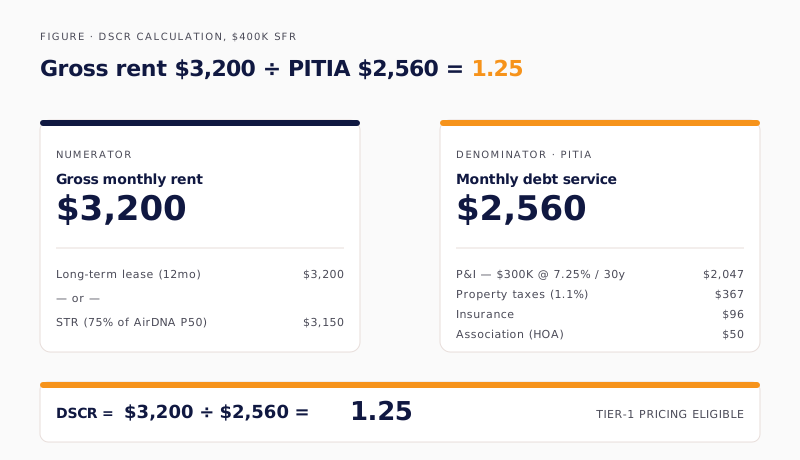
Walking through every line:
The deal lands cleanly in tier 1. The lender prices at the published best rate (currently 5.99% from on PML's DSCR program), the borrower closes with no rate adjustment, and the property cash-flows $640 per month before reserves.
Notice what is not in the calculation: the borrower's W-2 income, their other rental properties, their DTI, their mortgage on their primary residence. None of that enters the numerator or denominator. The deal qualifies on its own.
The four DSCR pricing tiers
Lenders bucket DSCR ratios into four pricing tiers, each with its own rate sheet.
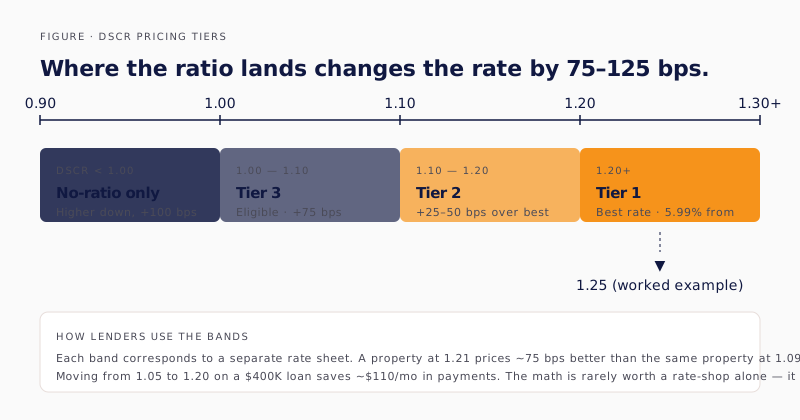
Tier 1: DSCR ≥ 1.20
Best-rate territory. Lender risk is comfortably low because rent covers debt with at least 20% margin. Most fixed-rate 30-year DSCR programs publish their advertised rate at this tier — currently 5.99% on PML's program. Tier 1 is what a well-priced rental in a normal-tax market lands at.
Tier 2: DSCR 1.10 to 1.20
Eligible at slight rate adjustment, typically +25 to +50 basis points over tier 1. The deal still cash-flows, but the margin is thinner and the lender's loss-given-default cushion shrinks. Properties in high-tax markets (NJ, IL, TX) frequently land in this band purely on the tax line.
Tier 3: DSCR 1.00 to 1.10
Eligible at a 75 basis-point adjustment over tier 1, often with a max LTV cap reduced from 75% to 70% or 65%. The property is barely covering itself. Most lenders also tighten reserves requirements at this band.
No-ratio: DSCR below 1.00
Property does not cover its own debt. Some specialty lenders — including PML — will still write at a 100 basis-point premium with reduced LTV (typically 65%) and higher reserves (12 months of PITIA in the bank). This is what gets called "no-ratio" or "investor-debt-service-not-required" pricing.
Move from 1.05 to 1.21 on the same property and the rate drops about 75 basis points. On a $300,000 loan over 30 years, that is roughly $135 a month — or $48,600 over the life of the loan. The math justifies real effort to push the ratio over each tier boundary.
A DSCR file is decided in three numbers: monthly rent, monthly tax, and the rate quote. Move any one and the deal moves between tiers.
DSCR for short-term rentals (Airbnb / VRBO)
STR DSCR works differently because there is no signed lease. Lenders fall back on a projection-plus-haircut approach.
The AirDNA P50 method
AirDNA aggregates Airbnb and VRBO listing data to produce projected revenue at the P25, P50 (median), and P75 percentiles for any given address or zip code. Most DSCR lenders use the P50 with a 20–30% haircut:
The haircut compensates for vacancy variance, seasonality, and the fact that AirDNA P50 is a market median; an individual host runs above or below it depending on listing quality, photography, and pricing strategy.
Trailing-12-month actuals
If the property already operates as an STR with at least 12 months of history, lenders blend the trailing actuals with the AirDNA P50 (typically 50/50). Properties that significantly outperform AirDNA can use actuals weighted higher, but expect lender skepticism — outperformance can be photographs, pricing, or a brief seasonal spike that does not repeat.
Local STR regulation
Some lenders apply additional underwriting restrictions or refuse STR DSCR loans entirely in markets where short-term-rental ordinances are unsettled or restrictive (Honolulu, Santa Monica, NYC outside Class B districts, large parts of New Orleans). Always confirm STR eligibility with the local zoning authority before assuming the projection.
The four levers that move DSCR
Once a deal pencils, there are exactly four ways to push the ratio higher to qualify for a better tier.
Lever 1: raise rent to market
The free lever. If existing leases are below market, project the post-renewal rent in the underwriting and supply rent-comp evidence (a Form 1007 or three direct comps will do it). On a property with a $2,800 lease but $3,200 market rent and a renewal in 60 days, the underwriter will use the higher figure if you request it explicitly. Lazy file submissions never even ask.
Lever 2: lower property tax via reassessment or homestead reclassification
The taxes line in PITIA is annual tax bill ÷ 12. If the property is currently over-assessed, contesting the assessment can drop the line by 10–25%. On a $400,000 property in a 1.2%-tax market, dropping from $4,800 to $3,800 of annual tax saves $83 a month — enough to move some files between tiers. The reassessment process takes 60–180 days, so this lever is usable when underwriting is paced rather than rushed.
Lever 3: shop insurance
The smallest of the four levers in absolute dollars but real on a tight file. Specialty landlord-insurance carriers (NREIG, REIGuard, Steadily) often write below the major-carrier home-insurance product on the same dwelling. A $300/year savings is $25 a month off PITIA — sometimes the difference between 1.19 and 1.21.
Lever 4: smaller loan or rate buy-down
The expensive lever, used last. Reducing the loan size lowers P&I dollar-for-dollar and improves DSCR proportionally. On the worked example above, dropping from $300K loan to $280K loan moves DSCR from 1.25 to 1.34 — cleanly into best-tier even on edge cases. Or buy down the rate at closing: each "point" bought (1% of loan amount paid at close) reduces the rate by roughly 25 basis points, which on the same loan saves about $50 a month in P&I.
DSCR vs conventional investor financing
Conventional investor financing — Fannie/Freddie agency loans — underwrites the borrower's full personal financial picture: tax returns, DTI, reserves across all properties, employment continuity. Up to 10 financed properties total per borrower (with strict tier breakpoints at 4, 7, and 10).
DSCR removes those constraints at a cost. Comparison:
| Dimension | Conventional investor | DSCR (non-QM) |
|---|---|---|
| Income docs | 2 yrs tax returns + W-2s | None |
| DTI cap | ~50% | N/A |
| Property limit | 10 financed total | No cap |
| Vesting | Personal name only | LLC permitted |
| Rate | ~6.0–6.5% | ~5.99–7.5% (tier-dependent) |
| Min FICO | 620 | 620–680 (program-dependent) |
| STR / vacation rental | Limited (DSCR-style addendum) | Native; AirDNA-based |
| Min loan | ~$70K | ~$100–$150K typical |
The trade is roughly: conventional offers cheaper rates with strict income/DTI underwriting and a 10-property cap; DSCR offers no income underwriting, unlimited properties, and LLC vesting, at a 25–75 basis point premium. Investors with multiple properties, complex tax situations, or LLC ownership preferences default to DSCR for everything past the first 2–3 doors.
What else underwriters check on a DSCR file
DSCR is the headline ratio, but the file still has discipline. Underwriters check:
- FICO floor: 660 typical for tier-1, 620 floor on tier-3 with rate adjustment.
- Reserves: 3–6 months PITIA in the bank for tier 1; 6–12 months for lower tiers.
- Foreclosure / bankruptcy seasoning: 3–7 years from event, depending on type.
- Property type: 1–4 unit residential, condo, condotel (in some programs), short-term rental, multi-family up to 10 units (program-dependent).
- Vesting: personal name, LLC, LP, or trust. LLC vesting requires the operating agreement and EIN at closing.
- Soft credit pull, then hard at close: standard non-QM order. Borrower's score is locked at the soft pull for pricing.
None of those gating items appear in the DSCR ratio itself. They are independent file-level checks that DSCR underwriting still requires.
Glossary
The ratio of gross monthly rent to monthly debt service (PITIA) on a rental property. Above 1.0 indicates rent covers debt; below 1.0 indicates a shortfall. Used as the primary qualification metric on non-QM rental loans.
Acronym for Principal, Interest, Taxes, Insurance, Association dues — the five components of monthly debt service on a property. The denominator of the DSCR formula. PITI without the A applies if the property has no HOA.
Fannie Mae appraisal addendum forms the appraiser uses to establish market rent. 1007 is for single-family; 1025 is for 2–4 unit properties. Used as the rent figure when no signed lease is available, or as a sanity check against the lease amount.
The median (50th percentile) projected gross revenue for a short-term rental at a specific address or in a specific market, derived from AirDNA's STR data aggregation. Used as the baseline rent figure for STR DSCR calculations, typically with a 20–30% haircut.
A loan that does not meet the CFPB's Qualified Mortgage criteria, typically because it does not document the borrower's income or DTI. DSCR loans are a subcategory of non-QM. Non-QM loans have looser underwriting but cannot be sold to Fannie/Freddie/Ginnie, which is why they are typically held in private capital pools.
Liquid funds (cash, marketable securities, retirement accounts at appropriate haircuts) the borrower must hold post-closing. Typically expressed in months of PITIA. DSCR programs require 3–12 months depending on tier.
The legal entity that holds title to the property. Common DSCR vesting options include personal name, LLC, LP, and revocable trust. LLC vesting is preferred by most active investors for liability isolation across a portfolio.
Closing-cost dollars paid to the lender to reduce the note rate. Each "point" equals 1% of the loan amount paid at close and typically reduces the rate by roughly 25 basis points. Used to push DSCR over a tier boundary or to reduce monthly P&I.
Frequently asked questions
What is a "good" DSCR ratio for a rental loan?
1.20 and above qualifies for tier-1 (best-rate) pricing. 1.10–1.20 is tier 2 with a 25–50 basis-point rate adjustment. 1.00–1.10 is tier 3 with a 75 basis-point bump and lower max LTV. Below 1.00 is no-ratio territory — eligible only with higher down payments and rate adjustments around 100 basis points. Most experienced investors target 1.20–1.25 for the cleanest pricing on a stabilized rental.
Does PITIA include HOA fees?
Yes. The "A" is for Association — HOA, condo association, or co-op dues. If the property has any monthly association fee, it is required to be in the DSCR denominator. Properties without an HOA simply use PITI; the math is otherwise identical.
What gross rent figure do lenders use for STR / Airbnb?
For short-term rentals, lenders typically use AirDNA's P50 (median) projected revenue with a 20–30% haircut to account for vacancy variance and seasonality. Some lenders blend AirDNA with the property's last 12 months of actual STR revenue if available. If no STR history exists, the long-term rent estimate from a 1007 form is the fallback floor. Always verify your local STR regulations before assuming the projection.
Can I qualify for a DSCR loan with no W-2 income?
Yes — that is the primary use case. DSCR loans do not require tax returns, W-2s, pay stubs, or DTI calculations. The qualification is property-based: the loan must service itself from the rental income. Borrowers do supply an asset statement (60–90 days of bank statements or brokerage statements for reserves) and a soft credit pull, but personal income documentation is not part of the file.
What FICO score do I need for a DSCR loan?
Most DSCR programs floor at 660 FICO for tier-1 pricing, with 620–640 floors on tier-3 programs at meaningful rate adjustments. Lower FICO scores either price up roughly 12–25 basis points per 20-point FICO band, or fall out of eligibility entirely below 620. PML's DSCR program publishes its FICO floor at 660 for the advertised 5.99% tier-1 rate.
Can I close a DSCR loan in an LLC?
Yes. LLC vesting is one of the structural advantages of DSCR over conventional. The LLC operating agreement, EIN, and Certificate of Good Standing are part of the closing package. Some lenders also allow LP and revocable-trust vesting; check the specific program. If the LLC has multiple members, all members typically sign personal guarantees.
How can I improve my DSCR before closing?
Four levers, in order of cost-effectiveness: (1) raise rent to market when leases come up for renewal pre-close, (2) shop tax and insurance for lower premiums, (3) reduce loan amount to lower P&I, (4) buy down the rate at closing. The first two are no-cost; the last two trade closing dollars for ratio improvement. A 5% rent bump or a 25-basis-point rate buy-down typically moves the deal one full pricing tier.
Does the DSCR ratio affect my LTV cap?
Yes. Tier 1 (DSCR ≥ 1.20) typically allows up to 75–80% LTV. Tier 2 may cap at 75%. Tier 3 commonly caps at 70%. Below 1.00 (no-ratio) often caps at 65%. Underwriters reduce LTV at lower DSCR tiers because the property's ability to absorb rent volatility shrinks — lower equity means less cushion for the lender at default.
Get a real DSCR quote on a specific property.
Send us the address and the rent. We will run the full DSCR calculation, return the tier you land in, and quote in writing within four business hours.