 Private Money Lenders
Read time: 30 seconds
- BRRRR = Buy, Rehab, Rent, Refinance, Repeat. A long-term rental strategy that recycles one capital base through multiple deals.
- Capital required to start: roughly $40-70K for a $250K all-in deal. Most of it comes back at the refinance.
- Seasoning: 3-6 months for DSCR refi, 6 months for conventional. Required before the refinance lender will use the new ARV.
- The walk-out math: ARV × 75% (DSCR max LTV) must equal or exceed purchase + rehab + carry. Achievable if you buy 25%+ below ARV and rehab adds material value.
- Five common failures: low ARV, rehab overruns, longer seasoning, weak rents, refi declines. One is recoverable; two together is usually a capital-stuck deal.
What BRRRR stands for and where it came from
BRRRR is an acronym for Buy, Rehab, Rent, Refinance, Repeat — a five-stage real estate investment cycle that uses short-term hard money to acquire and improve a property, then converts to long-term DSCR or conventional financing to pull most of the original capital back out. The recycled capital then funds the next deal.
The acronym was popularized by Brandon Turner at BiggerPockets around 2014, though the underlying mechanic predates the name by decades. What BiggerPockets did was give a chaotic informal practice a clean five-letter name and a published playbook. The strategy spread quickly because it answered a structural question that buy-and-hold investors had been working around for decades: how do you scale a rental portfolio without needing fresh capital for every deal?
The answer is the refinance leg. By extracting equity from a stabilized rental, the investor's capital base — the same dollars — turns over multiple times. A $50,000 capital base run through six BRRRR cycles in three years produces six rentals, not one. Each rental generates its own cash flow on top of the recovered capital. That compounding is the actual return on BRRRR.
The five steps in order
Each step is its own operation with its own duration, capital requirement, and failure mode. Skipping or shortening any one of them compromises the next.
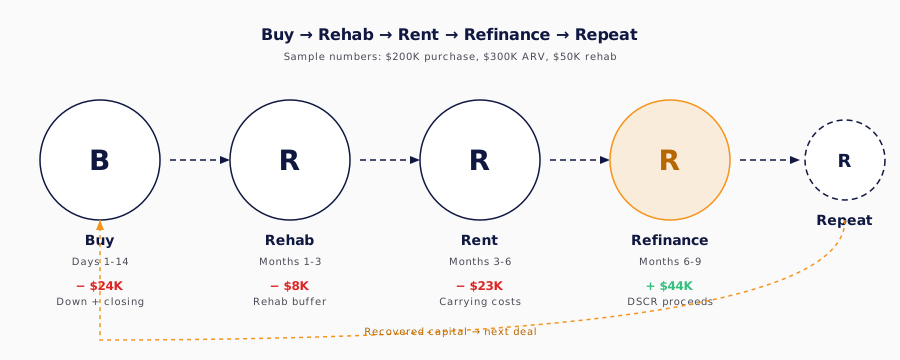
Step 1: Buy
Acquisition with a hard money or fix-and-flip loan. Target property: a single-family, 2-4 unit, or small multifamily with significant repair upside relative to its purchase price. Buy 25-35% below the property's after-repair value (ARV). The bigger the spread, the more capital comes back at refinance.
Typical BRRRR acquisition: 88-92.5% LTC on a hard money loan, 6-12 month term, 10-12% APR, 1-2 origination points. The buyer puts 7.5-12% down out of pocket on the purchase price.
Step 2: Rehab
Property improvements that lift the property to retail-rental condition and validate the ARV. Common BRRRR rehab scopes: kitchen and bath updates, flooring, paint, basic systems (HVAC, water heater, electrical updates), curb appeal, landscaping. Stay clean and consistent — BRRRR rehabs are mass-market presentations, not custom builds.
Hard money funds 100% of rehab as draws on a Schedule of Values. Typical rehab duration: 60-120 days depending on scope. The investor advances rehab from cash and is reimbursed as work passes inspection.
Step 3: Rent
Lease execution with a paying tenant. Goal: market-rate rent, 12-month lease, qualified tenant (700+ credit, 3× rent income, no recent evictions or felonies). The lease and the first month's rent receipt become evidence at refinance.
Lease-up duration: usually 14-45 days in a normal market once rehab is complete. The investor manages the property themselves or hires a property manager at 7-10% of monthly rent.
Step 4: Refinance
Conversion of the hard money loan into a long-term DSCR or conventional rental loan. The refinance pays off the existing hard money balance and ideally returns additional capital to the investor.
Most DSCR refinances close at 70-80% LTV of the new appraised value. With a strong ARV gain and rent that supports the loan, the refi can return most or all of the original capital. With a weak ARV or marginal rent, some capital stays trapped in the deal.
Refinance timeline: 30-45 days from application to funding. Most lenders require 3-6 months of seasoning post-rehab before they will refinance.
Step 5: Repeat
The recovered capital is the down payment for the next BRRRR acquisition. The rental income from the first property supplements the investor's W-2 (or replaces it). The cycle repeats.
An investor running BRRRR consistently builds a portfolio of cash-flowing rentals using essentially one capital base. The compounding kicks in when rent from properties 1-4 starts funding the carrying cost of property 5, removing the need to advance carrying capital from outside the system.
Capital stack: a worked $300K BRRRR example
Below: the full cash flow on a representative BRRRR deal. Single-family, $300K ARV target, $50K of rehab.
In this base scenario, the investor recovered everything except the $11,500 that stays in the deal as residual equity. That residual is recovered through monthly rental cash flow over the holding period. The DSCR loan amortizes; the property appreciates; both contribute to equity buildup.
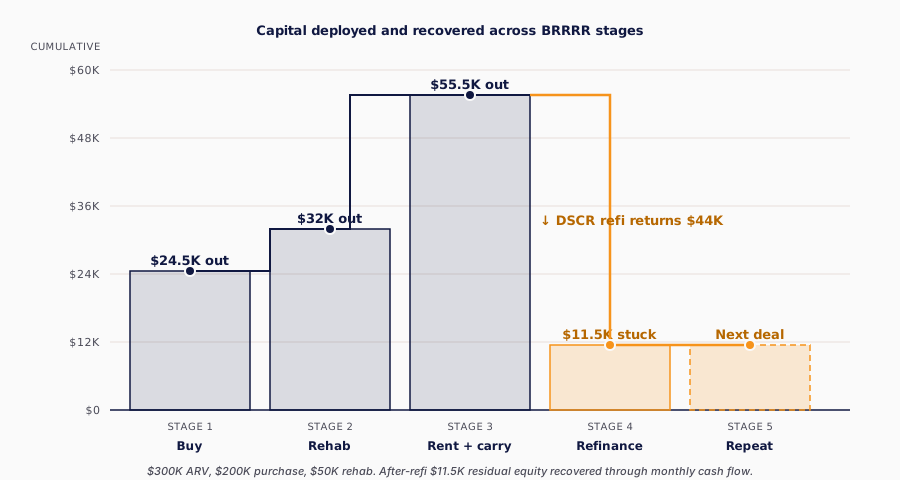
Compare this to a perfect BRRRR — where the spread between ARV and basis is large enough to walk out capital-neutral or even capital-positive. On the same $300K ARV with a $175K purchase (instead of $200K), the refinance returns $25K more cash, and the investor exits with the entire $55K of original capital recovered plus a stabilized rental producing $2,400/mo gross.
The seasoning question
Seasoning is the time between acquisition (or rehab completion) and refinance closing. Every refinance lender has a seasoning requirement. Two reasons:
- Income verification. The lender needs to see actual rent collected. A signed lease alone is not enough; they want 3-12 months of bank statements showing the tenant paid.
- Value support. The lender's appraiser uses the new (post-rehab) value, but they want enough hold time to confirm the value is durable, not a flip-driven valuation peak.
| Refinance lender type | Seasoning required | Uses new ARV? |
|---|---|---|
| DSCR (most lenders) | 3-6 months | Yes, post-rehab |
| DSCR (some) | 0-3 months | Yes, but capped |
| Conventional Fannie/Freddie | 6 months minimum | Yes, post-rehab |
| Commercial portfolio | 12 months | Yes |
Most BRRRR investors target 4-6 months of seasoning. Less than 4 risks the refi lender capping ARV at the original purchase price. More than 6 burns extra hard money interest. The sweet spot is rehab completion at month 3, lease at month 4, refi application at month 5, refi close at month 6-7.
DSCR refinance mechanics
The refinance leg of BRRRR is almost always a DSCR loan rather than conventional Fannie Mae. Three reasons:
- No DTI required. DSCR underwrites the property's cash flow, not the investor's. This is critical for investors building portfolios — Fannie Mae caps borrowers at 10 financed properties total, while DSCR has no count limit.
- Faster timeline. 30-45 day DSCR close vs 45-60 day conventional.
- Self-employment friendly. Most active BRRRR investors are self-employed or running side businesses. Their tax returns understate true income. DSCR ignores tax returns entirely.
DSCR pricing in May 2026 ranges 5.99-8.5% depending on FICO, LTV, property type, and DSCR ratio. Most BRRRR refis price at the lower end — 30-year fixed at 6.5-7.5% for stabilized single-family rentals.
The DSCR ratio calculation:
1.24x clears most DSCR programs comfortably. Investors who want to maximize loan amount push DSCR closer to 1.10x — the floor at most lenders. Read our complete DSCR calculation article for the formula in detail.
BRRRR is not a get-rich-quick scheme. It is an operating-system upgrade for a buy-and-hold investor: same time horizon, same risk, dramatically more leverage on the capital base.
Five common failure modes
The strategy works in roughly 60-70% of attempted deals at expected economics. The other 30-40% miss on one of these dimensions:
1. ARV comes in below projection
The refi lender's appraiser values the property 5-12% below the investor's eyeball ARV. The refi loan shrinks proportionally. If ARV came in at $280K instead of $300K, the 75% LTV becomes $210K instead of $225K — the investor recovers $15K less.
Mitigation: pull conservative comps before bidding, discount your ARV estimate by 5-8% to approximate appraiser discipline, and choose a deal where the spread between purchase + rehab and ARV is wide enough to absorb a low appraisal.
2. Rehab budget overruns
The $50K budget becomes $65K due to scope creep, contractor changes, or unknown-unknown discoveries (foundation, roof, environmental). The extra $15K comes out of the investor's pocket because hard money is contractually capped at the original Schedule of Values.
Mitigation: build a 15-20% contingency reserve outside the rehab budget. Walk the property with a contractor before bid. Avoid pre-1960 properties without a foundation inspection.
3. Seasoning takes longer than planned
Lease-up takes 60 days instead of 30. Hard money interest accrues for two extra months. On a $300K loan at 10.5%, that is $5,300 of extra carry.
Mitigation: start marketing the property at week 4 of rehab, not week 12. Have a pre-qualified tenant pipeline (working with a leasing agent rather than relying on Zillow alone).
4. Market rent comes in below projection
$2,200 actual vs $2,400 projected. The DSCR ratio drops to 1.14x, which still clears, but a softer rent reduces the size of the refi loan and may push it to a higher pricing tier. On the example above, $200 less rent makes the DSCR refi $20K smaller.
Mitigation: pull rental comps from Rentometer, Zillow, and 3 actual leased listings in the immediate area. Discount projection by 5% to be safe.
5. Credit or DTI declines on the refinance
Investor's credit took a hit between acquisition and refinance (often from running other rehab projects on credit cards). DTI got worse. The DSCR lender adds a half-point to the rate, or worse, declines.
Mitigation: do not run up credit cards during the BRRRR cycle. Pre-qualify with the refinance lender before the acquisition closes, not after. Have a backup refinance lender on standby.
The walk-out math
"Walking out capital-neutral" is the gold standard for BRRRR. The formula:
For a capital-neutral exit, ARV must be high enough that 75% of it covers the entire project basis. Inversely: the all-in basis (purchase + rehab + carry) must not exceed 75% of ARV. That is the same ratio as the 70% rule with the selling-cost component stripped out (because BRRRR doesn't sell).
Worked example for a capital-neutral exit on a $300K ARV:
If purchase price + rehab budget stays under $201,000 on a $300K ARV property, the deal walks out capital-neutral. That is a 67% basis-to-ARV ratio — the practical BRRRR ceiling.
When BRRRR beats flipping
Same property, two strategies. The choice depends on hold horizon, monthly cash flow needs, and capital-deployment goals.
| Dimension | Fix and flip | BRRRR |
|---|---|---|
| Time to exit | 4-9 months | 6-8 months to refi, hold indefinitely |
| Cash profit at exit | $50-90K (10-25% ROI) | $0-15K typically |
| Monthly cash flow after exit | None (property sold) | $200-500/mo per door |
| Capital recycled into next deal | Yes, plus profit | Yes, minus residual equity |
| Long-term equity buildup | None | Loan paydown + appreciation |
| Tax treatment | Ordinary income (active) | Passive losses, 1031 eligible |
| Operational load | Ends at sale | Continues (property management) |
BRRRR makes sense for investors who want passive cash flow, tax-advantaged income, and a growing rental portfolio. Fix and flip makes sense for investors who need cash profit now and do not want long-term operational responsibility for the property. Many serious investors do both: flips fund the lifestyle and the down payments; BRRRRs build the portfolio.
How a lender thinks about BRRRR deals
From the lender side, BRRRR is two separate transactions: a hard money acquisition (high-rate, asset-based, 6-12 month term) and a DSCR refinance (long-term, cash-flow-based). Most direct lenders that cover both sides — including PML — are happy to write both legs of the deal under one underwriting relationship.
What this means for the borrower: ask whether your hard money lender writes the refi too. A single lender on both sides eliminates a second underwriting process, a second appraisal, and a second closing. PML's fix-and-flip loan seamlessly converts to our DSCR loan at month 6, often using the same appraisal updated for stabilized rent.
Pre-qualify both legs before acquisition. If the DSCR refi math doesn't pencil at the projected ARV and rent, the BRRRR doesn't work and the deal should either flip or get walked away from. Send a deal and we will quote both the acquisition and the projected refi at the same time.
Glossary
Buy, Rehab, Rent, Refinance, Repeat. A long-term rental investment strategy using hard money for acquisition and DSCR refinance for permanent financing, with capital recycled across multiple deals.
The waiting period a refinance lender requires between acquisition (or rehab completion) and refinance closing. Most DSCR lenders require 3-6 months; conventional requires 6 months minimum.
Monthly rental income divided by monthly PITIA (principal, interest, taxes, insurance, association fees). Refi lenders typically require 1.10-1.25x DSCR. Full article here.
The appraised value of the property after rehab completion. The basis for the refinance loan amount (typically 70-80% of ARV) and the gating value for whether the BRRRR walks out capital-neutral.
The amount of original investment returned to the investor after the refinance closes. A capital-neutral walk-out means the refi loan amount equals or exceeds total invested capital. A capital-stuck deal means some portion remains in residual equity.
Annual cash flow divided by remaining capital in the deal. On a BRRRR with $11,500 stuck and $400/mo cash flow, cash-on-cash is ($400 × 12) / $11,500 = 42%. The metric becomes infinite as walk-out approaches capital-neutral.
Principal, Interest, Taxes, Insurance, Association fees (HOA). The total monthly cost of carrying a property. Used in the denominator of the DSCR ratio.
An IRS section allowing investors to defer capital gains tax by reinvesting proceeds from a property sale into a like-kind investment property. Available to BRRRR exit-by-sale but not relevant to the refinance leg (refis are not taxable events).
Frequently asked questions
What does BRRRR stand for in real estate?
Buy, Rehab, Rent, Refinance, Repeat. A long-term rental investment strategy where the investor uses short-term hard money to acquire and rehab a property, stabilizes it with tenants, then refinances into permanent (DSCR or conventional) financing to recover most or all of the original capital — which is then deployed into the next deal.
How long is BRRRR seasoning?
Most DSCR refinance lenders require 3-6 months of seasoning after rehab completion and lease execution. Conventional lenders require 6 months minimum. Seasoning serves two purposes: it proves the property's rental income is stable, and it lets the refinance lender use the new (post-rehab) appraised value rather than the original purchase price.
What is the difference between BRRRR and fix and flip?
Both start with hard money acquisition and rehab. Fix and flip exits by selling to a retail buyer; BRRRR exits by leasing the property and refinancing into a long-term loan. Fix and flip generates cash profit; BRRRR generates a cash-flowing asset plus a recoverable capital base. Fix and flip applies the 70% rule; BRRRR applies a 75-80% LTV-on-refinance ceiling.
Can you walk out of a BRRRR deal with no money down?
Yes, but only when the deal math works. Walking out capital-neutral means the refinance loan amount equals or exceeds your total invested capital (down + rehab + closing + holding). Math: ARV × 75% (DSCR max LTV) must equal or exceed purchase + rehab + carrying. Achievable on properties where you can buy 25%+ below ARV and rehab adds material value, but not on every deal.
What DSCR ratio do I need for BRRRR refinance?
Most DSCR lenders require a 1.10-1.25x debt service coverage ratio. PML's DSCR refi requires 1.15x at standard tier, 1.00x with a 5-10% LTV reduction. The ratio is calculated as monthly rent divided by PITIA. A property renting at $2,800/mo with $2,400 PITIA produces a 1.17x DSCR. Full DSCR article here.
How much money do I need to start BRRRR?
For a $250K all-in deal, expect to need $40,000-$70,000 of starting capital. Breakdown: 10% down on hard money ($25K), 15-20% of rehab as a reserve ($10K), closing ($5K), 6 months of holding ($10K for taxes, insurance, utilities, interest). After refinance, $35-50K is typically recovered, leaving $5-25K permanently in the deal as residual equity.
What are the most common BRRRR failure modes?
Five recurring failures: ARV came in below estimate (refi loan smaller than expected), rehab budget overran (more out-of-pocket), seasoning longer than planned (extra hard money interest), rental rate softer than projected (DSCR fails), and credit/DTI issues on refinance (loan declined). Each one independently reduces the walk-out percentage; two together typically converts a capital-neutral deal into one requiring permanent capital.
Can I refinance hard money before 6 months?
Some DSCR lenders fund at 3 months of seasoning if rehab is complete, lease is executed, and rent is being collected. Conventional requires 6 months minimum. Trade-off: shorter seasoning often means the refi lender uses the original purchase price instead of the new ARV, which reduces the loan amount. For maximum capital recovery, the 6-month wait is usually worth the extra carrying cost.
Quote both legs of a BRRRR before you bid.
Send the address, ARV estimate, and projected rent. We will reply with both the acquisition loan and the refinance terms within four business hours — so you know the deal pencils before contract.