 Private Money Lenders
Read time: 30 seconds
- The formula: Maximum offer = (ARV × 0.70) − rehab budget.
- The 30% buffer is not profit. It absorbs financing, holding, selling costs, and profit. Roughly 6% each, plus an 8–12% margin target.
- Stretch to 75% in fast markets (sub-21-day DOM), with predictable rehab and cheap backup capital.
- Drop to 65% in slow markets, on first-time projects, on structural-risk properties, or when rates push holding costs above 8%.
- The rule is a screening tool, not a substitute for underwriting. Run the full deal math after the 70% check passes.
What the 70% rule actually says
The 70% rule is a one-line decision filter for fix-and-flip investors. It says: do not pay more than 70% of the after-repair value of a property, minus your rehab budget. Anything above that ceiling is statistically likely to compress your margin to the point where the deal stops being worth your time.
In formula form:
That is the rule in full. The 30% gap between ARV and 70%-of-ARV is your working room — the space inside which financing costs, holding costs, selling costs, and the project's profit have to fit. Bid above $230,000 in our example and that working room shrinks; bid materially above and the room collapses to zero or worse.
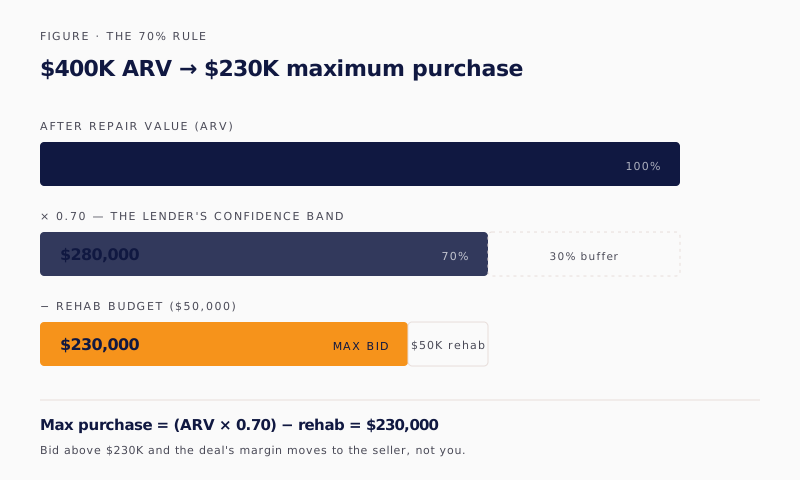
The rule did not appear in a textbook. It was reverse-engineered from the empirical cost stack of typical fix-and-flip projects in the late 1990s and codified in the early 2000s through the BiggerPockets investor community. The original buffer breakdown looked roughly like this:
That math is durable when financing costs are around 8–9% APR and holding times average 4–6 months. When rates climb, holding times stretch, or both, the buffer's components shift. Below we walk through when each shift matters — but first, three worked scenarios across different ARV bands so the rule's behavior becomes legible at scale.
Three worked scenarios across ARV bands
The 70% rule scales linearly with ARV, but its real-world behavior changes by band. Entry-level properties have lower holding costs in absolute dollars but tighter margins as a percentage. Luxury properties carry more absolute profit but stretch days-on-market and inflate selling costs.
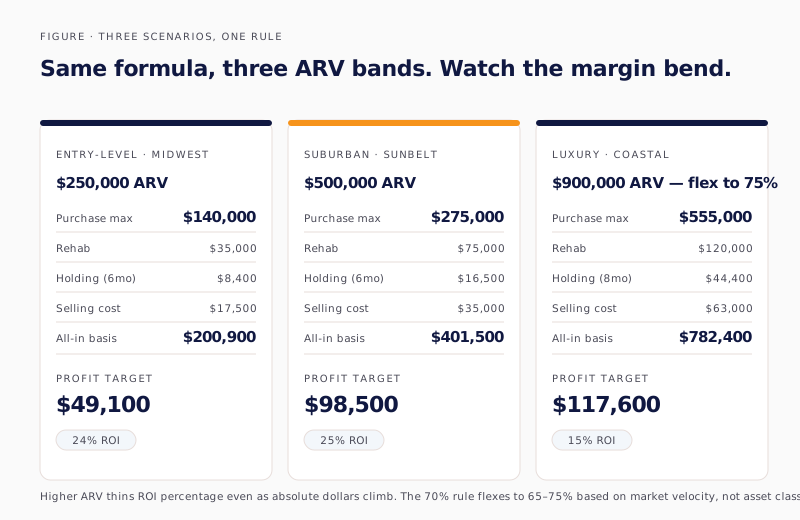
Scenario A — entry-level Midwest, $250,000 ARV
Smaller deal, shorter holding period, lower fixed costs. The 70% buffer is sufficient and the absolute profit ($49,100 on a 24% ROI) is meaningful at scale — this is the kind of deal an investor doing 12 turns a year survives on.
Scenario B — suburban Sunbelt, $500,000 ARV
The middle of the market. Six-month hold, mainstream rehab, normal financing. Profit $98,500 at 25% ROI. The 70% rule holds cleanly here because every cost component sits at its empirical mid-point.
Scenario C — luxury coastal, $900,000 ARV
This deal stretches in two directions. Holding extends to 8 months because high-end days-on-market run longer. Selling costs hit 7% because luxury commissions remain higher. ROI compresses to 15% even at the more permissive 75%-of-ARV stretch — a deliberate flex on the rule justified by speed of capital deployment, not deal quality.
Notice the consistent pattern: dollar profit climbs as ARV climbs, but ROI percentage tightens. Investors who scale into bigger deals are trading rate-of-return for absolute capital deployed. That is a defensible strategy if your capital base is large enough to need it — if not, repeating the entry-level deal six times produces more total profit than one luxury deal at the same risk-adjusted hold.
Why 70% and not 65 or 75?
The number 70 looks arbitrary because it is — chosen for being a round, easily-memorable midpoint of the empirical bands rather than a precise calculation. It works because the cost stack it implicitly models has been remarkably stable across decades.
You can derive the same rule from first principles. Start with the cost components actually involved in a flip:
- Financing — hard money typical: 9–11% APR + 1.5–2.5 points + ~$2,500 closing. On a 6-month hold, that runs 5–6.5% of the loan amount.
- Holding — property taxes (1–1.5% annualized, prorated to hold), insurance ($1,500–$3,000 for a vacant rehab), utilities, lawn, HOA. Typically 4–6% of ARV over a 6-month hold.
- Selling — agent commissions (4–6% combined), title and transfer taxes (1–3% depending on state), seller concessions (0–3% in most markets). Typically 7–10%.
- Profit margin target — institutional flippers target 8–12% net of all of the above; serious independents target 12–18% to justify the active-management cost of their time.
Add those up at midpoints: 5.5 + 5 + 8 + 11 ≈ 30%. That is the math behind the buffer. The 70% rule is the inverse statement: preserve a 30% gap between purchase price and ARV so the cost stack has somewhere to live.
The 70% rule is a sentence-long way of saying: a fix-and-flip is a leveraged time-value bet, not a real estate purchase. Price the time and the leverage first.
When to stretch the rule to 75%
Three conditions independently justify a stretch to 75%. Two together is comfortable; all three is aggressive but defensible.
1. Days-on-market under 21 in the comp set
Holding costs are linear in time. A property that sells in 14 days carries roughly 25% of the holding cost of a property that sells in 60. In hot markets where comparable homes consistently move sub-21-day, the empirical 5% holding component compresses to 1.5–2.5%, freeing 2.5–3.5 points of buffer to push acquisition.
2. Predictable rehab on a property you already know
Most rehab cost overruns come from the unknown unknowns — the foundation crack you discover in week three, the roof structure that turned out to need a rebuild, the electrical panel that fails inspection. A second flip in the same neighborhood at the same vintage with the same contractor team has materially lower variance. The "rehab unknowns" portion of the buffer compresses.
3. Cash-equivalent backup capital
The reason the 70% rule embeds a financing-cost component is that hard money runs 9–11%. If your overruns are funded from a HELOC at 7.5% or a business line of credit at 8.25%, your effective marginal financing cost is 200–300 bps lower. That difference, applied to the variance portion of the buffer, supports a tighter purchase.
The trap to avoid: stretching purely because the comp set looked good and the agent says it will move fast. Comp sets at the time of acquisition are rarely the comp sets at the time of sale — they are 4–6 months stale by then. A 75% stretch should be earned through documented holding-cost compression, not assumed.
When to drop the rule to 65%
The reverse case. Four conditions independently justify dropping to 65%. Two together is prudent; three is mandatory.
1. Slow market, days-on-market over 60
Mirror image of the stretch case. If similar properties are sitting 90+ days, the holding component of the buffer doubles. Without compensating with a tighter purchase, the deal's profit gets eaten by carrying cost.
2. First-time flipper, anywhere
Variance on rehab estimates by first-timers is empirically 30–50% above stated. The conservative buffer protects the deal against the budget you do not yet know how to estimate. Under 65% is a way of buying yourself the wider error bars that come standard with the first three flips.
3. Structural or environmental risk
Foundation, roof structure, septic, well, mold remediation, environmental remediation, asbestos, lead paint — any of these turn rehab cost into a distribution rather than a number. The 65% band covers the long tail.
4. Elevated rate environment (10%+ all-in)
The 70% rule's empirical buffer assumes financing at 9–10% APR. When rates are at 11%+ and points at 2.5+, the financing component moves from 5% of ARV to 7–8%. The buffer compensation has to come from somewhere; tightening the purchase price is the cleanest lever.
Three common misuses of the rule
The rule is misapplied more often than it is rejected. Three patterns worth flagging.
Treating the 30% buffer as profit
The most expensive misread. A first-timer sees a $400K ARV with a $50K rehab, applies the rule, and concludes a $230K purchase yields a $120K margin (the $400K minus the $230K minus the $50K rehab). It does not. The "margin" has to absorb 18–24% of ARV in financing, holding, and selling. Realistic profit is more like $50K–$90K depending on velocity.
Using post-rehab comps without lender appraisal discount
Investors estimate ARV by pulling sold comparables and assuming the lender will agree. Lender appraisers run on policy: they discount adjustments, weight more conservative comparables higher, and are required to triangulate. Real lender ARV typically comes in 5–8% below the investor's eyeball ARV. The 70% rule applied to your ARV becomes the 64–66% rule applied to the lender's. Our fix-and-flip program lends to the appraised ARV, so this gap is the actual lending base.
Treating the rule as the underwriting
The 70% rule is a screen, not a deal evaluation. It tells you which deals deserve the 90 minutes of cost-stack work, and which ones to discard at the listing. Any deal that passes the screen still requires a contractor walk-through, three real comparable sales, a holding-cost projection, a financing-quote validation, and a sell-side disposition plan before bid. Skip those and the rule's 30% buffer becomes the only thing standing between you and a loss.
How lenders look at the 70% rule
From the lender side, the 70% rule does double duty: it screens deals at intake and it bounds maximum loan-to-cost. Most hard money lenders — including PML — will lend up to 90–92.5% of the purchase price plus 100% of rehab, but the loan amount is also capped at 70–75% of the lender's ARV.
That double cap means a deal can pencil for the borrower at the 70% rule and still get reduced by the lender if the appraisal lands below the borrower's ARV estimate. The fix is to underwrite to the more conservative of the two ceilings before signing a contract. Run a quote on a specific address and we will give you both the loan amount and the appraisal-driven cap in writing within four business hours.
Lenders also use the 30% buffer to size the interest reserve on rehab draws. If a borrower's basis at completion eats too much of the buffer, the deal becomes uninsurable on exit value — meaning the lender cannot underwrite to a 12-month sell-or-refi exit with confidence. That underwrites back into the loan terms, often as a lower LTC or a higher rate.
When the 70% rule does not apply: BRRRR exits
If the exit is rental rather than resale, the rule changes. BRRRR (buy, rehab, rent, refinance, repeat) replaces the 70% test with a DSCR test and a max-LTV-on-refinance test. The investor can pay more aggressively at acquisition because they are not paying selling costs at the back end — they are refinancing.
The classic BRRRR purchase ceiling is closer to 75–80% of ARV minus rehab, sized to the refi LTV. If the refinancing lender will fund 75% LTV on a stabilized rental and the investor can leave 0–10% in the deal, the math collapses to: purchase + rehab ≤ refi LTV × ARV. We cover this in detail in the upcoming BRRRR mechanics article. The relevant point here: do not apply the 70% rule to a BRRRR deal. It will under-bid you out of every transaction in a hot rental market.
Glossary
The estimated value of a property after all planned renovations are complete and the property is sold or rented at market. Established by a licensed appraiser for lending purposes; estimated by the investor or wholesaler at the screening stage.
An investor screening rule stating that a fix-and-flip purchase price should not exceed 70% of ARV minus the rehab budget. The 30% gap absorbs financing, holding, selling, and profit.
The total dollar amount an investor has invested in a deal at the moment of sale: purchase price + closing costs + rehab + financing costs + holding costs. Profit equals sale price minus selling costs minus all-in basis.
How long a property is publicly listed before going under contract. Drives holding-cost projections directly: every 30 days adds roughly 0.7–1.0% of ARV in carrying cost.
A long-term-rental strategy that uses hard money for acquisition and rehab, then refinances into a permanent rental loan after stabilization. Replaces the 70% rule with a DSCR-and-LTV-bounded acquisition ceiling.
The fraction of total project cost (purchase + rehab) that the lender will fund. Distinct from loan-to-value (LTV), which is the fraction of as-is or as-completed value.
The total time a property is owned before sale, measured from close-of-purchase to close-of-sale. Drives the holding-cost component of the 70% buffer; longer holds compress profit.
Total transaction costs at sale: agent commissions (typically 5–6% combined), title, transfer taxes, seller concessions, staging, and any closing-cost contributions. Routinely 7–10% of sale price.
Frequently asked questions
Where does the 70% rule come from?
The rule emerged from auction-investor practice in the 1990s and was codified in the early 2000s by the BiggerPockets community as a quick mental check. It is not a regulation or a lender requirement. The 30% buffer was empirically derived from the typical fix-and-flip cost stack: roughly 8% selling costs, 5% financing, 5% holding, plus a 12% profit target. Today's ranges have shifted with higher rates, but the buffer math still roughly holds.
Is the 70% rule the same in commercial real estate?
No. Commercial value-add deals use cap-rate-based math (NOI ÷ cap rate) rather than ARV-based screening. The conceptual analog is the "value-add yield-on-cost" target — usually 200–300 bps above the market cap rate. That serves the same function as the 70% rule in residential: a quick screen of whether the spread justifies the project work.
Should I include closing costs in the rehab budget?
Standard practice is to include them in the buffer rather than the rehab line. Acquisition closing (title, lender fees, recording) typically runs 1.5–3% of purchase, which the financing-cost portion of the buffer already covers. If your specific closing is unusually expensive (transfer-tax-heavy state, expensive title insurance), pull the excess into the rehab line to keep the buffer accurate.
How do I estimate rehab cost before owning the property?
Three disciplines reduce the variance: walk the property with a contractor before bid (most contractors will do a free walk for serious buyers), pull a Schedule of Values from a similar past project, and add a 15–20% contingency line specifically for the unknowns the walk-through cannot reveal. First-timers often have variance above 30%; the contingency budget is what protects the 70% rule from breaking.
Can I bid above the 70% rule and still profit?
Sometimes — in hot markets, on properties with predictable rehab, with cheap backup capital, or when the acquisition unlocks value the comp set has not yet seen. The right framing is: bidding above 70% requires you to document which buffer component is compressed and by how much. "I think it will sell fast" is not documentation; "the comp at 1234 Maple sold in 11 days last week, 90 days of holding compresses to 25" is.
Does the 70% rule apply to BRRRR deals?
No. BRRRR deals exit by refinancing, not selling, so the selling-cost portion of the buffer (8–10% of ARV) disappears. That frees up roughly that much in acquisition headroom. BRRRR investors typically use a 75–80% ceiling instead, sized to the refinancing lender's max LTV and the investor's tolerance for capital left in the deal.
What is the 70% rule in real estate wholesaling?
The same formula, but the wholesaler is computing the maximum the end-buyer (investor) will pay, not what the wholesaler pays. The wholesaler's assignment fee ($3,000–$20,000 typical) sits on top. If the wholesaler's offer to the seller plus the assignment fee exceeds the investor's 70% ceiling, the deal does not move — which is why disciplined wholesalers underwrite from the buyer's side first, not from the seller's.
How does PML use the 70% rule in underwriting?
We do not apply the 70% rule directly — we underwrite to loan-to-cost (purchase + rehab) and a separate ARV-based loan-to-value cap. But our ARV cap of 70–75% LTV is the lender-side mirror of the same constraint. A deal that fails the 70% rule on the borrower's projection generally fails our LTV cap on appraisal too. Send a deal and we will run both caps in writing within four business hours.
Run a real fix-and-flip quote against the rule.
Send us the address and your ARV estimate. We will reply with the loan amount, the appraisal-driven cap, and whether the deal clears both within four business hours.