 Private Money Lenders
Read time: 30 seconds
- Hard money: short-term (6-24 months), asset-based, 8.99-12% APR, closes in 5-14 days. For acquisitions, rehabs, and bridge situations.
- Conventional: long-term (15-30 years), borrower-based, 6.5-7.5% APR, closes in 30-60 days. For stabilized holds and refinance exits.
- The four real differences: speed (5 days vs 45), leverage (92.5% vs 80%), documentation (asset-based vs W-2 + tax returns), and recourse (typically recourse vs may be non-recourse).
- On a 12-month hold, hard money costs ~2× the interest of conventional. On a 4-month flip, the speed-to-close and rehab-funding advantages usually outweigh the rate premium.
- The hybrid play: hard money for acquisition and rehab, refinance into conventional or DSCR after 6 months of seasoning. Best total cost on long-term holds.
What hard money actually is
Hard money is a category of loan, not a specific product. It refers to short-term, asset-based loans funded by private lenders — companies or individuals lending their own capital or pooled capital from accredited investors — specifically for real estate investment purposes.
The "hard" in hard money refers to the asset, not the difficulty. Underwriting is anchored on the real estate itself: the as-is value, the after-repair value (ARV), the loan-to-cost, and the loan-to-value. The borrower's W-2 income, tax returns, and debt-to-income ratio play a far smaller role than they do in conventional underwriting — in many cases they are not requested at all.
Three structural features define hard money:
- Short-term: typical terms range from 6 to 24 months, sometimes extending to 36 months on construction loans. There is no 30-year hard money mortgage. The product is designed for transactional capital, not permanent financing.
- Interest-only payments: monthly payments cover interest only; principal is repaid as a balloon at maturity. This keeps cash flow flexible during a project and aligns with the short-term thesis.
- Asset-based underwriting: the property, not the borrower, is the primary collateral test. A strong deal with a thin borrower file can close; a weak deal with a strong borrower file generally cannot.
Hard money lenders are typically state-licensed (some states require licensure, some require only registration, some require neither), and they are explicit business-purpose lenders. Federal consumer-protection rules like TILA, RESPA, and the Ability-to-Repay/Qualified Mortgage standard do not apply to business-purpose investor loans, which is why hard money exists as a category at all. More on this in our FAQ.
What conventional actually is
Conventional financing is the umbrella term for residential mortgage loans not insured by a government agency (FHA, VA, USDA). For investment properties, conventional almost always means a loan conforming to Fannie Mae or Freddie Mac underwriting guidelines — the two government-sponsored enterprises that buy roughly 60% of all residential mortgages in the United States.
The conforming-loan playbook is highly standardized. The underwriting matrix is published, the rate sheets are public, and the loan limits are reset annually. As of 2026, the standard conforming-loan limit for a one-unit investment property in most counties sits around $806,500, with high-balance areas exceeding $1.2M.
Three structural features define conventional investment-property lending:
- Long-term, fully amortizing: 15, 20, or 30-year fixed rates, or 5/1, 7/1, 10/1 ARMs. Principal and interest paid every month for the term of the loan.
- Borrower-based underwriting: two years of tax returns, two years of W-2s (or 1099 + Schedule C for self-employed), a fully documented debt-to-income ratio (DTI), and a tri-merge credit pull. Self-employed borrowers must demonstrate two years of stable self-employment income; many do not qualify.
- Strict leverage caps: investment-property purchases capped at 80% LTV on single-family, often 75% on 2-4 unit. Cash-out refinances capped at 75% on single-family, 70% on 2-4 unit. No allowance for rehab budget.
The four real differences
Glossy comparison pages get caught up in rate. Rate is the smallest of the four real differences. In order of significance:
| Dimension | Hard money | Conventional |
|---|---|---|
| Speed to close | 5-14 days | 30-60 days |
| Leverage on purchase | Up to 92.5% LTC | Up to 80% LTV |
| Rehab funded | Yes, up to 100% | No (HomeStyle/203k is a separate product) |
| Documentation | Asset-based, minimal income docs | 2yr tax returns, W-2s, DTI |
| Property condition | As-is, including non-warrantable | Must be habitable, lender-warrantable |
| Self-employed friendly | Yes | Difficult; 2yr seasoning |
| Credit floor | 600 FICO | 680 FICO (often 700+) |
| Term | 6-24 months | 15-30 years |
| Recourse | Typically full recourse | Recourse on investor loans |
| Rate (May 2026) | 8.99-12% APR | 6.5-7.5% APR |
| Points | 1-3 typical | 0-1 typical |
| Prepayment | Open after 3-6 months | Usually open |
The two differences that matter most to most investors are speed and leverage. The rate gap matters at the margin, but the speed and leverage gaps determine whether the deal is possible at all.
Cost over time: a worked $400K example
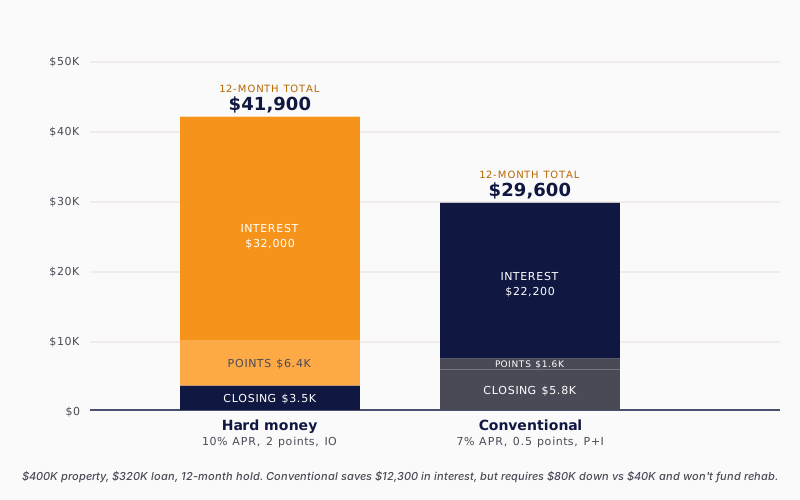
The most common framing of the rate difference is annual interest. That is the wrong frame for short-hold projects, where total dollar cost matters more than annualized rate. Below, a $400,000 acquisition financed two ways, held for 12 months.
Conventional wins by $12,300 over a 12-month hold — about 31% cheaper. The premium for hard money is real and meaningful.
But the picture changes when you factor in two things conventional cannot do:
- Conventional requires 20% down on every purchase. Hard money requires 7.5-10% down on the purchase, depending on lender and deal. On the same $400K property, hard money requires $30-40K of cash vs conventional's $80K. The extra $40-50K of preserved liquidity can fund a second deal.
- Conventional does not fund rehab. If the deal includes $50K of work, conventional won't finance it. The borrower funds rehab from savings (eating more liquidity) or runs a HELOC at 8-9% (adding another loan). Hard money funds rehab as draws, at the same blended rate.
The decision matrix
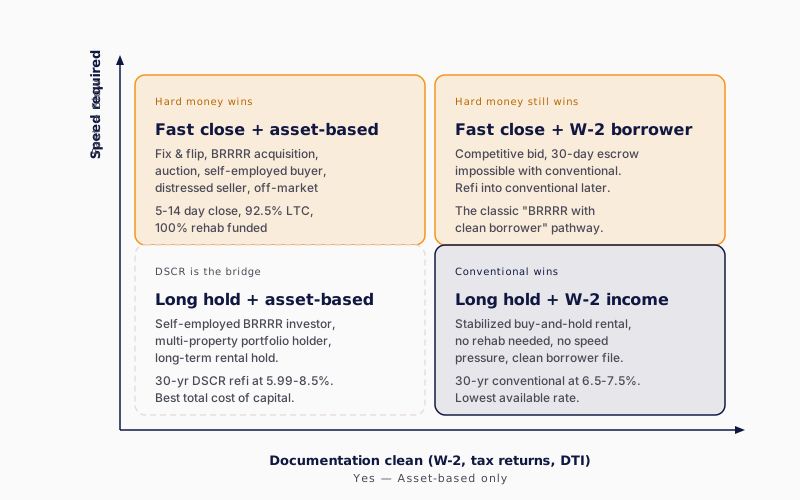
Five scenarios cover most investor situations. The right answer is rarely "always hard money" or "always conventional" — it depends on the deal.
Scenario 1: Fix and flip, 4-month hold
Hard money wins. Conventional won't fund a property that needs rehab. Even if you could find a conventional product for it (like the Fannie Mae HomeStyle), the 45-day close time loses the deal to a cash or hard money competitor. The 4-month interest premium ($10,700 on the example above, prorated) is small versus the deal-economy upside. Hard money's rehab-draw structure also matches the project cash flow.
Scenario 2: BRRRR — buy, rehab, hold, refinance
Hybrid wins. Hard money for the acquisition-and-rehab phase (months 0-6), then refinance into a DSCR or conventional loan at month 6 once the property is stabilized and seasoned. This is the canonical BRRRR play: speed and rehab funding on the front end, low rate on the back end. Read the full BRRRR mechanics article for the capital stack at each stage.
Scenario 3: Stabilized rental purchase, no rehab needed
Conventional or DSCR wins. No rehab to finance, no urgent close, long hold period — the structural advantages of hard money do not apply. The rate advantage of conventional dominates over a 5+ year hold. If the borrower's W-2 income is documented and the DTI works, conventional is the cheapest option. If not, DSCR is the next-best alternative.
Scenario 4: Ground-up construction
Hard money construction loan wins. Conventional construction lending exists but is highly restricted, requires extensive contractor pre-approval, and typically funds 70-75% loan-to-cost vs hard money's 85-90%. Hard money construction is purpose-built for this use case: weekly draws, interest reserves, no progress audit before draw 1. The rate premium is the cost of getting the project built. See our construction loan page for terms.
Scenario 5: Cash-out refinance of a held rental
Conventional or DSCR wins. No speed pressure, no rehab to fund, no documentation issue if the borrower is W-2'd. Conventional at 7% is the cheapest path to extract equity. Self-employed or multi-property borrowers who cannot pass conventional DTI fall back to DSCR (also typically cheaper than hard money for a long hold).
Hard money is a screwdriver. Conventional is a hammer. The investor's job is to know which tool the job calls for, not to have a religious commitment to either.
When hard money is the right tool
Six conditions, each of which on its own is sufficient justification. Two or more makes it the clear default.
- Speed is required. Auction, off-market, distressed seller, multi-offer situation — anywhere the close timeline determines whether you win the deal.
- The property needs rehab. Conventional won't fund work; even the Fannie Mae HomeStyle product caps leverage and adds friction. Hard money pays for rehab in draws at the same loan.
- Documentation is the issue, not the deal. Self-employed with 2 years of 1099 but no Schedule C history. Multi-property investor whose DTI fails Fannie Mae but whose cash flow is strong. Recent business pivot or restructure. Hard money's asset-based underwriting reads through these complications.
- The leverage gap matters. 92.5% LTC vs 80% LTV is a 12.5-percentage-point swing on every deal. On a $500K property, that is $62,500 of preserved capital — enough for a second deal's down payment.
- The hold is short. Under 12 months, the interest premium of hard money is small in absolute dollars relative to the deal economy. Over 12 months and the rate gap starts to dominate.
- The exit is refinance, not sale. Hard money is designed to be repaid through refinance. The conventional or DSCR refinance becomes the long-term loan; hard money is the acquisition vehicle.
When conventional is the right tool
Five conditions. One or more makes it the cleaner option.
- Long-term hold, no rehab. Buy-and-hold rental, stabilized condition, 5+ year intended hold. The rate advantage compounds over time.
- W-2 employment with clean DTI. Conventional underwriting was designed for this borrower profile. The lower rate and the lower points are real cash savings.
- Standard 30-day or longer escrow. No competing offers, no seller urgency, no need to wave a fast-close as a competitive lever.
- Sub-680 FICO without explanation. Conventional pricing penalizes credit harder than hard money, but hard money below 660 also pays a tier-2 rate premium. If credit is recoverable, conventional is the better long-term play once it is repaired.
- Owner-occupied or primary residence. Hard money is business-purpose only. Buying a place to live is conventional, FHA, or VA territory.
The hybrid strategy
Most experienced investors do not pick one financing tool and stay with it. They use hard money to acquire and stabilize, then refinance into conventional or DSCR for the long-term hold. The hybrid play captures hard money's structural advantages on the front end and conventional's rate advantage on the back.
A typical sequence on a BRRRR deal:
The total cost of this two-stage approach beats either pure hard money (rate stays high forever) or pure conventional (cannot fund the rehab in the first place, deal does not happen). See the BRRRR mechanics article for the capital-walked-out calculations.
How a lender thinks about it
Most direct lenders specialize. PML offers hard money products only — construction, fix and flip, bridge, and DSCR rental (which sits at the boundary, asset-based underwriting at conventional pricing). We do not write conventional Fannie Mae loans because the regulatory and operational overhead of conforming origination is different than asset-based lending and the two specializations rarely sit in the same shop.
What this means for the borrower: do not expect a single lender to compete on both products. The decision of which to use generally precedes the decision of which lender to use. If hard money is the right tool, you talk to direct private money lenders. If conventional is the right tool, you talk to mortgage brokers or banks. Send us a deal and we will tell you honestly whether hard money is the right structure or whether you should be working with a conventional lender instead.
Glossary
A short-term, asset-based real estate loan funded by a private lender for business purposes (investment property only). Typical terms: 6-24 months, 8.99-12% APR, 1-3 origination points, interest-only.
A long-term residential mortgage conforming to Fannie Mae or Freddie Mac guidelines. For investment properties: up to 80% LTV on purchase, 75% LTV on cash-out refinance, 6.5-7.5% APR in May 2026.
The lender's financing as a percentage of total project cost (purchase + rehab). The primary leverage measure on fix-and-flip and construction loans. PML's max LTC on fix-and-flip is 92.5%.
The lender's financing as a percentage of property value (as-is or after-repair). The primary leverage measure on conventional and DSCR loans. Conventional caps at 80% LTV on investment-property purchase.
Loan approval anchored on the real estate's value and projected cash flow rather than the borrower's personal income. Standard for hard money and DSCR products.
The borrower's monthly debt obligations divided by gross monthly income. Required for conventional underwriting (capped at 43-50% on investment properties). Not used in hard money underwriting.
Debt service coverage ratio loan. Long-term (30-year) rental loan underwritten on the property's rental income covering debt service (typically a 1.10-1.25x ratio), not the borrower's W-2. Common BRRRR exit. Full DSCR article here.
The period a property must be held after purchase or rehab completion before a refinance lender will fund. Conventional typically requires 6 months. DSCR varies by lender (some 3, some 6, some 12).
Frequently asked questions
Is hard money more expensive than conventional?
Per month, yes — about 200-450 basis points higher. Over a 12-month hold, hard money runs roughly 2× the interest of conventional. But total cost depends on hold period. On a 4-month flip, the speed-to-close and rehab-funding advantages of hard money usually offset the rate premium. The right comparison is total dollar cost over your actual hold, not annualized rate.
Can I use hard money to buy a primary residence?
In most states, no. Hard money loans on owner-occupied properties trigger consumer protection rules (TILA, RESPA, ATR/QM) that hard money lenders are not equipped to comply with. Hard money is structured as a business-purpose loan for investment properties only. For a primary residence, conventional, FHA, or VA financing is the only realistic path.
Why would an investor pay 10% when they could get 7% conventional?
Three reasons. First, speed: hard money closes in 5-14 days, conventional in 30-60. On a competitive deal that speed wins the contract. Second, leverage: hard money funds up to 92.5% of cost plus 100% of rehab; conventional caps at 80% of purchase only. Third, documentation: hard money is asset-based; self-employed investors with strong rental cash flow often cannot qualify conventional even when their economics are excellent.
What credit score do I need for hard money vs conventional?
Hard money typically has a 600 FICO floor with tier-1 pricing at 680+. Conventional Fannie Mae and Freddie Mac investment-property loans require 680 FICO minimum, with the best rates reserved for 740+. Hard money is materially more permissive on credit; conventional is materially more permissive on rate.
Can I refinance hard money into conventional?
Yes — this is the most common exit for both BRRRR (fix-and-hold) and ground-up construction-to-permanent strategies. After 6-12 months of seasoning (most conventional lenders require 6 months), the property can be refinanced from hard money into a conventional or DSCR rental loan at the lower long-term rate. The seasoning requirement exists to prove stabilized rental income.
How fast can hard money close vs conventional?
Hard money typically closes in 5-14 calendar days; the fastest closes complete in 48-72 hours when title is clean and the appraisal is desktop-eligible. Conventional financing for investment properties typically closes in 30-45 days, sometimes longer for self-employed borrowers due to the income verification process. The speed differential is the primary competitive advantage of hard money in any seller-paced acquisition (auction, off-market, distressed sale).
What is a DSCR loan and is it hard money or conventional?
DSCR (debt service coverage ratio) loans are a third category — long-term loans (typically 30-year fixed or 5/1 ARM) priced like conventional but underwritten like hard money. The qualifier is the property's rental income covering its debt service (a 1.10-1.25× DSCR), not the borrower's W-2 income. Rates run 5.99-8.5%, longer than hard money but priced below conventional investment-property loans. DSCR is the typical exit for hard money on a long-term rental hold. Full DSCR article here.
Can a self-employed investor get conventional financing?
Yes, but with friction. Fannie Mae and Freddie Mac require 2 years of stable self-employment income documented through tax returns, often Schedule C plus year-to-date P&L. Income is calculated as average of the two years, sometimes discounted further. Many self-employed investors with strong cash flow fail conventional DTI calculations because tax returns understate true income (legitimate business deductions reduce reported income). DSCR or hard money is often the more accessible path even at a slightly higher rate.
Not sure which tool fits your deal? Ask us.
Send the address, the purpose, and the timeline. If hard money is the right structure we will quote it. If conventional is the better fit we will tell you that too.