 Private Money Lenders
Read time: 30 seconds
- A draw is a reimbursement, not an advance. The lender funds work that is already in place, verified by a third-party inspector — not work you are about to do.
- The lender funds the lesser of claimed and verified. Claim framing at 100% and the inspector scores 80%, you get funded at 80%. The inspection report is the basis for the wire.
- The schedule of values is the scorecard. Every draw releases against percent-complete on specific line items set at closing. Vague SOVs cause slow draws.
- Typical timeline: 3–7 business days from request to wire. The bottleneck is almost always inspection scheduling, not lender approval.
- The fixes are upstream. A clean SOV, a contractor who understands reimbursement timing, collected lien waivers, and an honest draw schedule keep the money moving.
What a draw actually is
A construction loan does not hand you the full budget at closing. The lender funds the land or acquisition portion up front, then holds the entire construction budget in reserve and releases it in installments — draws — as the building physically takes shape.
This is the single most important thing to internalize about construction lending, and it is where first-time builders most often get the cash flow wrong: a draw reimburses work already in place. It does not advance money for work you are about to do. The lender is funding against value that already exists on the ground, because that value is the collateral. Concrete poured is collateral. A purchase order for concrete is not.
The practical consequence is that someone has to float the cost of each phase between starting it and getting reimbursed for it. On most ground-up jobs that is the general contractor, who carries the labor and materials for a phase, then gets paid when the draw funds. On owner-builder projects, that float lands on the borrower. Either way, the gap between spending and reimbursement is real and has to be planned for. It is the reason an underfunded builder stalls even on a fully approved loan.
Hard money construction loans are purpose-built for this rhythm. They fund a high loan-to-cost — PML's construction program funds up to 85–90% of total project cost — with weekly or on-demand draws, an interest reserve to cover payments during the build, and no full progress audit before the first draw. That structure exists precisely because conventional construction lending is too slow and too restrictive for an active builder. The trade-off is that every dollar is verified before it moves.
How percent-complete is measured
"Percent-complete" sounds subjective, and at the edges it is. But lenders standardize it into one of three measurement methods, and the method is set in your loan agreement before you ever request a draw.
| Method | How it works | Best for |
|---|---|---|
| Line-item percent | Each SOV line is scored individually (framing 80%, electrical 40%). Draw = sum of verified line values minus prior draws. | Most ground-up and heavy-rehab projects |
| Milestone / phase | Funds release in fixed blocks when a whole phase is signed off (foundation done, dried-in, finals). | Modular, simpler, or fixed-bid builds |
| Cost-to-complete | Inspector estimates remaining cost; lender funds the difference, keeping the loan fully collateralized. | Troubled or over-budget projects |
The overwhelming majority of hard money construction loans use the line-item percent method, because it is the most granular and the fairest to both sides. You get paid for exactly what is in place, and the lender never gets ahead of its collateral. The rule that governs every draw, regardless of method, is simple and absolute:
The lender funds the lesser of what you claim and what the inspector verifies. There is no version of a draw where the claim wins over the inspection.The core rule of every construction draw
If you submit a draw claiming rough plumbing is 100% complete and the inspector arrives to find the supply lines run but the fixtures not set, they will score it at, say, 70%. Your draw funds at 70% of that line. The other 30% is not lost — it funds on the next draw once the work is visible — but it is deferred, and that deferral is a cash-flow event if you were counting on the full amount.
The third-party inspection
The person who scores your work is not your loan officer and not you. It is an independent third-party inspector — sometimes a dedicated construction-inspection firm, sometimes an appraiser performing a progress inspection — dispatched by the lender and paid for by the borrower (typically $150–$350 per draw, netted from proceeds).
The inspector's job is narrow and mechanical: visit the site, walk it against the approved schedule of values, photograph each line item, and assign a percent-complete to each. They are not judging quality of workmanship or whether the design is good. They are answering one question for the lender — is the collateral that this draw claims actually here? The report they file, with date-stamped photos, becomes part of the permanent loan file.
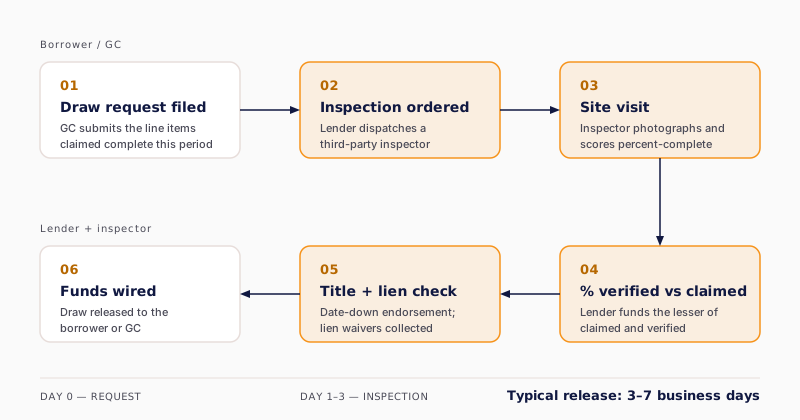
Two things determine how fast this moves. First, scheduling: a lender who dispatches the inspector the same day a draw is requested funds far faster than one with a multi-day inspection backlog. Second, readiness: if the work plainly matches the request, the inspector scores it and leaves. If line items are claimed before they are visibly complete, the inspector scores them low, and you are back for another inspection — and another fee — sooner than you wanted.
The schedule of values
The schedule of values (SOV) is the single document that makes the whole draw system work. It is a line-item breakdown of your entire construction budget, with every trade and phase assigned a dollar amount. It is approved at closing, and from that moment it is the scorecard against which every draw is measured.
A workable SOV is detailed enough to track real progress but not so granular it becomes unmanageable. A simplified SOV on a $300,000 ground-up build might look like this:
When you request a draw, you are claiming a percent-complete against these specific lines. The inspector verifies those percentages, and the draw funds the verified dollar value of progress since the last draw. Because the SOV is fixed at closing, a line item that runs over its SOV budget does not automatically get more money — overages trigger a budget conversation, and sometimes a re-underwrite, rather than a quiet larger draw. Building the SOV with honest, slightly conservative line values at closing is the cheapest insurance you can buy against mid-project friction.
A worked draw request
Take the SOV above, four weeks into the build. Foundation is done, framing is mostly up, demo was finished at the first draw. Here is how draw #2 reconciles:
The framing gap ($5,500) is not denied — it funds at draw #3 once the gables are sheathed and visible. The retainage ($8,600 so far) accrues in a holdback the lender releases at completion. The takeaway: plan your cash around verified-minus-retainage, not around what you claim. The difference is exactly the float the contractor has to carry.
Interest reserves and how draws affect them
A property under construction produces no income, but the loan still accrues interest every month. Most ground-up construction loans solve this with an interest reserve — a portion of the loan set aside at closing to make the monthly interest payments during the build. The lender draws each month's interest from the reserve automatically; you do not write a check.
The reserve is sized to the expected build timeline. This is where draw discipline and an honest schedule pay off twice: a project that runs months past its timeline can exhaust the interest reserve, at which point the borrower starts paying interest out of pocket on a property that still is not finished or sold. The reserve is also why your effective interest cost rises with every week of delay — the same dynamic covered in our piece on Dutch vs non-Dutch interest, where interest is charged on committed rather than drawn funds. On a construction loan with a Dutch structure, an unused reserve can still be accruing interest against you.
Where first-timers lose days
Almost every stalled draw traces back to one of five avoidable mistakes. None of them are about the quality of the build; they are about the paperwork and timing around it.
- Claiming work before it is visibly complete. The inspector scores what is on the ground the day they visit. "It'll be done by the time they get here" is the single most common way a draw comes back short and a re-inspection fee gets triggered.
- A vague schedule of values. A four-line SOV ("sitework, structure, MEP, finishes") gives the inspector nothing precise to score and invites disputes. Fifteen to thirty well-defined lines is the sweet spot.
- Missing lien waivers. Lenders require conditional and unconditional lien waivers from subcontractors and material suppliers before releasing funds for their work. Chasing a waiver after the draw is requested adds days. Collect them as the work completes.
- Out-of-sequence work. Spending on finishes before the structure is verified means the inspector can see the cost but cannot fund it in the expected order. Build, and draw, in the sequence the SOV assumes.
- Too many tiny draws. Every draw carries an inspection fee and a few days of float. Six to eight draws over a typical build balances cash flow against cost; fifteen micro-draws just multiply fees and inspection lag.
Structuring the contractor agreement
The contractor agreement is where draw friction is either designed out or baked in, and most borrowers sign it without thinking about how it interacts with the lender's draw mechanics. Three provisions matter most.
First, align the contractor's payment schedule with the lender's draw schedule. If the contractor expects payment on net-15 terms but the lender funds draws every three weeks against verified progress, the contractor is carrying float they did not price for — and that tension lands on your project as slowdowns. Write the contractor's payment milestones to mirror the SOV and the draw cadence.
Second, make lien waivers a condition of payment in the contract itself. If the contractor and their subs owe you a signed waiver before they get paid, you are never chasing paperwork at draw time — it arrives with the invoice.
Third, account for retainage explicitly. The contractor should know up front that 10% of each payment is held until completion, because that is how the lender funds you. A contractor who assumes 100% payment per phase and discovers the holdback mid-project is a contractor who slows down. See our construction loan terms for how PML structures retainage and draws, and send us your SOV before you finalize the contractor agreement — we will flag anything that will fight the draw schedule.
Glossary
An installment of the construction budget released by the lender as work is completed and verified. A reimbursement for work already in place, not an advance for future work.
A line-item breakdown of the total construction budget, with each trade or phase assigned a dollar amount. Approved at closing; the scorecard for every draw.
The portion of a line item that is physically finished, scored by a third-party inspector. The lender funds the lesser of the claimed and verified percent-complete.
A percentage of each draw (commonly 10%) the lender holds back until substantial or final completion, protecting against a contractor leaving a job unfinished.
A portion of the loan set aside at closing to cover monthly interest during construction, when the property generates no income. Sized to the build timeline.
A signed document from a contractor or supplier waiving their right to file a mechanic's lien for work already paid. Required before the lender funds that work.
The lender's financing as a percentage of total project cost (land plus construction). The primary leverage measure on construction loans; PML funds up to 85–90% LTC.
A title update issued at each draw confirming no new liens have been recorded against the property since the prior draw, protecting the lender's first position.
Frequently asked questions
How does a construction draw work?
The lender holds the construction budget in reserve and releases it in installments called draws as the work is completed. You submit a request listing the line items finished since the last draw; the lender sends a third-party inspector to verify the percent of work actually complete, confirms title is clear of new liens, and wires funds for the verified amount. Most draws release in three to seven business days.
How do lenders verify percent-complete?
With an independent third-party inspector, not the borrower's word. The inspector visits the site, photographs each line item against the schedule of values, and scores the percent complete for each. The lender funds the lesser of what was claimed and what was verified. The inspection report becomes part of the loan file and the basis for the wire.
What is a schedule of values?
A line-item breakdown of the total construction budget, with each trade or phase assigned a dollar amount — demolition, foundation, framing, rough plumbing, electrical, HVAC, drywall, finishes, and so on. It is approved at closing and becomes the scorecard for every draw. Detailed enough to track progress, not so granular it becomes unmanageable.
How long does a draw take to fund?
Typically three to seven business days from request to wire. The largest variable is inspection scheduling. The fastest draws complete in 48 to 72 hours when the inspector is dispatched the same day, the work clearly matches the request, and title comes back clean. Delays usually come from inspection backlog, line items claimed before they are complete, or missing lien waivers.
Why did my draw come back lower than I requested?
Most often the inspector scored a line item below what was claimed, and the lender funds the lesser of the two. Draws are also reduced for work completed out of sequence, line items over their SOV budget, retainage being held, or a missing lien waiver. Each is fixable on the next draw once the work is visible and the paperwork is in.
What is retainage?
A percentage of each draw, commonly 10 percent, that the lender holds until substantial or final completion. It protects against a contractor walking off mid-build. A draw that funds at 100 percent of verified work with 10 percent retainage pays the contractor 90 percent now and the held 10 percent at the end, released against a certificate of occupancy or final inspection.
Who pays for the inspection?
The borrower, typically 150 to 350 dollars per draw, usually netted from the draw proceeds rather than billed separately. Because each draw carries an inspection cost, there is a trade-off between many small draws and fewer large ones. Most borrowers settle on four to eight draws over the project. Talk to us about structuring a draw schedule for your build.
Building ground-up? Send us the budget.
Share the schedule of values and the timeline. We will structure the draw schedule, the interest reserve, and the retainage so the money keeps pace with the build.