 Private Money Lenders
Read time: 30 seconds
- Dutch interest charges interest on the full face amount of the loan from day one, including rehab and construction funds you have not drawn yet.
- Non-Dutch interest charges interest only on the principal you have actually drawn.
- On a $400,000 fix-and-flip with $100,000 of rehab drawn over nine months, Dutch costs roughly $4,200 more than non-Dutch over a 12-month term.
- The difference shows up not in the rate but in the base on which the rate is applied. Read the term sheet language, not just the APR.
- PML uses non-Dutch interest on every rehab and construction draw across all our products.
What Dutch interest actually is
Dutch interest is a method of computing interest on a loan that has an undrawn portion — a rehab budget, a construction reserve, a future advance line. Under Dutch terms, interest accrues on the entire face amount of the loan from the moment it closes, whether or not the borrower has actually received those funds.
Non-Dutch interest, sometimes called standard or true principal-balance interest, accrues only on the outstanding principal — the funds that have actually moved from the lender’s ledger to the borrower’s. If you closed yesterday on a $400,000 loan but have only drawn the $300,000 needed to buy the property, you owe interest on $300,000 today, not $400,000.
The structures sound subtle. The cost difference is not. On the kind of loan a fix-and-flip investor or a small builder writes — the kind PML writes thirty times a month — the spread between Dutch and non-Dutch routinely amounts to one full percentage point of effective rate. On a tight-margin flip with three points of origination already burned, that extra point is the difference between a deal that pencils and a deal that does not.
Why does this matter now? Because hard-money lending has consolidated. Larger lenders — the ones that consolidated quickly through 2024 and 2025 — have moved their term-sheet defaults to Dutch interest while keeping their published rates flat. The headline rate looks competitive. The all-in cost is materially worse. A borrower comparing two loans on rate alone will pick the wrong one.
This article walks through the difference with specific numbers, two diagrams, and the exact phrases to look for in a term sheet. It is the same explanation we give every first-time borrower at PML during a quote call. The conclusion is not that Dutch interest is fraud — it is not, and lenders have a defensible reason for charging it. The conclusion is that you cannot compare two hard money quotes if you do not first verify which interest method each one uses.
A worked example: $400,000 fix-and-flip
The cleanest way to see Dutch versus non-Dutch is to walk through one real-world deal at month six.
Imagine a $400,000 fix-and-flip loan structured as follows:
- Purchase: $300,000 disbursed at close.
- Rehab budget: $100,000 disbursed in nine monthly draws of roughly $11,111 each.
- Term: 12 months, interest-only.
- Rate: 11% APR.
By the start of month six, the borrower has drawn five rehab payments — about $40,000 of the $100,000 budget. The total outstanding principal is $340,000. The remaining $60,000 of rehab money sits in a reserve account at the lender, untouched.
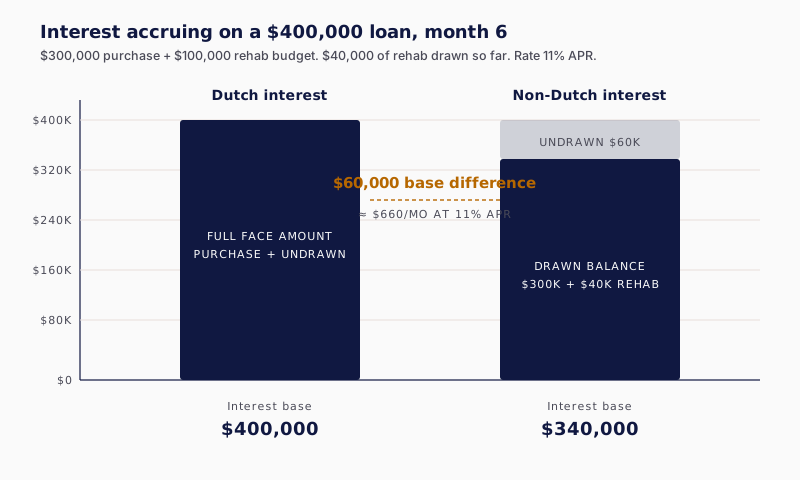
The math at month six:
Five hundred fifty dollars a month, on a single deal, is real money. But that figure understates the total cost. The borrower has been paying Dutch interest since day one of the loan — including the months when they had drawn even less of the rehab. Cumulatively, the gap is wider.
Cumulative cost over 12 months
Look at the same loan over its full term. Under Dutch interest, the borrower pays a flat $3,667 of interest every month for 12 months — $44,000 total. Under non-Dutch, the monthly interest climbs as draws come in and then plateaus once the rehab is complete around month nine.
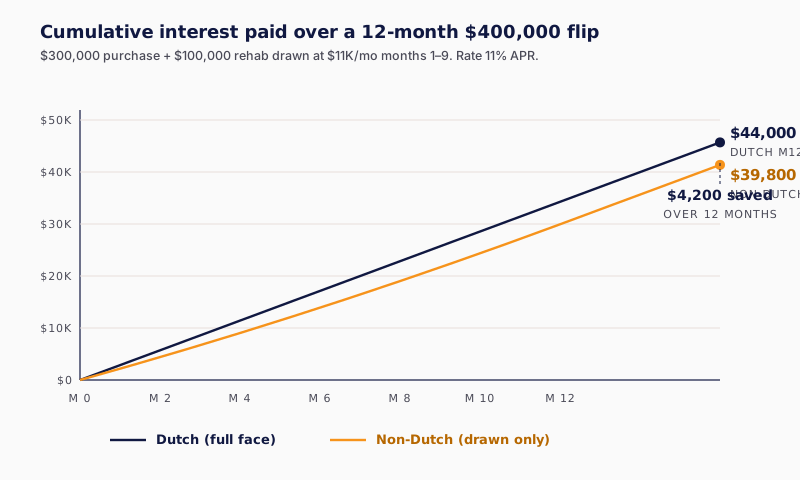
By month twelve, the cumulative cost difference is approximately $4,200. On a flip with a $40,000 net profit target, that is more than 10% of the deal’s margin handed back to the lender for capital that was never used.
Stretch the same comparison across a 24-month ground-up build with a $1.2 million construction reserve drawn evenly across 18 months and the gap widens to $22,000 to $28,000. On a $5 million build with a longer schedule, it can exceed $80,000. None of that is hidden in the rate. All of it is hidden in two words on the term sheet.
A point of rate is a point of rate. A Dutch interest structure on a slow-draw construction line is a point of rate, plus capital you never used.
Why does Dutch interest exist?
Dutch interest is not a trick — lenders have a real underwriting reason for it.
When PML closes a construction loan, our capital is committed from the moment we sign closing docs. That money is not free to lend somewhere else. We have wired it into a reserve account, our liquidity is encumbered, and our LP-investor partners are accruing the underlying cost of capital on every dollar we promised. From the lender’s side, money you have not yet drawn is not idle — it is earmarked.
There are three ways a lender can recover the cost of holding committed but undrawn capital:
- Charge a higher rate on the drawn balance — the non-Dutch path. Visible. Comparable. Borrowers can shop it directly.
- Charge a separate “commitment fee” on undrawn capital — common in commercial banking, rare in hard money. Banks call this a non-utilization fee; it usually runs 25 to 100 basis points per year on the undrawn portion.
- Charge interest on the full face amount regardless of what is drawn — the Dutch path. Less visible. Less comparable. The total dollar cost is similar to (1) but the line item looks like rate, not fee.
From a lender’s P&L, all three add up to the same place. From the borrower’s P&L — especially a borrower comparing two term sheets on rate alone — the third path looks cheapest. That is the reason it has spread.
When Dutch interest can actually be cheaper
Sometimes a Dutch loan really is the better deal — specifically when the lender takes the lower rate path because they expect the borrower to draw the full balance quickly.
Consider a different scenario: a quick rehab where the contractor is paid in full at month two and the rehab reserve clears completely by month three. In that case the “undrawn portion” barely exists; the loan is fully funded almost immediately. A Dutch loan at 10.5% can beat a non-Dutch loan at 11.25% under those mechanics.
Or consider a borrower who needs the entire face amount on day one for two reasons — cash purchase plus immediate rehab kickoff — with no slow draw schedule. Same outcome: there is nothing to be saved by being charged on the drawn balance because the drawn balance equals the face from week one.
The point is not that Dutch is always worse. It is that the right answer depends on the draw schedule, and the draw schedule depends on the project. The borrower has to do the math both ways for each specific deal. Lenders rarely do this comparison for you.
How to spot Dutch interest in a term sheet
Term sheets do not say “Dutch interest” in big letters. The structure hides under technical phrasing. Here are the exact phrases that should make you stop reading and ask a clarifying question:
Dutch tell-tale phrases (red flags)
- “Interest accrues on the committed loan amount”
- “Interest reserve based on full loan amount”
- “Interest charged on the face amount of the note”
- “Undisbursed funds reserve” with no clarification that interest is computed on the drawn portion
- “Monthly interest payment of $X” that is constant from month one regardless of draws
Non-Dutch phrases (green flags)
- “Interest accrues on outstanding principal balance”
- “Interest computed daily on drawn funds only”
- “Interest reserve sized to projected draw schedule”
- “Per diem interest on disbursed amount”
If neither phrase appears in the term sheet, ask the lender to confirm in writing. “Please confirm in writing whether interest is calculated on the outstanding principal balance or the full face amount of the note.” The answer should come back in one sentence. If it takes three paragraphs, that is its own answer.
Negotiating Dutch interest down
If you have an offer with Dutch interest from a lender you otherwise want to work with, the structure is sometimes negotiable. Three approaches work.
1. Ask for non-Dutch in exchange for a slight rate bump
This is the most common trade. The lender quotes 10.5% Dutch; you ask for 10.75% non-Dutch. On most fix-and-flip deals with a slow-draw rehab, you save 30 to 80 basis points all-in. Use the cumulative-cost math from Figure 2 for your specific draw schedule to verify before agreeing.
2. Ask for a commitment-fee replacement
Some lenders will not move off Dutch but will agree to a flat commitment fee structure: 1% of the undrawn balance instead of full interest accrual. That trade is usually a clear win for the borrower on slow-draw deals.
3. Compress the draw schedule
If Dutch is non-negotiable, restructure the project so the draws land faster. Pre-purchase rehab materials. Front-load the schedule. The Dutch penalty is bounded by how long undrawn money sits in reserve.
Dutch interest and the ground-up construction loan
Dutch interest is most expensive on construction loans precisely because construction draws inherently take a long time. A vertical build of a single-family home is a 9-to-15-month draw schedule. A multi-family project can be 18 to 30 months. The reserve account sits with the lender for most of that time.
This is why we wrote our construction loan non-Dutch from the start. On an $800,000 construction loan with a 14-month draw schedule, the Dutch-vs-non-Dutch gap can hit $14,000 to $18,000 over the life of the loan. That is a meaningful chunk of the budget’s contingency line. We would rather charge a clean rate than a back-channel rate.
If you are evaluating construction quotes from multiple lenders right now and the rates look identical, the interest method is almost certainly the difference. Run the math both ways.
Dutch interest and your true APR
Federal Truth in Lending Act (TILA) Regulation Z applies only to consumer mortgages, not investment-property hard money. So lenders are not legally required to disclose an APR that captures the Dutch-interest effect. The APR you see on a hard money quote is typically the contract rate against the face amount — identical for Dutch and non-Dutch on paper.
The honest way to compare two hard money offers is to compute total interest dollars over the expected loan life under your draw schedule, then divide by the average outstanding principal over that period. That gives you an effective rate that reflects how the loan actually behaves, not how the term sheet labels it.
It is unglamorous work for an unfamiliar borrower. It takes ten minutes in a spreadsheet. The PML team will run that calculation against any competing quote a borrower brings us, no obligation, because every time we do it the right answer becomes obvious.
How PML structures rehab and construction interest
PML uses non-Dutch interest on every rehab draw and every construction draw, across all our products: fix-and-flip, ground-up construction, multi-family construction, and rental refinances with capital improvements.
What that means in practice:
- Interest accrues daily on the outstanding principal balance. Interest is calculated based on what has actually been disbursed, computed at the contract rate divided by 365, applied to the daily balance, summed for the month.
- The interest reserve is sized to the projected draw schedule, not the full face. We work backwards from your project timeline. If your 9-month rehab actually pushes to 12 months, we extend the reserve at close cost.
- No commitment fees on undrawn capital. Rate alone is rate alone. The number on the term sheet is the number on the closing statement.
- Per-diem payoffs. If you sell on day 91 of a flip, you pay 90 days of interest on the actual balance, not 12 months on the face.
This is the same structure we have used since founding in 2019 across $650 million of capital deployed. It is more work for our underwriting team to track. It is less profitable for us than Dutch would be on identical-rate quotes. We do it anyway because the borrowers we want to repeat with are the borrowers who run their own numbers, and those borrowers run away from Dutch.
Glossary
Interest computed on the full face amount of a loan from closing forward, regardless of how much has been drawn. Most common on construction lines and rehab loans where the principal builds over time. The structure is descriptive, not legally defined — lenders use it because committed but undrawn capital still has an opportunity cost on their balance sheet.
Interest computed on the actual outstanding principal balance — the amount the lender has wired to the borrower, minus principal repayments. Sometimes called true principal-balance interest, drawn-funds interest, or simply standard interest. PML uses this on all rehab and construction draws.
The total committed loan amount as written into the promissory note. On a $400,000 face note structured as $300,000 purchase + $100,000 rehab, the face is $400,000 even before the rehab is drawn.
The cash currently owed by the borrower to the lender. Equal to the sum of all disbursed funds minus any principal repayments. Distinct from the face amount on a draw-down loan; identical to face on a single-disbursement loan.
Cash held back at closing to cover monthly interest payments during the construction period — common on ground-up loans where the property cannot generate income during the build. The reserve is a calculation of expected interest, not a separate fee. The Dutch-vs-non-Dutch question dictates how the reserve is sized.
A separate charge for committing to lend a specific amount, typically expressed as a percentage of either the undrawn or total commitment. Common in commercial banking; rare in hard money. Often used by Dutch-alternative lenders as a more transparent equivalent.
The agreed timetable for when rehab or construction funds will be released. Slower draw schedules amplify the cost difference between Dutch and non-Dutch interest.
Interest computed on the daily outstanding balance, summed for the billing period. Standard on non-Dutch loans. Allows mid-month payoffs without paying through end-of-month.
Frequently asked questions
Why is it called Dutch interest?
The term comes from Dutch auction lending and 17th-century Amsterdam merchant practice, where lenders would charge interest from the moment a credit line was struck rather than the moment funds moved. The name stuck in modern hard money even though the structure has nothing specifically Dutch about it today. There is no current Netherlands regulation that mandates this method.
Is Dutch interest the same as upfront interest?
No. Upfront interest is paid in advance at closing — deducted from the wire on day one, then refunded if the loan pays off early. Dutch interest is paid monthly like any other loan; it just accrues on the full face amount each month rather than the drawn balance. A loan can be both Dutch and front-loaded with prepaid interest, but they are answering different questions: prepaid is when, Dutch is how much.
How much more does Dutch interest cost on a typical fix-and-flip?
On a $400,000 loan with $100,000 of rehab drawn evenly over nine months at 11% APR, Dutch costs approximately $4,200 more than non-Dutch over a 12-month term — about a 10.5% increase in total interest paid. The exact figure scales with the size of the undrawn portion and the speed of the draw schedule. Slower draws mean a wider gap.
Are Dutch interest and Dutch auction the same thing?
Different concepts. A Dutch auction is a bidding format starting at a high price and dropping until a buyer accepts — used in IPO pricing and government bond sales. Dutch interest is a loan accrual method. The shared name comes from a common Amsterdam-merchant origin; the modern uses are unrelated.
Does Dutch interest apply to my purchase money or just my rehab?
Both, technically — Dutch interest accrues on the full face amount, which includes purchase and rehab. But the incremental cost of Dutch versus non-Dutch only applies to whatever portion is undrawn. Since purchase money typically wires at close, the Dutch penalty falls almost entirely on the rehab or construction reserve.
Can I refinance from a Dutch loan into a non-Dutch loan mid-project?
Sometimes, on construction loans where the project has stabilized enough to support refinancing. The math has to clear two hurdles: prepayment penalty on the existing loan, plus closing costs on the new loan, against the interest savings on the remaining draw schedule. Generally only worth doing if at least 6–9 months remain on a slow-draw line.
Does PML charge any commitment or non-utilization fees?
No. We do not charge separate commitment fees, non-utilization fees, or unused-line fees on any of our products. Our origination is a single transparent line item paid at close, and interest is non-Dutch on the drawn balance. The published rate is the rate.
How can I run the Dutch-vs-non-Dutch math on my own quote?
Build a 12-month spreadsheet. For each month: (1) compute the expected drawn balance at end of month given your draw schedule, (2) for non-Dutch, multiply that balance by rate divided by 12, (3) for Dutch, multiply the full face by rate divided by 12, (4) sum both columns over the term. The difference is your Dutch penalty. Or send us your quote at contact and we will run it for you in writing.
Run a real quote against the math.
Send us your competing term sheet. We will run the Dutch-vs-non-Dutch comparison on your specific draw schedule and reply in writing within four business hours.