 Private Money Lenders
Read time: 30 seconds
- Holding cost is a daily number, not a monthly one. On a $515,000 project it runs about $146 a day — roughly $28 per day per $100,000 of project cost.
- Thirty days of delay costs about 9% of the profit on a normally levered flip. Ninety days costs 27%.
- Delay at the end is the expensive kind. The loan is fully drawn by then, so every extra day burns interest on the whole balance, not the acquisition draw.
- The second-order cost is worse than the carry. One 3% price cut on a $640,000 ARV is $19,200 — more than four months of holding cost, decided in one afternoon.
- Any acceleration that costs less than $146 per day saved is accretive. That single test settles rush permits, premium subs, and second crews.
- Underwrite the buffered timeline, not the contractor’s. Add 25% to the schedule, carry the longer loan term, and price the deal on that.
What holding cost actually includes
Most investors track two holding costs — loan interest and property taxes — and are then surprised when the closing statement is worse than the spreadsheet. Holding cost is six line items, and the four people forget add up to about a fifth of the total.
Here is the full stack on a working deal. A tier-one sponsor buys at $420,000, budgets $95,000 of rehab, and underwrites to a $640,000 after-repair value. Three caps apply — 92.5% of project cost, 90% of the purchase price, and 75% of ARV — and the loan is the lowest of them. Here the purchase cap binds: 90% of $420,000 plus 100% of the $95,000 rehab is a $473,000 loan at 8.99%, with $42,000 of sponsor cash at close.
Interest is 80% of it, which is why the other five get ignored. But $885 a month of taxes, insurance, utilities, and upkeep is $5,310 across a six-month project — real money that never appears in a napkin underwrite.
One structural note that changes the interest line materially: whether your lender charges interest on drawn funds or on the committed balance. On a non-Dutch loan you pay for the $95,000 rehab tranche only as you draw it. On a Dutch loan you pay for all of it from day one. That is a separate article — Dutch vs non-Dutch interest — and on this deal the difference is worth roughly $2,000 over the rehab period.
Your daily burn number
Monthly framing hides the decision you actually make. Nobody chooses to be a month late. They choose to wait four days for a cheaper sub, six days for a permit they did not expedite, nine days for cabinets ordered after demo instead of at close. Those are daily decisions and they need a daily number.
Divide the monthly carry by thirty and put that number where you will see it. Every schedule decision you make is priced in it.The one habit that changes behavior
That last line travels. A $300,000 project burns about $84 a day; an $800,000 project about $224. Rates and taxes shift it, but as a mental default for triaging schedule decisions on the fly, $28 per day per $100,000 of cost is close enough to be useful and simple enough to actually remember.
Thirty days, priced
Take the deal to its planned exit first. Six months, on schedule, sold at the $640,000 ARV:
Now add delay. And note where it lands: delay almost always happens at the back end of a project — punch list, final inspection, listing, escrow — by which point the loan is fully drawn. Every extra day accrues interest on the entire $473,000, not on the acquisition draw.
| Delay | Extra holding cost | Net profit | Profit lost |
|---|---|---|---|
| On schedule | — | $49,792 | — |
| 30 days | $4,428 | $45,364 | 8.9% |
| 60 days | $8,856 | $40,936 | 17.8% |
| 90 days | $13,284 | $36,508 | 26.7% |
| 120 days | $17,712 | $32,080 | 35.6% |
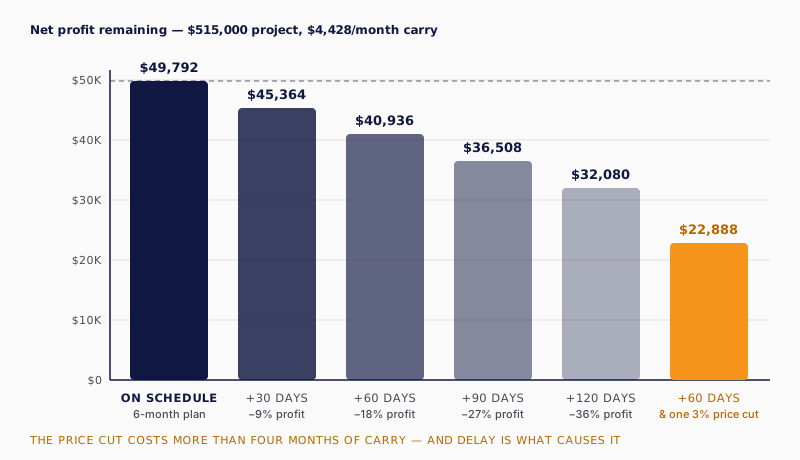
Roughly 9% of the profit per month, on a deal with a healthy 9.7% margin on cost. Push the leverage higher or the margin thinner and the percentage climbs fast. A deal underwritten to $30,000 of profit does not survive a 90-day slip at all — it survives about ten weeks, and then it is a break-even exercise in which you worked for six months for nothing.
Why delay costs more than the carry
The table above is the floor, not the ceiling, because delay produces costs that never show up in a holding-cost line.
The price cut. This is the big one. A house that sits accumulates days on market, buyers read that as a defect, and the answer is almost always a price reduction. One 3% cut on $640,000 is $19,200 — more than four months of holding cost, gone in a single conversation with your agent. And it is causally linked to the delay: the flip that lists in September into an active market does not need the cut that the same house needs listing in December.
From $49,792 to $22,888 — a 54% cut in profit from two months and one price reduction. That is the realistic bad case, and it is far more common than the pure-carry scenario.
Season slip. In most markets, spring and early summer carry a listing premium and a shorter time to contract. A project that misses that window does not just pay more carry; it sells into thinner demand. Ninety days of delay in the wrong direction can move you across a seasonal boundary and cost more than the interest ever did.
Extension pricing. If the delay pushes past maturity you are asking for an extension, and extensions are priced. PML writes fix-and-flip terms from 6 to 18 months, which makes this largely avoidable: taking the longer initial term on a project with real schedule risk costs nothing extra in interest — interest accrues on time outstanding either way — and removes the maturity scramble entirely. There is no prepayment penalty, so finishing early costs you nothing.
The deal you did not do. Your $42,000 of equity, your reserves, and your attention are all locked in a project that should have closed. If your capital turns three times a year at $49,000 a turn, a 90-day overrun is not just $13,284 of carry — it is a full acquisition cycle you did not get to run.
Where the days actually go
Delays are not random. In our servicing book the same six causes account for nearly all of them, in roughly this order.
- Permits and municipal inspections. The single largest source, and the one most sensitive to preparation. Plans submitted the week of close instead of during escrow routinely save two to four weeks.
- Long-lead materials. Cabinets, windows, custom millwork, and HVAC equipment have lead times measured in weeks. Ordering them at demo instead of at close is the most common self-inflicted delay in the business.
- Trade sequencing. A sub who does not show costs you the crew behind them too. Sequencing failures cascade in a way that individual delays do not.
- Draw timing. Work stops when money stops. This one is squarely inside your control — know what triggers a draw, document line items as they complete, and request as soon as they do. Our draw inspection article covers exactly what the inspector is verifying and how to keep the cycle short. PML funds approved draws weekly with a 48-hour wire, which only helps if the request goes in on time.
- Discovery. Foundation, sewer lateral, knob-and-tube, unpermitted prior work. Genuinely unpredictable in kind, entirely predictable in aggregate — which is what the contingency is for.
- Escrow and buyer financing. After you are done. Appraisal scheduling, buyer underwriting conditions, and repair negotiations can add three to five weeks after an accepted offer, and you carry every day of it.
Buying time back
Once you know the daily burn, most schedule decisions stop being judgment calls and become arithmetic. The test is one line:
If it costs less than $146 per day saved, buy the time.The whole acceleration decision
| Acceleration | Cost | Days saved | Verdict |
|---|---|---|---|
| Permit expediter | $1,500 | 14 | Buy — $107/day |
| Premium sub, 15% over on a $12,000 scope | $1,800 | 10 | Buy — $180/day, marginal |
| Order long-lead items at close | $0 | 10–21 | Always |
| Second crew to overlap trades | $3,200 | 12 | Buy — $267/day, only if it also protects the listing window |
| Weekend punch-list labor | $900 | 4 | Buy — $225/day at the end, when a cut is the alternative |
| Waiting for a cheaper sub | Saves $1,100 | −9 | Decline — costs $1,314 in carry |
Two of those exceed the $146 threshold on carry alone and are still correct, because near the end of a project you are not only buying carry — you are buying the listing window, and the alternative cost is a price cut at $19,200, not $146 a day. The threshold is the floor of the analysis, not the whole of it.
Underwriting the delay before it happens
The professional move is not to eliminate delay. It is to have already paid for it in the underwrite, so the delay is an inconvenience rather than a repricing.
- Add 25% to the contractor’s schedule and underwrite that. A four-month build is a five-month carry. If the deal only works on the contractor’s number, it does not work.
- Take the longer loan term. With 6 to 18 month terms available and no prepayment penalty, a 12-month term on a six-month project is free optionality. Pay off early and you owe nothing extra.
- Hold holding-cost reserves separately from the rehab contingency. They cover different failures. A contingency that gets consumed by carry leaves you exposed on the next surprise.
- Sanity-check against the 70% rule. The rule’s 30% haircut is meant to absorb financing, carry, selling costs, and profit. If your buffered holding cost eats most of that spread, the acquisition price is wrong — not the schedule.
- Know the exit before you demo. If the resale window is tight, a refinance-and-hold exit converts a carry problem into a cash-flow decision instead of a forced price cut.
None of this requires optimism about your schedule. It requires the daily number, an honest buffer, and a loan term that does not force a decision on the worst possible day. Send us the deal and the real timeline — not the one you hope for — and we will structure the term around it.
Glossary
The total recurring cost of owning a project while it is being renovated and sold: loan interest, property taxes, insurance, utilities, upkeep, and HOA dues.
Monthly holding cost divided by days in the month. The number against which every schedule decision should be priced. Roughly $28 per day per $100,000 of project cost at current rates.
The portion of the loan actually funded to date. Interest on a non-Dutch loan accrues on this figure, which is why holding cost rises through a project as rehab draws fund.
Materials with procurement times measured in weeks — cabinets, windows, custom millwork, HVAC equipment. Ordering them at close rather than at demo is the cheapest schedule insurance available.
How long a listing has been active. Rising DOM is read by buyers as a defect signal and is the mechanism by which delay converts into a price reduction.
Additional time granted past a loan’s maturity date, typically priced. Largely avoidable by selecting a longer initial term where no prepayment penalty applies.
A budgeted reserve for scope surprises discovered during rehab. Distinct from a holding-cost reserve, which covers schedule overrun rather than scope overrun.
Frequently asked questions
What is included in holding costs?
Six line items: loan interest on the drawn balance, property taxes, builder’s risk or vacant dwelling insurance, utilities kept on for trades and inspections, upkeep (lawn, dumpster, security), and HOA dues where applicable. Interest is about 80% of the total, which is why the other five get ignored — but on a $515,000 project they still run about $885 a month, or $5,310 across a six-month hold.
How much does one month of delay cost?
On a $515,000 project financed to $473,000 at 8.99%, holding cost runs about $4,428 a month, or $146 a day. Against a net profit near $49,800, that is roughly 9% of the profit per month. Ninety days costs 27%. Thinner margins lose a larger share — a deal underwritten to $30,000 of profit does not survive a 90-day slip.
How do I calculate my daily burn?
Add the six monthly line items and divide by 30. A shortcut worth memorizing: about $28 per day per $100,000 of project cost at current rates. A $300,000 project burns about $84 a day; an $800,000 project about $224. Keep the daily figure visible — schedule decisions are made daily, not monthly.
Why is a late-stage delay worse?
Because the loan is fully drawn by then. Early on you pay interest only on the acquisition draw — rehab funds have not advanced. By punch list, final inspection, and listing, the whole rehab budget has funded, so each extra day accrues on the full balance. Late delay also lands nearest the listing window, which is where a price cut becomes likely.
Interest or the price cut — which is worse?
The price cut, by a wide margin. One 3% reduction on a $640,000 ARV is $19,200 — more than four months of carry on the same deal. Sixty days of delay plus one 3% cut takes net profit from about $49,800 to about $22,888, a 54% reduction. The two are linked: a house accumulating days on market is what produces the cut.
Is it worth paying to speed things up?
One test: if it costs less per day saved than your daily burn, buy the time. On a $146-a-day project, a $1,500 permit expediter saving 14 days is $107 a day — clearly worth it. Ordering long-lead materials at close instead of at demo costs nothing and saves 10 to 21 days. Near the end, the threshold is effectively higher, because you are buying the listing window, not just the carry.
How much schedule buffer should I underwrite?
Add about 25% to the contractor’s schedule and underwrite the carry on that timeline — a four-month build is a five-month carry. If the deal only works on the contractor’s number, it does not work. Keep holding-cost reserves separate from the rehab contingency; they cover different failures. Then check against the 70% rule: if buffered carry eats most of the 30% spread, the purchase price is wrong, not the schedule.
What if I run past maturity?
Then you are asking for an extension, and extensions are priced. It is largely avoidable at the outset: PML writes fix and flip terms from 6 to 18 months with no prepayment penalty, so a 12-month term on a six-month project costs nothing extra. Interest accrues on time outstanding either way and early payoff carries no penalty — which makes the longer term free schedule insurance.
Structure the term around the real timeline.
Send us the deal and the schedule you actually believe — not the optimistic one. We write 6 to 18 month terms with no prepayment penalty, so buying schedule insurance costs you nothing if you finish early.