 Private Money Lenders
Read time: 30 seconds
- Anyone who furnished labor or material can record a mechanic’s lien — and in many states that lien relates back to when work began, which can put it ahead of a lender recorded later.
- That relation-back is why lien waivers exist. They are how the lender confirms its first position survived the last draw before it releases the next one.
- Four waiver types, two variables: conditional or unconditional, progress or final. Conditional means “effective when the money clears.”
- The pattern that works: trailing unconditional, current conditional. Each draw request carries unconditional waivers for the draw already paid and conditional waivers for the one being requested.
- The blind spot is the second tier. Subs of your subs and suppliers you never met have lien rights. Your preliminary-notice file is your waiver list — treat it that way.
- Several states mandate exact statutory wording. A well-meant custom form can be void. Use the title company’s forms and do not draft your own.
Why the lender cares this much
A mechanic’s lien is a statutory right, not a contractual one. In every state, parties who furnish labor or materials that improve real property can record a claim against that property if they are not paid. They do not need your agreement, your signature, or a contract with you — a subcontractor you have never met can encumber your title.
On its own that would be a manageable risk. What makes it a financing problem is priority.
In many jurisdictions a mechanic’s lien does not take priority from the date it is recorded. It relates back to an earlier moment — commencement of work on the property, or that claimant’s first furnishing of labor or material, depending on the state. A lien recorded in month seven can therefore attach with a priority date from month one.
Now consider what that does to a construction lender. You record a deed of trust in month one and begin advancing funds. In month seven an unpaid framer records a lien that relates back ahead of your advances. The lender that believed it held a clean first position on a $473,000 loan discovers it is standing behind a $38,000 claim that predates its own money.
Every draw is the lender voluntarily increasing its exposure. Lien waivers are how it confirms the position it is increasing still exists.The entire logic of the process
This is why the draw cycle has a distinct title and lien check stage sitting between inspection and funding — the fifth of the six stages in our draw process. The inspector confirms the work happened. The lien check confirms nobody has recorded a claim over it. Both must clear before the wire goes.
The four waiver types
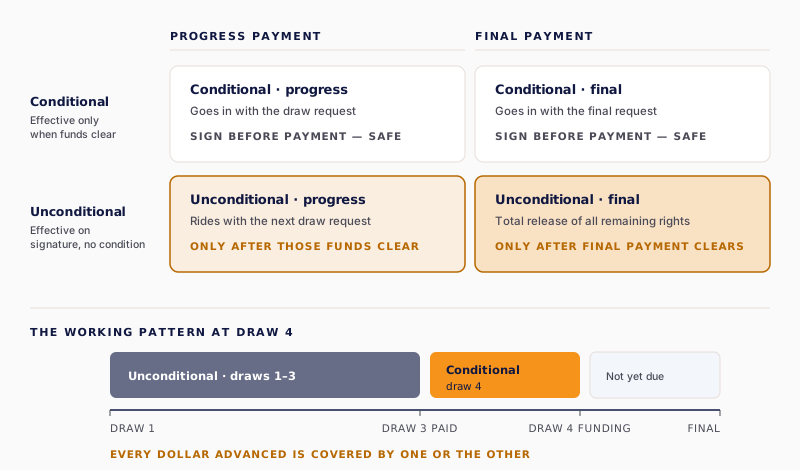
Two binary variables produce four documents. Almost every waiver dispute in construction traces to someone signing the wrong one of these four.
| Waiver | Covers | Takes effect | Signed when |
|---|---|---|---|
| Conditional, progress | Work through a stated date | Only when the payment actually clears | With the draw request, before funding |
| Unconditional, progress | Work through a stated date | Immediately on signature | After that draw’s funds have cleared |
| Conditional, final | All work on the project | Only when the final payment clears | With the final draw request |
| Unconditional, final | All work on the project | Immediately — total release | After final payment has cleared |
The word doing the work is conditional. A conditional waiver says: when I am paid the stated amount, my lien rights through the stated date are released. If the check bounces or the wire never lands, the waiver never takes effect and the claimant’s rights survive intact.
An unconditional waiver says: my rights through this date are released, now. No payment condition. A subcontractor who signs one before the money has cleared has given away the claim and kept only a breach-of-contract action — which is worth considerably less than a lien on real property.
As the borrower, understand both sides of this. You need unconditional waivers eventually, because conditional ones leave a paper trail of unresolved conditions your title company will not be comfortable with at payoff. But demanding an unconditional waiver before you have paid is a request no competent contractor should grant, and pushing for it damages a relationship you need for another six months.
Where waivers sit in the draw cycle
The standard pattern is simple once seen and confusing until then. Each draw request carries two sets of waivers pointing in opposite directions in time:
Trailing unconditional, current conditional. Run that pattern and the file is self-proving: at any moment, every dollar the lender has advanced is covered by an unconditional release, and every dollar it is about to advance is covered by a conditional one that activates the instant the wire lands.
Two practical consequences follow, and both are worth building into your process from draw one.
Draw 1 is the easy one. Draw 2 is where files stall. On the first draw there is nothing trailing, so a conditional set is all anyone needs. On the second draw you must produce unconditional waivers for draw 1 — which means chasing signatures from subs who have been paid and have moved to another job. Collect them in the week the money clears, not in the week you need the next draw.
The through-date is not decoration. A waiver releases rights for work performed through a specific date. If your draw 3 waiver says “through March 15” but the sub worked through March 28, there are thirteen days of unwaived work sitting in your file. Title will find it. Match through-dates to the draw period, every time.
Who has to sign, and the tier problem
The general contractor’s waiver is necessary and not remotely sufficient. Lien rights belong to each party that furnished labor or material, and each one holds their own.
Typically required on a residential rehab or ground-up:
- The general contractor, for their own contract.
- Every subcontractor above the lender’s threshold — commonly anything over a few thousand dollars, though on smaller projects some lenders want all of them.
- Material suppliers billing directly, which routinely includes lumber yards, cabinet suppliers, window manufacturers, and appliance vendors.
- Anyone who served a preliminary notice, whether or not you thought they were significant.
The failure mode nearly always lives one level down. Second-tier claimants — the electrician’s hired helper, the supplier your framer bought trusses from, the crane operator subcontracted for one afternoon — have lien rights against your property even though your contract is with someone else and you have never spoken to them. Your GC pays them. If your GC does not, they lien you.
Three defences, in order of effectiveness:
- Make sub waivers a payment condition in the construction contract. Draw funds are released to the GC only against waivers from every party the GC paid in that period. This is the single most effective clause you can put in a contractor agreement and it costs nothing to include.
- Joint checks for large suppliers. A check payable jointly to the GC and the supplier cannot be cashed without the supplier’s endorsement, which is itself strong evidence of payment.
- Direct payment on the largest exposures. On a $14,500 cabinet package, paying the supplier directly and taking their waiver removes the largest second-tier risk on the job outright.
Preliminary notices are your waiver list
In most states, a claimant must serve a preliminary notice — sometimes called a pre-lien or notice to owner — within a set window of first furnishing labor or material, as a precondition to later lien rights. The deadline is commonly 20 days, and it varies meaningfully by state.
Borrowers treat these notices as junk mail. They are the opposite: they are a self-assembling list of every party who can lien your project, mailed to you at no cost, in advance.
The discipline is small and it prevents most waiver emergencies:
- Keep every preliminary notice in one file, indexed by claimant name and date of first furnishing.
- Reconcile that list against your waiver package at every single draw, not at the end.
- Any name on the notice list without a corresponding waiver is an open exposure — resolve it while the party is still on site and still wants your next payment.
A name that shows up on a preliminary notice in month two and never appears in a waiver package is the exact profile of the lien that surfaces in month seven.
The final package and the lien window
The last release is different in kind, because after the final payment there is no leverage left. Every party has been paid; nobody needs anything from you.
A complete final package generally includes:
- Unconditional final waivers from the GC and from every sub and supplier on the notice list.
- A recorded notice of completion, where the state provides for one. This matters more than it looks: recording it typically shortens the window in which claimants may still record a lien, sometimes dramatically.
- A title datedown endorsement confirming no liens have appeared between the last check and the final advance.
Then the part that surprises people: the lien window does not close when the work ends. Claimants typically have somewhere between 30 and 90 days after completion or last furnishing to record, depending on the state and on whether a notice of completion was filed. A lien can therefore appear weeks after your project is finished, painted, and listed.
This is what retainage is for, where a facility uses it, and it is why a title company may want the window to run before issuing a clean policy on a sale. If you are flipping, build that window into your timeline rather than discovering it in escrow — a lien surfacing mid-escrow is both a delay and a carry cost measured in days.
What actually goes wrong
Six failures cover nearly every stalled draw we see, and five are clerical.
- Wrong property identification. The waiver names an address or parcel number that does not match the security instrument. Void for the purpose, and it will be caught at title.
- Through-date mismatch. The waiver covers a period shorter than the work performed, leaving an unwaived gap.
- Amount mismatch. The waiver states a figure that does not tie to the draw. Reconciliation stops until someone explains why.
- Non-conforming form. Several states prescribe exact statutory language for waivers. A custom or out-of-state form in one of those states can be legally ineffective no matter how clearly it is written. Use the title company’s current forms for the state the property sits in.
- Missing notarisation or signature authority. Where required, an unnotarised waiver or one signed by someone without authority to bind the entity is not a waiver.
- The genuine dispute. A sub who believes they are owed more will not sign, and no amount of process fixes that. The real remedies are commercial: negotiate and pay, hold the disputed amount in escrow with title, or bond around the lien — a bond substitutes surety for the property and clears title so the project can proceed while the dispute is resolved separately.
Everything except the last one is a filing discipline problem, solved by collecting waivers in the week payment clears and reconciling against your preliminary-notice list at every draw. Build that habit on draw one and the process becomes invisible; skip it and it becomes the reason a fully performing project cannot get its money. Send us the project and the contractor structure and we will tell you exactly which waivers your draw package will need before draw one goes in.
One closing caveat that should be obvious and often is not: lien law is state law and it varies substantially in deadlines, forms, notice requirements, and priority rules. Nothing here is legal advice. It is the vocabulary you need so your title officer and your counsel can give you an answer quickly.
Glossary
A statutory claim against real property available to parties who furnished labor or material and were not paid. Arises by statute rather than by contract with the owner.
The rule in many states giving a mechanic’s lien priority from commencement of work or first furnishing rather than from its recording date — which can place it ahead of a lender’s later advances.
A release of lien rights that takes effect only when the stated payment actually clears. The correct form to sign before funding.
A release effective immediately on signature, with no payment condition. Should be signed only after the corresponding funds have cleared.
Notice served by a potential claimant shortly after first furnishing labor or material, a precondition to lien rights in most states. Collectively, these notices form the definitive list of parties who can lien the project.
A subcontractor or supplier engaged by another subcontractor rather than by the owner or general contractor. Holds lien rights against the property despite having no contract with the owner.
A recorded document declaring the work finished. Where available, recording it typically shortens the period in which claimants may still record a lien.
A title endorsement confirming no new liens or encumbrances have appeared since the prior check. Issued at each draw and before the final advance.
Substituting a surety bond for the property as security for a disputed lien claim, clearing title so the project can proceed while the dispute is resolved separately.
Frequently asked questions
What is a lien waiver?
A document in which a contractor, subcontractor, or supplier releases their statutory right to record a mechanic’s lien for work through a stated date. Lenders require them because in many states a lien takes priority from commencement of work, not from recording — so a lien recorded in month seven can attach ahead of advances made in month two. Waivers are how the lender confirms its first position survived the last draw.
Conditional vs unconditional — what is the difference?
A conditional waiver takes effect only when the stated payment clears — if the wire never lands, the waiver never activates and the claimant keeps their rights. An unconditional waiver is effective the moment it is signed, no payment condition. Rule: conditional before payment, unconditional after the funds clear. A sub who signs unconditional before being paid has traded a claim on real property for a contract action.
Which waivers go with which draw?
Trailing unconditional, current conditional. Each request carries unconditional waivers for the previous draw (already paid) plus conditional waivers for the draw being requested. Every dollar advanced is covered by an unconditional release; every dollar about to advance is covered by a conditional one that activates on the wire. Draw 2 is where files stall — it is the first time you must chase unconditional waivers from subs who have been paid and moved on.
Do subs I never hired need to sign?
Usually yes — and it is the most common gap in a waiver package. Second-tier claimants (a sub hired by your sub, a supplier your framer bought from) hold lien rights against the property even though their contract is with someone else. Best defense is contractual: make delivery of waivers from every party the GC paid a condition of releasing that draw. Joint checks to large suppliers and direct payment on the biggest material packages close most of the rest.
What is a preliminary notice?
A notice served by a potential claimant shortly after first furnishing labor or material — commonly within about 20 days — and in most states a precondition to later lien rights. Receiving one is routine, not a threat. It is also the most useful document you will get: collectively these notices are a free, self-assembling list of everyone who can lien your project. Reconcile it against your waiver package at every draw; a name with no waiver is an open exposure.
Can a lien be filed after the work is done?
Yes. Claimants typically have 30 to 90 days after completion or last furnishing to record, depending on state and on whether a notice of completion was filed — so a lien can appear weeks after the project is finished and listed. Where the state provides for one, recording a notice of completion often shortens that window substantially. Build it into your timeline rather than meeting it in escrow, where it is both a delay and a daily carry cost.
What if a sub refuses to sign?
First separate clerical from genuine. Most refusals are form problems — wrong property identification, a through-date that does not match the work, an amount that does not tie to the draw, or a non-conforming form in a state that prescribes statutory wording. Reissue the correct document. A real money dispute is commercial: negotiate and pay, hold the disputed sum in escrow with title, or bond around the lien, substituting a surety bond for the property so title clears and the project proceeds while the dispute is resolved separately.
Can I write my own waiver form?
Do not. Several states prescribe exact statutory language, and in those states a custom or out-of-state form can be legally ineffective however clearly it is drafted — meaning a waiver you believed you held does not exist. Use the title company’s current forms for the state the property sits in. Lien law is state law and varies substantially in deadlines, forms, notice rules, and priority; your title officer and counsel are the authority on the specific jurisdiction.
Know the waiver package before draw one.
Send us the project and the contractor structure. We will tell you which parties your draw package needs waivers from, and where the second-tier exposure sits, before the first request goes in.