 Private Money Lenders
Read time: 30 seconds
- The schedule of values is the contract your draws are scored against. Once it is approved, every inspection measures percent-complete line by line against that document and nothing else.
- Too coarse and you starve. A five-line SOV means a partially finished trade scores partial credit on a huge line — you fund less, later, than the work you actually did.
- Front-loading is caught at approval, not at draw. Underwriting benchmarks each line against cost norms. If a padded SOV slips through, the punishment arrives at the end, when the finish trades are $17,000 short of what the work costs.
- 12 to 20 line items is the working range for a residential rehab — granular enough to score cleanly, coarse enough that nobody is inspecting a $400 line.
- Split labor and material on long-lead trades. Cabinets delivered but not installed score zero on a combined line and 60% on a split one.
- Contingency lives outside the SOV. Bury it inside line items and you have padded your own budget; hold it separately and a real surprise triggers a change order instead of a shortfall.
What the SOV actually governs
A schedule of values is a line-item breakdown of the construction budget, each trade or phase assigned a dollar amount that sums to the total. That is the definition. What matters is its function: after approval, the SOV is the only document your money is measured against.
The draw mechanic makes this concrete. When you file a draw request, an independent third-party inspector visits the site, walks it against the approved schedule of values, photographs each line item, and assigns a percent-complete to each one. The lender then funds the lesser of what you claimed and what the inspector verified. Our draw inspection article covers that verification step in detail.
Follow the implication. The inspector is not evaluating whether the project is going well, whether you are on budget, or whether the work is good value. They are scoring rows in a table you wrote. A badly written table produces badly funded draws on a perfectly healthy project.
Which is why the SOV deserves an hour of real attention before submission and almost never gets it. Most first-time borrowers hand over whatever their contractor produced for the bid, discover in month three that their draws are running behind their spend, and conclude the lender is slow. The lender is not slow. The table is wrong.
The two ways an SOV fails
Failures are symmetrical, and both are common.
Too coarse
A contractor submits five lines: demo, exterior, mechanical, interior, finish. It looks clean. It funds terribly.
Consider a single $48,000 “interior” line covering insulation, drywall, paint, trim, doors, and flooring. You have finished insulation and drywall — roughly $13,000 of real work — but the inspector is scoring one line and there is no drywall-only row to score. They assign a judgment percentage to the whole bundle, and judgment under uncertainty rounds down. You get 20% of $48,000, or $9,600, against $13,000 spent. That gap comes out of your pocket and stays out until the next draw.
Repeat that across five oversized lines for six months and a fully funded project develops a permanent working-capital deficit that nobody can point to.
Too clever
The opposite error: 60 lines, each broken to the fixture. Now every draw requires the inspector to verify dozens of small items, inspections take longer, discrepancies multiply, and a single ambiguous $600 row can hold up a reconciliation. You have optimized for precision and paid in cycle time — and on a project burning carry daily, cycle time is money.
Twelve to twenty lines. Enough that finished work has a row to land in; few enough that a draw can be verified in one site visit.The working range for a residential rehab
Building the line items
Structure the SOV the way the work actually happens — in the sequence a trade arrives, finishes, and leaves. Here is a $180,000 rehab budget as a working SOV:
| Line item | Amount | Share | Notes |
|---|---|---|---|
| Permits & plans | $6,500 | 3.6% | Often funded at first draw on receipts |
| Demolition & debris | $9,000 | 5.0% | Fast to verify, scores cleanly |
| Foundation & structural | $14,000 | 7.8% | Split if scope is discovered mid-project |
| Framing & carpentry | $22,000 | 12.2% | Largest single line; consider a rough/finish split |
| Roofing | $13,500 | 7.5% | Binary in practice — on or off |
| Windows & exterior doors | $11,000 | 6.1% | Long lead — split material and install |
| Plumbing, rough & finish | $16,000 | 8.9% | Two rows if rough and finish are months apart |
| Electrical, rough & finish | $15,000 | 8.3% | Same logic as plumbing |
| HVAC | $12,500 | 6.9% | Equipment is long lead |
| Insulation & drywall | $13,000 | 7.2% | Scores well — visually unambiguous |
| Interior finishes — paint, trim, doors | $10,500 | 5.8% | |
| Flooring | $9,500 | 5.3% | |
| Cabinetry & countertops | $14,500 | 8.1% | Long lead — split material and install |
| Fixtures & appliances | $6,000 | 3.3% | Often stored, not installed — know the policy |
| Exterior, landscape, final clean | $7,000 | 3.9% | Last money out |
| Total | $180,000 | 100% |
Fifteen lines. Every trade has somewhere to land, no row is so small it wastes inspection time, and the largest line is 12% of the budget.
Three structural rules are doing the work here:
- No line above roughly 15% of the total. Above that, partial completion of one row moves too much money and invites a judgment call.
- No line below roughly 2%. Below that you are adding verification burden for money that does not move the draw.
- Split any trade whose start and finish are separated by other trades. Plumbing rough happens before drywall; plumbing finish happens after paint. Those are two events months apart, and one row cannot represent both.
Pricing the lines, and the material trap
The most expensive avoidable mistake in SOV construction is bundling material and labor on long-lead trades.
Cabinets illustrate it. You order $9,000 of cabinetry in month one because lead time is eight weeks. They arrive in month three and sit in the garage until the floors are down in month five. On a single combined $14,500 “cabinetry and countertops” line, what does the inspector score in month three? Nothing is installed. The realistic score is 0% to 10%. You are $9,000 out of pocket on a line the lender has funded almost nothing against.
Split it and the picture changes completely:
Same project, same progress, $7,550 difference in month-three liquidity, decided entirely by how the row was written months earlier.
Two caveats that keep this honest. Stored-material funding is a policy question — some lenders fund delivered material on site, some require installation, some fund stored material only with proof of delivery and insurance coverage. Ask before you write the SOV, not at the draw. And material lines require receipts; a split line without documentation scores worse than a bundled one.
Front-loading, and why it always collects
Front-loading is assigning inflated values to early trades so the first draws come in large. Demo priced at $18,000 instead of $9,000. Framing at $30,000 instead of $22,000. The total still sums to $180,000, so the SOV looks fine.
Contractors propose it for real reasons — they need working capital and they have been burned by slow-paying owners. Borrowers accept it because early cash feels like winning. It is worth understanding exactly how it fails.
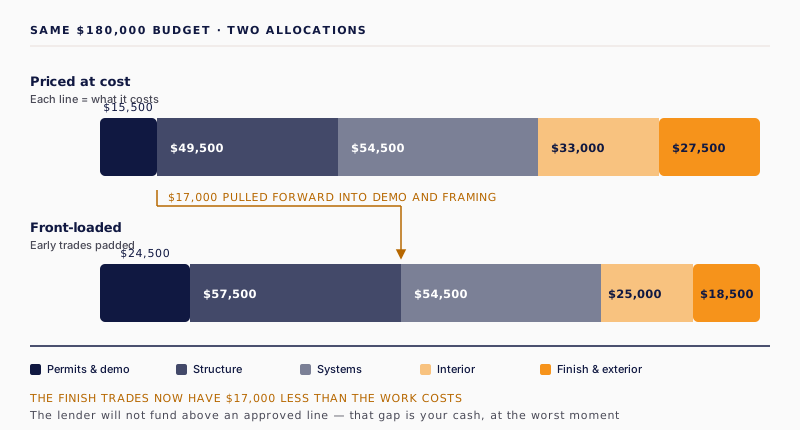
Path one: underwriting catches it. Lines get benchmarked against cost norms for the market and the scope. A demolition line at double the going rate is visible immediately, and the SOV comes back for revision. You have lost a week for nothing.
Path two — the dangerous one: it gets approved. Now the padded SOV is the contract. Draws one and two fund large and everyone is pleased. Then the finish trades arrive against the rows that were raided to pay for it. Flooring, paint, trim, fixtures, and final exterior have $17,000 less than the work costs, and the lender will not fund above an approved line. You cover the gap in cash, at exactly the point in the project where your carry is highest and your reserves are thinnest.
The rule is simple and unglamorous: price each line at what that line costs. If your contractor needs mobilisation capital, address that directly through deposit terms in the construction agreement, not by distorting the document your funding is scored against for the next nine months.
Where contingency belongs
Every rehab budget needs a contingency, and almost every borrower puts it in the wrong place.
The wrong way: add 10% to each line item. You have now front-loaded every row simultaneously, your SOV fails benchmarking, and if it clears you are inspecting inflated lines all project long. Worse, the contingency is invisible — you cannot tell whether you have spent it, because it never had a name.
The right way: hold contingency as a separate, identified line, or outside the loan budget entirely as sponsor reserve. Then a genuine surprise — a rotten sill plate, an unpermitted addition, a failed sewer lateral — runs through a defined path: document the condition, price the change, request a change order or budget modification, and the SOV is formally amended.
That path exists and it is routine. Where a scope increase is supported by value, an underwriter can increase the loan amount up to the original ARV cap, typically within five business days, at a modest modification cost. That works when the budget structure is clean and the surprise is documented. It does not work when the contingency was smeared invisibly across fifteen rows.
A sensible default on a residential rehab is 10% to 15% of hard costs, held outside the line items, higher on pre-1960 stock or anything where you have not opened the walls.
The SOV that clears on the first pass
Everything above, as a submission checklist:
- 12–20 line items, sequenced the way the work happens.
- No line above ~15% or below ~2% of the total budget.
- Rough and finish split for plumbing, electrical, and anything else interrupted by another trade.
- Material and labor split on every long-lead item — windows, cabinets, HVAC equipment, custom millwork.
- Each line priced at cost, benchmarkable against local norms. No mobilisation funding hidden in demo.
- Contingency held separately at 10–15% of hard costs, not distributed into the rows.
- Sums exactly to the approved budget — a rounding mismatch is a revision cycle you did not need.
- Line names match your contractor’s invoice language, so draw requests, invoices, and inspection reports use the same words. Mismatched vocabulary is a surprisingly common source of reconciliation delay.
Get that right and the rest of the process is mechanical: request weekly, get inspected, get funded. Approved draws wire in 48 hours on our construction and rehab products, and the schedule of values is the single document that determines whether that speed reaches you or stops at the inspection report. Send us the scope and the budget and we will tell you where the SOV will snag before it costs you a draw cycle.
Glossary
A line-item breakdown of the construction budget, each trade or phase assigned a dollar amount summing to the total. After approval, it is the document every draw is scored against.
The share of a line item the inspector verifies as finished. The lender funds the lesser of the claimed and verified figures.
Assigning inflated values to early trades so initial draws fund larger, offset by understating finish trades. Caught in benchmarking, or paid for at the end of the project.
Material with a procurement time measured in weeks — windows, cabinetry, HVAC equipment. Should carry separate material and installation lines.
Purchased material delivered to site but not installed. Whether it is fundable is lender policy and should be confirmed before the SOV is written.
A documented amendment to scope and budget, the formal path for handling discovered conditions. Where value supports it, may accompany an increase in the loan amount up to the original ARV cap.
Reserve for scope surprises, held as a separate identified line or as sponsor reserve outside the loan. Typically 10–15% of hard costs.
A percentage withheld from each draw until completion, used on some construction facilities to ensure the job is finished. Confirm whether and at what rate it applies before budgeting cash flow.
Frequently asked questions
What is a schedule of values?
A line-item breakdown of the construction budget — demolition, foundation, framing, roofing, plumbing, electrical, drywall, finishes — each assigned a dollar amount summing to the approved total. Once approved, it becomes the document every draw is measured against: an inspector walks the site against it, photographs each line, assigns a percent-complete, and the lender funds the lesser of claimed and verified.
How many line items should it have?
12 to 20 on a residential rehab. Fewer, and finished work has nowhere specific to land — a partly complete bundle gets a judgment percentage that rounds down, and you fund less than you spent. More than about 20 and inspections take longer, discrepancies multiply, and one ambiguous small row can hold a reconciliation. Guardrails: no line above ~15% of budget, none below ~2%.
Should material and labor be separate lines?
On long-lead items, yes — one of the highest-value calls in the document. Cabinets ordered in month one may arrive in month three and not install until month five. On a combined line, the month-three inspection scores near zero even though $9,000 is spent. Split into material and installation and the delivered material can be verified and funded. Confirm the lender’s stored-materials policy first: some require installation, some require proof of delivery and insurance.
What is front-loading?
Assigning inflated values to early trades — demo, framing — so first draws fund large, offset by understating finish trades. The total still sums, so it looks fine. Underwriting benchmarks lines against local cost norms and usually catches it, costing a revision cycle. The worse outcome is approval: the finish trades then arrive against raided rows, the lender will not fund above an approved line, and the shortfall lands when carry is highest and reserves thinnest.
Where should contingency go?
As a separate identified line, or outside the loan as sponsor reserve. Adding 10% to every row front-loads the whole schedule at once, fails benchmarking, and makes the contingency invisible — you cannot tell whether you have spent it. Held separately, a surprise runs a defined path: document, price, request a change order, amend the schedule. Default is 10–15% of hard costs, higher on pre-1960 stock.
Can the SOV be changed after approval?
Yes — through a change order or budget modification, not informally. Discovered conditions (failed sewer lateral, rotten framing, unpermitted prior work) are routine and have an established path: document, price, submit for amendment. Where added scope is supported by value, an underwriter can increase the loan amount up to the original ARV cap, typically within about five business days at a modest modification cost. What does not work is shifting money between lines informally and expecting draws to follow.
Why did my draw fund less than I requested?
Most often the inspector scored a line below what was claimed, and the lender funds the lesser. The structural causes usually trace back to the schedule: lines too large for partial completion to score accurately, material bought but not installed on a combined row, or work done out of sequence against rows written in another order. A persistent gap between spend and funding is nearly always a document problem, not a draw dispute.
How fast do draws fund?
PML funds approved draws weekly, with the wire out inside 48 hours of approval; request to wire typically runs three to seven business days, and the largest variable is inspection scheduling rather than lender processing. A well-structured schedule is what lets that speed actually reach you — it removes the reconciliation ambiguity that stalls draws between inspection and approval.
Want the SOV checked before it costs you a draw cycle?
Send us the scope and the budget. We will tell you which lines will snag in benchmarking and which ones need a material and labor split, before the first draw request goes in.