 Private Money Lenders
Read time: 30 seconds
- Cash-out is always capped below purchase — 75% against 80% on the DSCR product, 70% against 75% on stabilized multi-family.
- Which product your asset falls under moves the number more than its condition does. The same $800,000 building is $600,000 as a small multi-family under DSCR and $560,000 as stabilized multi-family.
- The LTV cap is rarely what actually binds. On the worked deal, coverage caps the loan at $537,500 — $62,500 below the LTV maximum.
- Not yet leased? Bridge cash-out runs to 75% with no coverage test, at roughly triple the rate and a term measured in months.
- “Value” means the new appraised value only once seasoning is satisfied. Before that, many lenders use what you paid.
- Mixed-use, condotels, and non-warrantable condos all move you down a tier — establish the classification before you plan around a number.
Why cash-out is capped below purchase
Every lender publishes a lower maximum for a cash-out refinance than for a purchase of the identical property. It is not an oversight or a fee grab — three specific things change when money leaves the closing table in your direction rather than the seller’s.
Your equity stops being observable. On a purchase, a real buyer paid a real price in an arm’s-length transaction, and the down payment is documented cash you actually parted with. On a cash-out, value rests on an appraiser’s opinion and your equity is a number derived from it. Opinions have error bars; contract prices do not.
Your incentives change. A borrower who just wired $160,000 into a property behaves differently from one who just took $160,000 out of it. Lenders have long data on this, and cash-out loans carry measurably higher default rates than purchase loans at equal leverage. The reduced cap prices that.
The safety margin has to come from somewhere. Purchase leverage is anchored by a transaction. Cash-out leverage is anchored by an estimate, so the buffer is widened by five points.
Five points sounds small and is not. On an $800,000 asset it is $40,000 of proceeds — frequently the difference between recycling your capital and leaving it in the deal.
The matrix
Maximums across PML’s products, for stabilized assets:
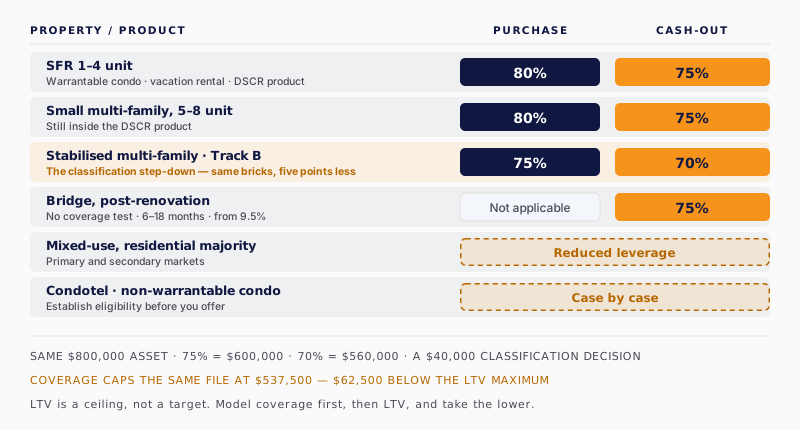
| Asset / product | Purchase | Cash-out | Note |
|---|---|---|---|
| SFR 1–4 unit, DSCR | 80% | 75% | The core residential investor product |
| Warrantable condo | 80% | 75% | HOA review required |
| Vacation rental / STR | 80% | 75% | Same product; income at 75% of gross |
| Small multi-family, 5–8 unit | 80% | 75% | Still inside the DSCR product |
| Stabilized multi-family, Track B | 75% | 70% | The classification step-down |
| Bridge, post-renovation | — | 75% | No coverage test; short term |
| Mixed-use, residential majority | Reduced | Primary and secondary markets | |
| Condotel / non-warrantable condo | Case by case | Establish eligibility before offering | |
Note the row that does the damage. A five-to-eight unit building financed under the DSCR product cash-outs at 75%. The same building classified as stabilized multi-family cash-outs at 70%. Same bricks, same rent roll, five points of difference decided by which desk the file sits on.
Classification is the first decision
Because the step-down is driven by product rather than by property, the classification question deserves attention before you model proceeds.
The DSCR rental product covers one-to-eight unit residential: single family through fourplex, warrantable condos, small multi-family to eight units, and vacation rentals, at $75,000 to $3,000,000 per asset. If your building fits inside that envelope, you are generally looking at 75% cash-out.
Above eight units, or where the asset is underwritten as a commercial multi-family operation rather than as residential rental, the multi-family tracks apply — and Track B tops out at 70% cash-out.
The practical advice for anyone buying in the five-to-ten unit range is unglamorous and worth real money: ask which product a building will be underwritten under before you buy it, not when you want your money back. A nine-unit and an eight-unit are similar buildings with materially different refinance ceilings.
Coverage is the second cap, and it usually binds first
Investors plan cash-outs off the LTV table and are then surprised by the number that funds. The reason is that LTV is a ceiling, not a target. A second constraint runs alongside it, and on most stabilized assets it binds first.
Work an actual file. A stabilized asset appraises at $800,000, rents for $5,600 a month, and carries $733 of monthly taxes and $267 of insurance.
That clears the 0.75x program minimum comfortably. But 1.10x is not where you want to be priced — 1.20x is the coverage most sponsors target, and it is the threshold that unlocks the better end of the tier structure. Solve backwards for the loan that produces it:
The coverage cap sits $62,500 below the LTV cap. Plan against 75% and you have overstated your proceeds by more than 10%.
LTV tells you the most a lender will ever lend. Coverage tells you what the rent will actually carry. Model both, take the lower.The mistake that shows up at the closing table
This is the same structure as the three caps on a fix-and-flip loan, transposed to the refinance side. The lesson generalises: published maximums are ceilings on one dimension, and the funded number is the lowest of all of them.
Four levers move the coverage cap, in rough order of how quickly you can pull them: raise rent to market, shop insurance, appeal a tax assessment, or take an interest-only structure — which is available on the DSCR product and lowers the payment substantially, at the cost of amortization.
What “value” means at cash-out
Every percentage above multiplies a value. Which value is a separate question, and it is where BRRRR investors lose the most money.
Once seasoning is satisfied, “value” means the current appraised value. Before it, many lenders substitute your original purchase price, and 75% of what you paid is a completely different number from 75% of what the property became. On a property bought at $385,000 and now worth $520,000, that substitution costs $101,250 — the arithmetic worked through in the seasoning article.
Two paths avoid it. Satisfy the seasoning requirement, or use a lender for whom it does not apply: refinancing from a PML fix-and-flip into a PML DSCR carries no seasoning requirement, with cash-out at up to 75% of the new appraised value and often no second appraisal, because the same underwriter handled both files.
And because the appraisal is doing the work, the same discipline that protects a purchase protects a refinance: a documented comp packet, a clean scope record, and realistic expectations about what the market supports.
What moves you down a tier
Beyond product classification, five characteristics reduce the maximum or make it conditional. All are knowable before you commit.
- Mixed-use. Allowed with a residential majority, at reduced leverage, in primary and secondary markets. A ground-floor retail bay changes both your LTV and your buyer pool at eventual sale.
- Condotel. Reviewed case by case. Resort-style condos with rental programs, front desks, and short-stay operations sit outside standard warrantability and cannot be assumed eligible.
- Non-warrantable condo. High investor concentration, ongoing litigation, a single owner holding too many units, or inadequate reserves can each push a project out of warrantable status — a building-level fact you cannot fix from your unit.
- Sub-1.0 coverage. Permitted at a rate adjustment, and worth understanding as a real option rather than a failure. But a lower rate would have produced better coverage, so this compounds against you.
- Thin comparable data. Rural properties and unusual configurations produce wider appraisal uncertainty, and uncertainty is resolved conservatively.
Reserves apply regardless: six months of PITIA, verified liquid, per loan. On the worked file that is roughly $28,000 — and it comes out of the proceeds you just took, which is exactly the sort of thing that belongs in the model rather than in the surprise column.
Sequencing a cash-out that actually funds
In order, because each step constrains the next:
- Establish the product classification. Unit count and use decide whether you are looking at 75% or 70%, and everything downstream depends on it.
- Confirm the value basis. Appraised value or purchase price? If seasoning is not satisfied and your lender substitutes cost basis, nothing else in the model matters.
- Compute the coverage cap first, the LTV cap second. Take the lower. Doing it in that order stops you from anchoring on a number you cannot reach.
- Get the lease to market rent before the appraisal. Rent drives the coverage cap directly, and a below-market lease caps your loan for the life of the refinance.
- Deduct reserves and closing costs from proceeds. Six months of PITIA plus 0.75–2 points of origination and third-party costs.
- Decide whether maximum leverage is right. More proceeds is worse coverage and a step-down prepayment penalty of 5/4/3/2/1 — buy-out available for 50 to 75 basis points if you expect to sell inside the window.
Investors who run that sequence before ordering an appraisal rarely get surprised. Investors who start from the LTV table almost always do. Send us the address, the rent roll, and the current debt and we will tell you which cap binds and what actually funds — before you pay for an appraisal.
Glossary
A refinance for more than the existing payoff, returning the difference to the borrower. Capped below purchase leverage on every product.
Loan amount as a percentage of appraised value. A ceiling on one dimension, not a target, and frequently not the binding constraint.
The largest loan whose PITIA the property’s rent supports at a target DSCR. On stabilized assets it commonly binds below the LTV cap.
A condominium in a project meeting standard eligibility criteria for owner-occupancy mix, litigation status, reserves, and single-owner concentration. Non-warrantable projects fall to case-by-case review.
A condominium operated with hotel-like services and short-stay rental programs. Reviewed case by case rather than under standard residential terms.
The stabilized, DSCR-underwritten multi-family program, distinct from Track A value-add. Cash-out tops out at 70% of value.
A declining penalty across the early years of a loan, 5/4/3/2/1 on the DSCR product, with buy-out available for 50 to 75 basis points.
Liquid funds a borrower must hold after closing, six months of PITIA per loan on the DSCR product, verified. Deducted from usable proceeds.
Frequently asked questions
What is the maximum cash-out LTV?
On the DSCR rental product, 75% cash-out against 80% purchase — covering SFR through fourplex, warrantable condos, vacation rentals, and small multi-family to eight units. On stabilized multi-family Track B, 70% cash-out against 75% purchase. A bridge loan for post-renovation cash-out runs to 75% with no coverage test but a 6–18 month term. Mixed-use with residential majority is allowed at reduced leverage; condotels and non-warrantable condos are case by case.
Why is cash-out capped lower?
Three things change. Your equity stops being observable — a purchase has a real buyer paying a documented price at arm's length; a cash-out rests on an appraiser’s opinion. Incentives change, and cash-out loans default at measurably higher rates than purchase loans at equal leverage. And the safety margin has to come from somewhere: purchase leverage is anchored by a transaction, cash-out leverage by an estimate. Five points on an $800,000 asset is $40,000 of proceeds.
Does LTV decide my loan amount?
Usually not. LTV is a ceiling on one dimension; a coverage constraint runs alongside it and on most stabilized assets binds first. On a worked file appraising at $800,000 with $5,600 rent, $733 taxes and $267 insurance: the 75% LTV cap is $600,000, giving PITIA of $5,093 and a ratio of 1.10x. Solving instead for a 1.20x target gives allowable PITIA of $4,667, P&I of $3,667, and a loan near $537,500 — $62,500 below the LTV cap.
Why does unit count change the cap?
Because the step-down is driven by product classification, not by the building. The DSCR product covers 1–8 unit residential, including small multi-family to eight units, and cash-outs at 75%. Above eight units — or where the asset is underwritten as a commercial multi-family operation rather than residential rental — the multi-family tracks apply and Track B tops out at 70%. If you buy in the five-to-ten unit range, ask which product a building falls under before you buy it.
Purchase price or appraised value?
It depends entirely on seasoning. Once satisfied, value means the current appraised value. Before it, many lenders substitute your original purchase price — and 75% of what you paid is a very different number from 75% of what the property became. On a property bought at $385,000 and now worth $520,000, that substitution costs $101,250. Two paths avoid it: satisfy seasoning, or refinance from a PML fix-and-flip into a PML DSCR, which has no seasoning requirement and cashes out at up to 75% of the new appraised value.
What reduces my leverage?
Mixed-use with residential majority — reduced leverage, primary and secondary markets. Condotels — case by case. Non-warrantable condos — conditional, and a building-level fact you cannot fix from your unit (investor concentration, litigation, single-owner concentration, thin reserves). Sub-1.0 coverage — permitted at a rate adjustment. And thin comparable data on rural or unusual properties produces appraisal uncertainty, which is resolved conservatively.
How much do I actually keep?
Less than loan minus payoff. Six months of PITIA, verified liquid, is required per loan — roughly $28,000 on the worked file, and it comes out of the proceeds you just took. Origination runs 0.75–2 points, plus third-party title, escrow, recording and appraisal. There is no application fee at any point. Model reserves and closing costs as a deduction from proceeds rather than treating the loan amount as cash in hand.
Should I take the maximum?
Not automatically. More proceeds means a higher payment against unchanged rent, so coverage falls and pricing worsens — and the DSCR product carries a 5/4/3/2/1 step-down prepayment penalty, with buy-out available for 50–75 bps. If a sale is likely inside that window, buy the penalty out or take less. Better sequence: compute the coverage cap first, the LTV cap second, take the lower, then decide whether the last increment of leverage is worth what it costs in coverage and flexibility.
Find out which cap binds before you pay for an appraisal.
Send us the address, the rent roll, and the current debt. We will tell you the product classification, which of the two caps governs, and what actually funds.