 Private Money Lenders
Read time: 30 seconds
- STR income qualifies at 75% of gross, not 100%. Twelve months of platform-verified revenue from Airbnb or VRBO, multiplied by 0.75.
- The 25% haircut is not conservatism — it is a proxy for operating cost. PITIA excludes cleaning, management, supplies, and platform fees, which on a real STR run 30% or more of gross.
- No operating history? AirDNA submarket projection on the subject address, at the same 75% factor. And if your trailing twelve substantially exceeds the submarket median, expect a tighter ratio.
- On a worked $650K asset: $7,200 gross becomes $5,400 qualifying against $4,211 PITIA — a 1.28x DSCR. The same house as a long-term rental is 0.81x.
- DSCR is not cash flow. That same 1.28x property nets about $583 a month after real operating costs.
- Regulatory risk is the real risk. If an ordinance forces the asset to long-term, coverage falls from 1.28x to 0.81x overnight. Stress-test that before you close, not after.
Why STR income gets its own rulebook
A long-term rental produces a number a lender can verify in one document. There is a lease, it states a rent, a tenant is obligated to pay it for a defined term, and underwriting can read it. A short-term rental produces something structurally different: a stream of hundreds of small, cancellable, seasonally clustered transactions with no obligation behind any of them.
Both throw off income. Only one of them throws off a contract.
That difference drives every STR underwriting rule, and it is worth naming the specific risks rather than treating the haircut as generic caution:
- No contractual floor. A twelve-month lease survives a soft quarter. A booking calendar does not — occupancy responds immediately to demand, weather, competition, and a single bad review cycle.
- Gross is not net, and the gap is wide. Long-term rent arrives with an expense load of perhaps 8–10% outside PITIA. Short-term revenue carries cleaning, turnover, management, supplies, utilities, and platform commission — frequently a third of gross.
- Concentration in time. A ski or beach asset can book 60% of its annual revenue in four months. The annual average looks fine; the trough is where a loan defaults.
- Regulatory fragility. A city council vote can end the use case. No other residential asset class carries a comparable overnight-obsolescence risk.
The 75% factor is how all four get priced into one number.
The 75% factor, and what it is really pricing
PML accepts twelve months of platform-verified short-term rental income at 75 percent of gross. Market practice elsewhere is similar — most lenders apply a 20% to 30% haircut — so 75% sits mid-range rather than at either extreme.
The instinct is to read the haircut as pessimism about your revenue. It is not. It is an operating-expense estimate wearing a different hat.
Remember what PITIA actually contains: principal, interest, taxes, insurance, and association dues. Our DSCR calculation article builds it line by line. Notice what is absent from that list on a short-term rental:
A DSCR computed on gross short-term revenue would compare a number carrying a 30% cost load against a payment that excludes all of it. The ratio would look strong on assets that lose money. The haircut restores the comparison.
The 25% haircut is not the lender doubting your revenue. It is the lender declining to count money that is already spoken for.Why 75% and not 100%
And as the worked example below shows, 25% is a slightly generous estimate of STR operating cost, not a punitive one.
Two documentation paths
Which path you are on depends entirely on whether the subject property has an operating history.
Path one: trailing twelve months, platform-verified
The strong path. Twelve months of documented Airbnb or VRBO income on the subject address, qualifying at 75% of gross — and importantly, including the seasonal swings. A full year captures the trough as well as the peak, which is precisely why a full year is the standard.
Verification means platform statements, not a spreadsheet. Expect to produce host earnings reports and expect them to be reconciled against deposits.
One rule worth knowing before you assemble the file: AirDNA submarket reports get pulled as a sanity check against your trailing twelve. If your revenue substantially exceeds the submarket median, underwriting may qualify you at a tighter ratio. That is not a penalty for being good at the business — it is a judgment that revenue far above submarket may reflect something not transferable or not repeatable: an exceptional operator, a one-off event year, a listing with unusual review momentum. If you genuinely outperform, document why — a superior renovation, a rare amenity, a unique location within the submarket — and put that in the file rather than letting the variance speak for itself.
Path two: AirDNA submarket projection
For new STR acquisitions with no operating history, an AirDNA submarket projection on the subject address is accepted, at the same 75-percent factor, in markets underwritten directly.
Two consequences for how you shop. First, the projection is address-specific, so comparable-property characteristics matter — bedroom count, amenities, and location within the submarket drive the number you will be qualified on. Second, buy in a market with real STR density. A projection in a submarket with thin comparable data is a weaker document, and thin data is exactly where lenders get cautious.
Program note: STR-specific tier pricing applies at a $200,000 minimum loan size, with interest-only available for the first 10 years.
A worked STR DSCR
A four-bedroom in a coastal submarket. Purchase $650,000, 75% LTV, 30-year fixed at 7.25%. Trailing twelve months of platform-verified revenue: $86,400, or $7,200 a month.
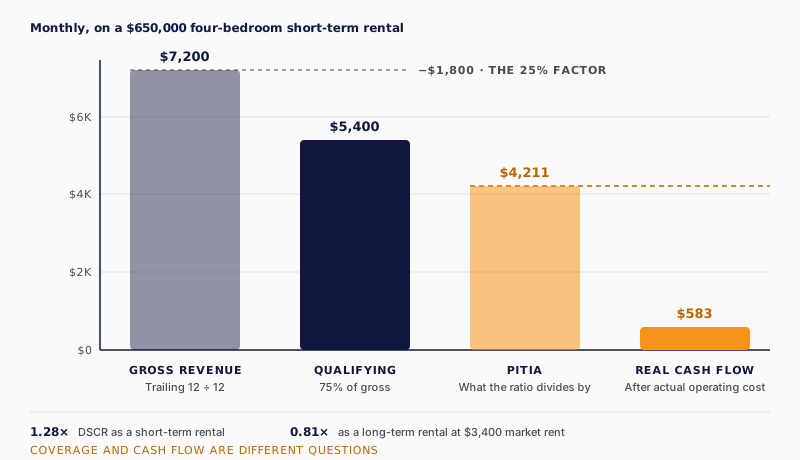
Note what the factor cost you. On gross revenue the ratio would be 1.71x. The haircut removes 0.43x of apparent coverage — which is the difference between an easy file and a considered one, and is exactly why understanding the factor matters before you write an offer.
Why 1.28x coverage is not $1,200 of cash flow
Run the same property as an operating business rather than as a loan file:
| Line | Monthly | Share of gross |
|---|---|---|
| Gross STR revenue | $7,200 | 100% |
| Management (20%) | − $1,440 | 20.0% |
| Platform commission (~3%) | − $216 | 3.0% |
| Utilities, internet, consumables | − $450 | 6.3% |
| Maintenance & furnishing reserve | − $300 | 4.2% |
| Net operating income | $4,794 | 66.6% |
| Less PITIA | − $4,211 | |
| Actual monthly cash flow | $583 |
Real operating cost came in at 33.4% of gross, against a 25% haircut. The factor was the generous assumption, not the harsh one — and a property that qualifies comfortably at 1.28x is producing about $583 a month before you have replaced a mattress or paid an unexpected repair.
If you self-manage, the 20% management line comes back to you and cash flow roughly triples. That is a real and legitimate strategy. Just be honest that you have bought a part-time job alongside the asset, and that a future sale prices the property on what a third-party manager would cost, not on your labor.
The same house, long-term
Market rent on that four-bedroom is $3,400 a month. On a long-term lease the whole picture inverts:
Short-term operation is what makes this asset financeable on attractive terms. That is the STR thesis in one line, and it is genuinely true.
It is also the risk, in the same line. A minimum DSCR of 0.75x means the long-term version is still fundable — sub-1.0 is allowed with a rate adjustment — but on materially worse pricing, with less proceeds and no margin. The gap between 1.28x and 0.81x is not a rounding difference. It is the entire investment case, and it rests on the property being permitted to operate short-term.
Seasonality and what reserves are actually for
The annual average is a real number that describes a month that never happens. Coastal and mountain assets routinely book 55–65% of annual revenue in four months.
Take the same $86,400 year with a realistic shoulder-season trough of $3,100 gross in a slow month:
This is precisely what the reserve requirement is built for. DSCR loans carry six months of PITIA, verified liquid — on this asset, $25,266. Borrowers experience that as a hurdle. On a seasonal STR it is the thing that keeps a perfectly good asset out of default in February.
Two practical implications. Do not underwrite an STR on the annual average alone — model the trough explicitly and confirm reserves cover it with room left over. And treat peak-season revenue as reserve replenishment rather than distributable income; an operator who sweeps every strong month is the operator who cannot make April.
Regulatory risk is the risk
Everything above is arithmetic. This section is the one that actually determines outcomes.
Short-term rental is a permitted use, and permission is revocable by parties who are not you. The common regimes:
- Registration and permit caps. Many cities cap the number of STR permits, tie them to the property rather than the owner, or maintain waiting lists. Whether a permit transfers on sale is a question to answer in diligence, not after closing.
- Primary-residence requirements. Some jurisdictions permit short-term rental only where the owner occupies the property — which excludes the investor use case outright.
- Night caps. Limits of 90 or 120 rented nights a year, which can cut the revenue your file was underwritten on roughly in half.
- HOA restrictions. Independent of municipal rules and frequently stricter. An HOA can prohibit rentals under 30 days by amendment, with a vote you do not control.
Underwriting will ask for the permit or evidence the use is allowed. That is diligence on the lender’s position, and it is worth more to you than to them — a file that stalls on a permit question has surfaced your problem before you own it.
The discipline that follows is a single stress test, and it is the most useful thing in this article:
Can this asset carry itself as a long-term rental? If not, you are taking regulatory risk with leverage on top.The test to run before you write the offer
On our worked deal the answer is no — 0.81x does not carry. That does not make it a bad deal. It makes it a deal whose viability depends on a permission that a city council can withdraw, and that fact should be priced into how much leverage you take and how deep your reserves run. An asset that clears 1.0x as a long-term rental and 1.4x as an STR is a fundamentally different risk from one that only works in one configuration, even when the STR ratios look identical.
Where a property fails that test, the levers are conventional: take less leverage, hold larger reserves, or buy in a jurisdiction with an established and stable STR framework rather than one currently debating its rules. Send us the address, the trailing twelve, and the permit status and we will quote the STR file and tell you where it stands as a long-term rental — because you want both answers before you close, not after.
Glossary
The share of gross short-term rental revenue counted as income for DSCR purposes. Functions as a proxy for the operating costs PITIA excludes.
Host earnings documented directly from Airbnb, VRBO, or similar platforms, reconciled against deposits. Twelve months is the standard for the strong documentation path.
A third-party revenue estimate for a specific address based on comparable short-term rental performance in the submarket. Used where the property has no operating history, and as a sanity check against trailing-twelve figures.
Principal, interest, taxes, insurance, and association dues — the denominator of the DSCR ratio. Excludes management, cleaning, utilities, platform fees, and maintenance.
Qualifying income divided by PITIA. A coverage ratio for the loan payment, not a measure of the property’s cash flow.
The weakest month of a seasonal booking year. The figure a short-term rental should be stress-tested against, rather than the annual average.
A municipal limit on how many nights a year a property may be rented short-term, commonly 90 or 120. Can halve the revenue a file was underwritten on.
A policy written for short-term commercial-style occupancy. Materially more expensive than a standard landlord policy and required to be in place at funding.
Frequently asked questions
Will my Airbnb income qualify?
Yes. PML accepts twelve months of platform-verified income (Airbnb, VRBO) at 75% of gross, seasonal swings included. AirDNA submarket reports are pulled as a sanity check — if your trailing twelve substantially exceeds the submarket median, the file may be underwritten at a tighter ratio. No operating history? An AirDNA submarket projection on the subject address at the same 75% factor. STR tier pricing applies at a $200K minimum loan size, with interest-only available for the first 10 years.
Why only 75% of gross?
Because PITIA excludes what an STR actually costs to run. Principal, interest, taxes, insurance and HOA do not include management, turnover cleaning, platform commission, utilities, consumables, or furnishing replacement. Comparing gross STR revenue to PITIA would pit a figure carrying a ~30% cost load against a payment excluding all of it. On the worked example, real operating cost was 33.4% of gross against a 25% haircut — the factor is the generous assumption, not the harsh one.
What if the property has no STR history?
Yes. With no operating history, an AirDNA submarket projection on the subject address is accepted at the same 75% factor, in markets we underwrite directly. Two shopping implications: the projection is address-specific, so bedroom count, amenities, and location within the submarket drive your qualifying number — and thin comparable data makes for a weaker projection, so buy where STR density is genuinely established.
What DSCR do I need?
The program minimum is 0.75x, and sub-1.0 is allowed with a rate adjustment — but pricing improves meaningfully as coverage rises. On the worked example, a $650K coastal four-bedroom grossing $7,200 a month qualifies at $5,400 against $4,211 PITIA: 1.28x. On gross revenue the same file would show 1.71x, so the factor removes about 0.43x of apparent coverage.
Does good coverage mean good cash flow?
No — conflating them is the most common STR mistake. DSCR measures qualifying income against the loan payment; it does not measure what you keep. On the worked example, a 1.28x property produces about $583 a month of real cash flow after management, platform commission, utilities and maintenance reserve. Self-managing recovers the management line and roughly triples that — but it is labor, not yield, and a future buyer prices the asset on third-party management cost.
How is seasonality handled?
By requiring a full twelve months so the trough is captured alongside the peak, and by requiring reserves. Coastal and mountain assets often book 55–65% of annual revenue in four months. On the worked example a trough month grossing $3,100 qualifies at $2,325 against $4,211 PITIA — a $1,886 monthly shortfall, about $7,544 across four slow months. DSCR loans carry six months of PITIA verified liquid, here $25,266, which comfortably covers it.
What if my city bans short-term rentals?
The loan does not change; the income supporting it does. On the worked example, the same house at 1.28x as an STR drops to 0.81x on a $3,400 long-term market rent — qualifying income falls from $5,400 to $3,400 while PITIA stays at $4,211. Hence the stress test: can this asset carry itself as a long-term rental? Where it cannot, the deal rests on a permission a council can withdraw, and that belongs in your leverage and reserve decisions.
What regulations should I check first?
Four regimes. Registration and permit caps — including whether a permit attaches to the property and transfers on sale. Primary-residence requirements, which exclude the investor use case outright. Night caps of 90 or 120 nights a year, which can roughly halve underwritten revenue. And HOA restrictions, independent of municipal rules, often stricter, and introducible by an amendment vote you do not control. Underwriting will ask for the permit or evidence the use is allowed.
Want both answers before you close?
Send us the address, the trailing twelve months, and the permit status. We will quote the short-term rental file and tell you where the same asset stands as a long-term rental — which is the number that matters if the rules change.