 Private Money Lenders
Read time: 30 seconds
- Most “100% financing” offers are true about something narrower than they sound — usually 100% of the rehab budget, not 100% of the deal.
- One question sorts the real from the marketing: what secures the part you did not pay for? A good answer names collateral. A bad answer changes the subject.
- On a standard fix-and-flip loan, three caps run at once — 92.5% of project cost, 90% of purchase price, 75% of ARV — and your loan is the lowest of them.
- Which means a tier-one sponsor brings about $42,000 on a $420K purchase with $95K of rehab, and cash to close is $53,660 once points and third-party costs land.
- A real 100% structure does exist, and it is bounded. PML’s 100% LTC program funds the entire project cost with no cash down — but caps the loan at 75% of ARV, so you only reach zero down by buying at or under three-quarters of the exit.
- That is the honest shape of the trade: the equity requirement never disappears. It converts from a payment you make into a 10% reserve you must hold.
What the phrase is actually selling
“100% financing” is one of the few phrases in private lending that is simultaneously true and misleading. It is true in the sense that something is being financed at 100%. It is misleading because the thing being financed at 100% is almost never the thing you were thinking of.
Three honest readings of the phrase exist in the market, and one dishonest one:
- 100% of the rehab budget. The real and common meaning. The lender funds every dollar of construction through draws. This is a genuine, valuable feature — and it is not a down payment.
- 100% of the purchase price on a deal bought far enough below value that the ARV or cost caps still clear. Rare, real, and a function of your acquisition rather than your lender.
- 100% of project cost through two stacked sources — a senior loan plus gap or partner capital. The money is all borrowed, but it is not all from one lender and it is not free.
- “No money down” as a lead magnet. The down payment has been moved somewhere you will find later — a fee, a profit split, a cross-pledge on another property you own.
For years our answer to “can I buy with no money down?” was a flat almost never, because almost every offer using that language was the fourth kind. That is still true of most of what you will see. It is no longer true of everything — including one of our own programs — which makes knowing how to tell them apart more useful than blanket scepticism.
So here is the test, and then the arithmetic behind it.
Ask what secures the part you did not pay for. A real structure names the collateral. A pitch changes the subject.The ninety-second test
If the answer is “nothing, we just fund 100%,” you are being sold something that is priced somewhere you have not been shown yet — in the points, in a profit split, or in a fee schedule that appears at closing. If the answer names a specific asset, a specific lien, and a specific release condition, you are looking at a structure. It may still be a bad trade for you. But it is real, and you can evaluate it.
Three caps, and your loan is the lowest
Every fix-and-flip quote runs three constraints simultaneously. Marketing quotes the friendliest one. Underwriting funds the smallest one.
Run them on a real deal. A tier-one sponsor buys at $420,000, budgets $95,000 of rehab — $515,000 of project cost — against a $640,000 after-repair value.
| Constraint | Calculation | Maximum loan | Binding? |
|---|---|---|---|
| Loan-to-cost | 92.5% × $515,000 | $476,375 | No |
| Loan-to-purchase | (90% × $420,000) + $95,000 rehab | $473,000 | Yes |
| Loan-to-ARV | 75% × $640,000 | $480,000 | No |
The loan is $473,000 and the sponsor brings $42,000. Notice what happened: the headline 92.5% loan-to-cost never applied. The purchase cap bound first, and the difference between the advertised number and the funded number is $3,375 of unexpected cash.
Which cap binds is a property of your deal, not your lender:
- Light rehab, thin margin → the purchase cap binds. Most of your cost is acquisition, so the 90% purchase limit is the tightest.
- Heavy rehab, strong ARV → the cost cap binds. Rehab is a big share of cost and it is fully funded, so loan-to-cost is what runs out first.
- Aggressive ARV assumption → the ARV cap binds. This is the dangerous one: it only reveals itself when the appraisal lands, and it is why the ARV that funds your loan deserves its own analysis before you go under contract.
The advertised leverage is the ceiling on one of three constraints. Your deal decides which one you actually get.Why the quote and the funding differ
What genuinely is financed at 100%
The rehab budget, and it matters more than borrowers expect.
On a tier-one file, PML funds 100% of the rehab budget through weekly draws as line items are completed. You are not funding $95,000 of construction out of pocket and waiting to be reimbursed at the end. You complete a line item, request the draw, the inspection verifies it, and the wire follows — funded weekly, with approved draws wired inside 48 hours.
The cash-flow difference between that and a reimbursement model is enormous. Under full rehab funding, your exposure is the $42,000 equity plus a working float of one draw cycle. Under a 90% rehab structure with a 10% holdback — the first-timer tier — you are carrying $9,500 of the budget yourself on a rolling basis, on top of a larger down payment.
On ground-up construction the same principle applies with different numbers: up to 90% of loan-to-cost with 100% of the construction budget funded. Your equity sits in the lot acquisition and in anything that runs over budget.
So the honest version of the sentence is: the construction is 100% financed; the acquisition is not. That is a real and useful feature, and it is the source of the entire marketing genre.
The real cash to close
Down payment is one line of four. Here is everything that moves on the tier-one deal above:
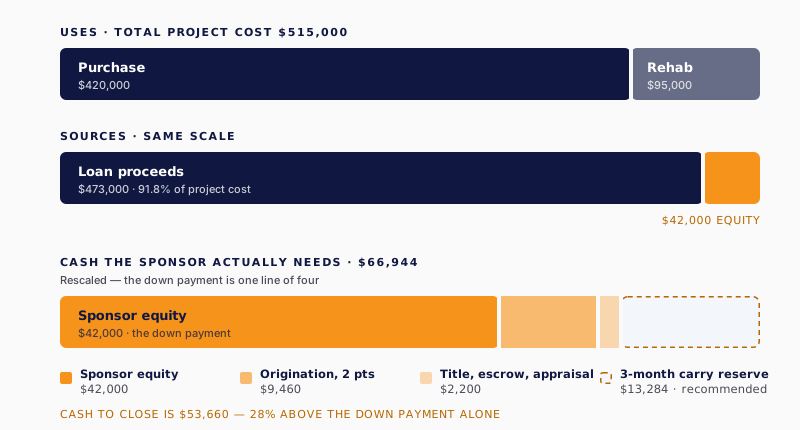
Note the two gaps. First, cash to close is 28% higher than the down payment, because points and third-party costs are real money on closing day. Second, the reserve. No lender forces you to hold three months of carry, and every sponsor who has had a project run long wishes they had. On this deal that is $13,284 — and a 90-day overrun costs $13,284, which is not a coincidence but the same arithmetic viewed twice.
There is no application fee at any point and no prepayment penalty, so nothing in that stack is a fee for the privilege of asking. But the money that does move is the money you need in the bank, sourced and seasoned, before an underwriter can clear the file.
Experience moves the number more than negotiation does
The single largest determinant of your down payment is not your credit score, your negotiating skill, or which lender you call. It is how many flips you have closed in the last 36 months.
| Tier | Rate from | Loan-to-cost | Rehab funded | Loan on this deal | Your equity |
|---|---|---|---|---|---|
| Tier 1 — 3+ flips | 8.99% | 92.5% | 100% | $473,000 | $42,000 (8.2%) |
| Tier 2 — 1–2 flips | 9.5% | 85% | 95%, 5% holdback | $437,750 | $77,250 (15.0%) |
| First-timer + licensed GC | 9.99% | 80% | 90%, 10% holdback | $412,000 | $103,000 (20.0%) |
Add points and closing costs and the all-in cash to close runs about $53,660, $88,205, and $113,440 across the three tiers. The first-timer needs 2.1 times the capital of the veteran to do the identical deal.
Two things follow, and both are more actionable than shopping for a lender who will pretend otherwise.
Your third closed flip is worth more than any rate you can negotiate. Moving from first-timer to tier one on this deal frees $61,000 of capital and drops the rate a full point. Nothing in a term-sheet negotiation is worth $61,000.
Underwrite your first two deals to survive their own cost of capital. If a deal only works at tier-one leverage and you are a first-timer, it is not a deal you can do yet. Bring a licensed GC, take the 80% tier, buy something with enough margin to carry it, and get the track record that changes the terms.
What a real 100% structure looks like
Everything above describes the standard program, which is what most borrowers get and what most of the market offers. There is a second structure, and because we now run one it would be dishonest to leave it out of an article named after it.
PML’s 100% LTC program funds 100% of the purchase price and 100% of the rehab budget. No cash down payment. Applying the test from the top of this article — what secures the part you did not pay for? — the answer here is not a lien on something else. It is two things:
- A hard cap at 75% of after-repair value. The loan is simultaneously limited to three-quarters of the exit, so the lender’s basis never exceeds it. This is the one that does the work.
- A much narrower borrower. 720+ FICO against a 600 floor on the standard program, 30+ months of rehab experience, five or more verified like-for-like transactions, residence in the market being invested in, and liquid reserves equal to 10% of the loan amount.
Zero down is not a concession you negotiate. It is what happens when your cost lands at or under 75% of the exit.The whole program, in one line
That second cap is why the headline is honest rather than promotional. Take the worked deal above — $420,000 purchase, $95,000 rehab, $640,000 ARV. Total cost is $515,000; 75% of ARV is $480,000. Under the 100% LTC program the ARV cap binds first and the sponsor still brings $35,000. Buy the same house at $400,000 with an $80,000 budget instead, and cost lands exactly at $480,000 — both caps allow it, and the deal closes at zero down.
So the lever is the purchase price, not the lender. Work backwards: 75% of a defensible ARV, minus your rehab budget, is the highest price at which the whole deal funds. That is the same discipline the 70% rule teaches, with the threshold moved five points and the reward changed from margin to leverage.
The equity requirement does not disappear either — it converts. Instead of wiring 10% at closing you must hold 10% of the loan amount liquid, separate from closing and rehab funds, for the life of the project. You keep the money. You just cannot spend it.
Two limits worth knowing before you plan around it. Loans cap at $750,000 in all states and $1,500,000 in California, with total borrower exposure capped at $6,000,000, on a 12-month term with extensions available. And the program is purchase-plus-rehab only — no refinance, no cash-out, no gut renovation, no ground-up, no rural — on light-to-medium scopes in metro and suburban locations.
If you do not clear those gates, the rest of this article is your path, and the next section prices it.
Four ways to close the gap, priced
Say you have the deal and are $42,000 short. Every route to filling that gap has a cost, and putting them on the same six-month basis makes the comparison brutal and clear.
| Source | Terms | 6-month cost | Annualised |
|---|---|---|---|
| Your own cash | — | Opportunity cost only | — |
| Seller carry-back second | 8%, lender consent required | $1,680 | ~8% |
| Draw on a facility | 8.99% against existing project equity | $1,888 | ~9% |
| Gap funder | 14% plus 2 points | $3,780 | ~18% |
| 50/50 equity partner | Half the profit | $24,896 | ~118% |
The last row is the one that should stop you. Handing half the profit to a partner who funds $42,000 costs $24,896 on this deal — roughly 118% annualised on their money. Investors reach for equity partners because there is no monthly payment and no personal liability, and both of those are genuine benefits. But price it honestly: an equity partner is the most expensive capital in the stack by a factor of six.
Two fair caveats. An equity partner also absorbs half the downside, which debt does not — if the deal loses $30,000, you lose $15,000 instead of $30,000 plus the gap loan. And on your first deal, a partner may be the only route that exists. Both are true. Neither makes 118% cheap; they make it a considered purchase rather than a default.
If you are running multiple projects, the second and third rows deserve a hard look. A cross-collateralized facility lets you draw against equity trapped in a project you already own, at your loan rate rather than at a gap funder’s. That is the closest thing to genuine zero-down that exists in this business, and it is available precisely because you already put cash into the last three deals.
What lenders will and will not allow
Before you plan a structure, know the four rules that govern it. Violating one of them does not get you a worse rate — it gets the loan pulled.
- Junior liens require consent. A seller carry-back or a secured gap loan recorded behind the first is an additional encumbrance. Most loan documents prohibit it without written approval, and on a carve-out guaranty an unpermitted lien is a springing-recourse trigger. See recourse vs non-recourse for what that actually costs. Ask first; consent is often granted, and it is never granted retroactively.
- Funds must be sourced and seasoned. Underwriting will trace your down payment. Money that appears three days before closing needs an explanation, and “a partner is wiring it” is an explanation that changes the structure of the file rather than ending the question.
- Undisclosed debt is a misrepresentation problem, not a paperwork problem. Funding the down payment on cards or an unsecured business line is legal; concealing it in the application is fraud, and it is the single most common way a first-time borrower turns a fixable issue into a dead file — and, on a guaranteed loan, into personal liability.
- Reserves get verified. Whatever the tier, an underwriter is looking for liquidity behind the sponsor. Spending every available dollar on the down payment weakens the file even when the down payment itself clears.
None of this is designed to make the deal harder. It is designed so that the sponsor still has capital on the day the foundation comes back worse than expected — which is the day the whole structure is actually tested. Send us the deal and the tier you are in and we will quote the real number, including which of the three caps binds, before you spend a dollar on diligence.
Glossary
The loan amount as a percentage of total project cost — purchase price plus rehab budget. Up to 92.5% for tier-one sponsors.
The acquisition portion of the loan as a percentage of the purchase price, capped at 90%. Frequently the binding constraint on light-rehab deals.
Total loan as a percentage of the appraised after-repair value, capped at 75%. The constraint that binds when the ARV assumption is aggressive, and the one that reveals itself latest.
The portion of the rehab budget the borrower funds rather than the lender. Zero at tier one, 5% at tier two, 10% for first-timers — carried by the sponsor on a rolling basis.
Everything due on closing day: sponsor equity, origination points, and third-party costs. Typically about 28% more than the down payment alone.
Short-term capital covering the difference between the senior loan and total project cost. Usually secured behind the first lien, which means it needs the senior lender’s written consent.
A note held by the seller for part of the purchase price. Cheap capital when the senior lender permits it, and an unpermitted encumbrance when it does not.
Funds whose origin is documented and which have been in the borrower’s account long enough to verify. The standard applied to down payments and reserves in underwriting.
Frequently asked questions
Can I get a loan with no money down?
On the standard program, no. Three caps run at once — 92.5% of project cost, 90% of purchase price, 75% of ARV — and your loan is the lowest, so a tier-one sponsor brings roughly 8% of project cost and a first-timer closer to 20%.
There is a separate structure with no cash down payment: the 100% LTC program funds the full purchase price and full rehab budget — but caps the loan at 75% of ARV. You reach zero down only when total project cost lands at or under three-quarters of the exit value.
What is the catch with 100% LTC?
The conditions are stated rather than hidden. The loan is capped at 75% of ARV at the same time as it covers 100% of cost — so you close at zero down only when total project cost sits at or under three-quarters of the exit. Eligibility is narrow: 720+ FICO, 30+ months of rehab experience, 5+ verified like-for-like transactions, residence in the market you are investing in, and liquid reserves equal to 10% of the loan held separate from closing and rehab funds. Loans cap at $750,000 ($1.5M in California), and it is purchase plus rehab only. Full terms on the program page.
What does ‘100% of rehab’ mean?
The lender funds the entire construction budget through draws as line items complete, rather than you paying for work and being reimbursed at the end. PML funds approved draws weekly, wired inside 48 hours, on tier-one files. Lower tiers carry a holdback — 5% at tier two, 10% for first-timers — which you fund on a rolling basis on top of a larger down payment.
Which cap decides my loan amount?
Three run at once and your loan is the lowest: up to 92.5% of project cost, up to 90% of purchase price on the acquisition portion, and up to 75% of appraised ARV. Which binds is a property of the deal — light rehab and thin margin hits the purchase cap, heavy rehab with strong exit value hits the cost cap, and an aggressive ARV assumption hits the ARV cap. The last is the dangerous one, because it only appears when the appraisal lands.
How much cash do I actually need?
More than the down payment. On a $420,000 purchase with $95,000 of rehab, a tier-one sponsor’s equity is $42,000, origination at 2 points adds $9,460, and third-party costs (title, escrow, recording, appraisal) add about $2,200 — $53,660 cash to close. A prudent three-month carry reserve of $13,284 brings all-in capital to $66,944. There is no application fee at any point.
How much more does a first-timer bring?
About 2.1 times the capital on the same deal. Tier one (3+ closed flips in 36 months) brings roughly $42,000 at 8.99%. One or two flips brings about $77,250 at 9.5%. A first-timer with a licensed GC brings about $103,000 at 9.99%. Closing your third deal frees more capital than any rate negotiation on a term sheet ever will.
What is the cheapest way to cover the gap?
On a $42,000 gap held six months: a seller carry-back at 8% costs about $1,680; a draw against equity in an existing project at 8.99% costs about $1,888; a gap funder at 14% plus 2 points costs about $3,780; a 50/50 equity partner costs about $24,896 — roughly 118% annualised. A partner does absorb half of any loss, which debt does not, but it is the most expensive capital in the stack by a factor of six.
Can I use a second loan for the down payment?
Sometimes, and always with written lender consent. A seller carry-back or secured gap loan recorded behind the first is an additional encumbrance, and most loan documents prohibit it without approval. On a carve-out guaranty, an unpermitted lien can be a springing recourse trigger that converts the whole loan. Consent is often granted when you ask in advance — and never granted retroactively.
Do lenders check where my down payment came from?
Yes. Underwriting traces the down payment to a documented source and expects it to have sat in the account long enough to verify — that is what sourced and seasoned means. Money appearing days before closing needs an explanation. Funding a down payment with credit lines is not itself prohibited, but concealing that debt on the application is misrepresentation, and on a guaranteed loan that is a personal-liability question rather than a paperwork one. Reserves behind the down payment get verified too.
Want the real number on your deal?
Send us the purchase price, the rehab budget, and your closed-deal count. We will tell you which cap binds on the standard program, what you bring to the table, and whether the deal clears our 100% LTC structure at zero down.