 Private Money Lenders
Read time: 30 seconds
- Cross-collateralization means one loan is secured by more than one property. Every asset in the pool backs the whole balance, not just its own slice.
- The release price is the entire negotiation. It is what you must pay to get one property out of the lien so you can sell it clean — typically 105% to 120% of that property’s allocated loan amount.
- The premium above 100% exists to deleverage the remaining pool. You sell your best asset first; the lender is left holding the weakest, so each release pays down more than the asset borrowed.
- Cross-default usually rides along. A default on one project is a default on all of them. That is the real risk, and it is separate from the collateral question.
- What you get back is speed and cost. One closing, one origination, one set of docs, and the ability to pull equity out of a finished project to seed the next acquisition without a new loan.
- PML’s facility starts at three concurrent projects, runs $1.5M to $25M, and prices 25 to 50 basis points inside single-asset fix-and-flip pricing.
What cross-collateralization actually is
A normal investment loan is a closed loop: one property, one lien, one payoff. Cross-collateralization breaks the loop. One loan is secured by two or more properties, and every property in the pool stands behind the entire outstanding balance — not just the portion of the money that went into it.
That is the whole concept, and the consequence is the part people underestimate. If you have three flips on one cross-collateralized facility and one of them goes badly wrong, the lender’s remedy is not limited to that property. The lien on the other two is live, securing the same debt, whether or not those projects are performing.
In exchange you get something single-asset lending cannot offer: the pool’s equity is one balance sheet. Strong assets carry weak ones. A project with $180,000 of trapped equity can support a draw for an acquisition down the street without a new appraisal cycle, a new closing, and a new set of loan documents.
Two terms get used interchangeably and should not be:
- Cross-collateralization is about security. Each property’s lien secures the whole debt.
- Cross-default is about trigger. An event of default on one obligation is an event of default on all of them.
They usually travel together, but they are separate clauses and they can be negotiated separately. Read both. A facility can be cross-collateralized without being aggressively cross-defaulted, and the difference shows up on the worst day of the deal.
The two shapes it takes
Cross-collateralization shows up in investor lending in two distinct forms, and they solve different problems.
The blanket loan
One loan, funded once, secured by a portfolio you already own. Common on stabilized rental portfolios: fifteen doors across nine parcels financed under a single note rather than nine separate DSCR loans. The appeal is administrative — one payment, one maturity, one servicer — and pricing that reflects a diversified pool rather than nine small-balance files.
The facility
A committed line you draw against as you acquire, secured by whatever is currently in the pool. Properties enter as you buy them and leave as you sell them and pay the release price. This is the structure built for active flippers and builders, because it matches the actual rhythm of the business: you are always mid-cycle on three or four assets, never on exactly one.
The rest of this article is about the facility, because that is where the mechanics are least understood and the money is largest.
Release prices: the clause that decides everything
If the pool secures the whole balance, how do you ever sell a single property? Through the partial release clause, and it is the single most important paragraph in the loan documents.
Two definitions do the work:
- Allocated loan amount (ALA). The portion of the facility balance assigned to a given property — usually what was drawn to acquire and rehab it.
- Release price. What you must pay to have the lien released from that property at its sale. Almost never equal to the ALA. Market range is 105% to 120% of ALA.
The premium above 100% is not a fee. It is the mechanism that keeps the lender’s position from decaying as the pool shrinks.
You will always sell the easiest asset first. The release premium is the lender’s answer to that fact.Why release price exceeds allocated loan amount
Think about the order in which properties actually leave a pool. The clean rehab in the strong submarket finishes first and sells fast. The problem asset — the one with the foundation surprise, the permit fight, the tired comps — sells last, if at all. If each release paid down exactly the ALA, the lender would watch its collateral quality erode with every closing while its loan-to-value on what remains climbed. Charging 110% or 115% means every sale deleverages the remaining pool, so the last property standing is not carrying an underwater balance.
What to negotiate here, in order of how much it is worth:
- The release percentage itself. The difference between 110% and 120% on a $460,000 ALA is $46,000 of cash at one closing.
- Whether ALAs are set at close or reset later. You want them fixed at draw, not recalculated at the lender’s discretion when you ask for a release.
- A minimum-remaining-collateral test. Some facilities allow release only if the remaining pool clears a loan-to-value threshold. Know the test before you rely on being able to sell.
- Release timing. Whether the lender will issue the release at closing through escrow, or requires funds to clear first. The second version can cost you a day and a buyer’s patience.
Three flips on one facility, worked
A sponsor is running three concurrent projects. Under single-asset lending that is three loans, three closings, three sets of third-party costs. On a facility it is one file.
| Asset | Purchase | Rehab budget | Total cost | Allocated loan (ALA) |
|---|---|---|---|---|
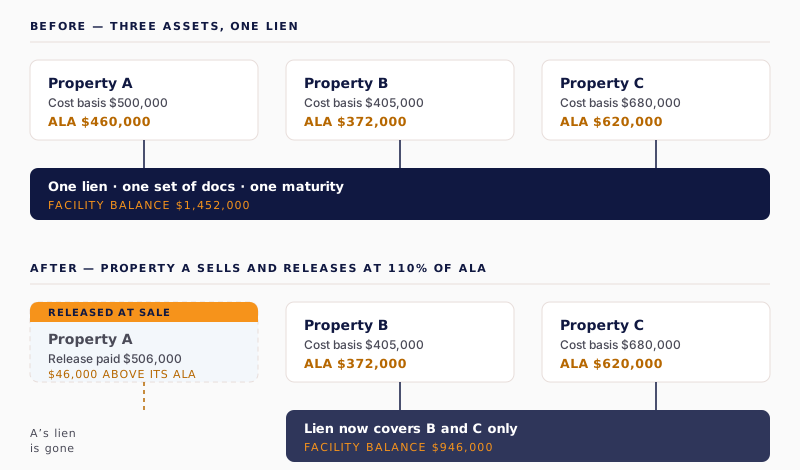
| Property A | $420,000 | $80,000 | $500,000 | $460,000 |
| Property B | $310,000 | $95,000 | $405,000 | $372,000 |
| Property C | $540,000 | $140,000 | $680,000 | $620,000 |
| Facility total | $1,270,000 | $315,000 | $1,585,000 | $1,452,000 |
Property A finishes first and sells for $700,000. Here is what actually happens at that closing, with a release price set at 110% of ALA:
Now look at what happened to the facility. The balance fell by $506,000 — $46,000 more than Property A ever borrowed. The remaining balance is $946,000 against Properties B and C, whose combined cost basis is $1,085,000. The lender’s position on the remaining pool improved, which is exactly what the premium was for.
Change one variable and watch the sponsor’s cash move:
| Release price | Paid at closing | Cash to sponsor | Facility balance after |
|---|---|---|---|
| 105% of ALA | $483,000 | $175,000 | $969,000 |
| 110% of ALA | $506,000 | $152,000 | $946,000 |
| 115% of ALA | $529,000 | $129,000 | $923,000 |
| 120% of ALA | $552,000 | $106,000 | $900,000 |
Sixty-nine thousand dollars of working capital separates the top row from the bottom, on one closing, decided by a percentage buried in the release provision. If you are negotiating a facility and you only fight for one number, fight for this one.
The risk, stated honestly
The efficiency is real and so is the exposure. Four things go wrong with cross-collateralized debt, and none of them are hypothetical.
One bad project contaminates the good ones. This is the headline risk. Under cross-default, a payment failure or covenant breach on Property C is a default on the facility — and the lender’s remedies run against A and B too. On single-asset loans, a failed project is a contained loss. On a facility, it is a portfolio event.
A stalled asset can block a release. If the facility carries a minimum-remaining-collateral test, and Property C’s value has slipped, you may find yourself unable to release Property A even with a signed purchase contract in hand — because the pool that remains would fail the test. Ask what happens in that scenario before you sign, not during escrow.
Everything matures at once. Three separate 12-month loans mature on three separate dates. A facility has one maturity, and every asset still in the pool has to be sold, refinanced, or extended by that date. Concentrated maturity is concentrated risk.
Refinancing one asset out is harder. Deciding to keep Property B as a rental means getting a DSCR refinance to pay a release price rather than a simple payoff — and the new lender needs a clean release commitment from the facility lender before it will fund. Coordinated, but not automatic.
The mitigations are contractual and worth the legal spend: negotiate cure periods, push for release triggers that are objective rather than discretionary, and cap the cross-default so that an immaterial breach on one asset does not accelerate the whole line.
When a facility beats single-asset loans
The structure earns its keep at a specific point in a sponsor’s growth, and not before.
| Dimension | Three single-asset loans | One facility |
|---|---|---|
| Closings | Three — each with its own title, escrow, and recording cost | One, plus a short joinder as each asset enters |
| Third-party cost | Roughly $1,800 to $2,400 per closing | Paid once, then per-asset title only |
| Rate | Standard single-asset pricing | 25 to 50 bps inside it |
| Speed on deal four | New application, new file, new close | Draw against the committed line |
| Equity mobility | Trapped until each asset sells | Pull against pool equity to seed the next buy |
| Exit friction | Simple payoff | Release price and lender release letter |
| Downside | Contained to one asset | Cross-default reaches the pool |
It fits when you are consistently running three or more projects at once, your acquisitions are competitive enough that closing speed wins deals, and your equity is the binding constraint on volume rather than deal flow.
It does not fit when you do two deals a year, when your projects vary wildly in risk profile so that one bad one would be catastrophic, or when you intend to keep some assets long-term and sell others — that mixed exit plan fights the structure.
What PML’s facility looks like
Concrete terms, so you can size the decision:
Run the savings on the $1,452,000 example above. Twenty-five to fifty basis points is $3,630 to $7,260 a year, or roughly $2,700 to $5,400 across a typical nine-month average hold. Two closings avoided at $1,800 to $2,400 each is another $3,600 to $4,800. Call it $6,000 to $10,000 on a three-asset cycle — before counting the acquisitions you win because you could close in days rather than starting a new file.
The reason the rate is inside single-asset pricing rather than outside it is diversification. Three properties in one file is less concentration risk for the lender than three separate small-balance loans, and that reduction gets returned as pricing. It is the same logic that produces experience-tier pricing: demonstrated, measurable risk reduction comes back to the borrower as basis points.
The honest counsel: do not take a facility because it is available. Take it when you are running enough concurrent volume that three closings a quarter is a real drag and trapped equity is genuinely holding back your next acquisition. Below that, single-asset loans keep your downside contained, and containment is worth more than 40 basis points. Tell us how many projects you are carrying and we will tell you honestly which side of that line you are on.
Glossary
A structure in which one loan is secured by two or more properties, with each property’s lien standing behind the entire outstanding balance rather than only the amount drawn against it.
A clause making an event of default on one obligation an event of default on all others. Separate from cross-collateralization, though the two usually appear together.
A single loan secured by a portfolio of properties already owned, typically used on stabilized rentals for administrative simplicity and portfolio-level pricing.
A committed line drawn against as assets are acquired and released as they are sold. Built for sponsors running continuous concurrent projects.
The share of the facility balance assigned to a specific property, usually the amount drawn to acquire and rehab it. The base for calculating that property’s release price.
The payment required to remove the lien from one property so it can be sold clear. Typically 105% to 120% of the allocated loan amount; the premium deleverages the remaining pool.
The loan provision governing how and when individual properties may leave the collateral pool, including price, timing, and any remaining-collateral tests.
A condition requiring the properties left in the pool after a release to satisfy a stated loan-to-value or coverage threshold. Can block a release even when a sale is under contract.
Frequently asked questions
What does cross-collateralized mean?
One loan is secured by two or more properties, and each property’s lien stands behind the entire outstanding balance — not just the money drawn against that property. If the loan defaults, the lender’s remedies reach every asset in the pool, including performing ones. In exchange, the pool’s equity works as one balance sheet, so a finished project can fund the next acquisition without a new loan.
How do I sell one property out of the pool?
Through the partial release clause. You pay a release price at closing and the lender issues a release of its lien so the property transfers clear. The release price is a percentage of that property’s allocated loan amount — typically 105% to 120%. Some facilities also impose a minimum-remaining-collateral test, meaning what is left in the pool must still clear a loan-to-value threshold after the release.
Why is the release price more than the ALA?
Because sponsors sell the easiest asset first. The clean project in the strong submarket closes quickly; the problem asset sells last. If each release paid down only the allocated loan amount, the lender’s collateral quality would erode with every closing while leverage on the remainder climbed. Charging 110% or 115% means each sale deleverages the remaining pool. It is a structural mechanism, not a fee.
Cross-collateralization vs cross-default?
Cross-collateralization is about security — each property’s lien secures the whole debt. Cross-default is about trigger — a default on one obligation becomes a default on all. They usually travel together but are separate clauses and can be negotiated separately. Cross-default is generally the more dangerous half, because it turns one failed project into a portfolio event.
Can I cross-collateralize multiple flips with PML?
Yes. PML offers cross-collateralized facility loans for sponsors running three or more concurrent projects — one closing, one origination fee, one rate, one set of legal docs, and the ability to pull funds against any one project’s equity to seed the next acquisition. Facility size starts at $1.5M and scales to $25M. Rates run 25 to 50 basis points inside our single-asset fix and flip pricing, because the diversification reduces our concentration risk.
What if one project in the pool fails?
Under a cross-defaulted facility, a default on one project is a default on the whole line, and the lender’s remedies reach every property in the pool regardless of how the others are performing. That is the central risk, and it is why single-asset loans still make sense at low volume. Mitigations are contractual: negotiate cure periods, push for objective rather than discretionary release triggers, and cap cross-default so an immaterial breach does not accelerate the facility.
Does a facility actually save money?
On a ~$1.45M three-asset cycle: 25 to 50 bps is roughly $3,600 to $7,300 a year, or about $2,700 to $5,400 across a typical nine-month hold. Two avoided closings at $1,800 to $2,400 each adds $3,600 to $4,800. Call it $6,000 to $10,000 per cycle — before counting the acquisitions you win because you could draw on a committed line instead of opening a new file.
When should I not use a facility?
When you close a couple of deals a year; when your projects vary widely in risk so one bad outcome would be catastrophic across the pool; or when you plan to hold some assets and sell others, because a mixed exit plan fights the structure. Below meaningful concurrent volume, single-asset loans keep downside contained to one property — and containment is usually worth more than 40 basis points.
Running three or more projects at once?
Tell us how many you are carrying and what your equity is doing. We will quote the facility against your actual cycle — and tell you plainly if single-asset loans still serve you better.