 Private Money Lenders
Read time: 30 seconds
- One point = 1% of the loan, paid once at closing. On a $320K loan, a point is $3,200. Hard money runs 1–3 points.
- Points buy a lower rate — but you pay them up front and never get them back. The rate savings accrue slowly, monthly.
- Break-even = extra up-front cost ÷ monthly savings. Pay $4,800 more in points to save $267/mo, and you break even at ~18 months.
- Hold under the break-even and low-points wins. Most flips and bridges (4–12 months) are well under it, so buying down the rate usually loses.
- APR lies on short loans. It annualizes one-time points over a few months of holding and inflates the number. Compare total dollar cost over your real timeline.
What a point actually buys
An origination point is a one-time fee equal to 1% of the loan amount, paid at closing. On a $320,000 loan, one point is $3,200. It is the lender's compensation for originating and funding the loan, and on hard money it typically runs one to three points.
The rate is the other lever. It is the annualized cost of carrying the borrowed money, charged monthly. On a hard money loan, which is almost always interest-only, the monthly payment is simply the loan balance times the annual rate divided by twelve. Lower the rate and you lower every monthly payment for the life of the loan.
The two are linked by a trade the lender offers at quote time: pay an extra point up front and the lender will shave the rate; pay fewer points and the rate goes up. A typical menu on the same deal might be 0.5 points at 10.5%, or 2 points at 9.5%. Both are real quotes for the same loan. Neither is "better" in the abstract. The one that costs you less depends on a single number you control — your hold period.
The crucial asymmetry: points are sunk the moment you close. The rate savings arrive in monthly drips. Pay off the loan in month four and you have paid every dollar of the points but collected only four months of rate savings. That asymmetry is the entire decision.
The trade-off, stated precisely
Compare two quotes on a $320,000 interest-only loan:
Option B costs $4,800 more up front ($6,400 − $1,600) but saves $267 every month ($2,800 − $2,533). Option B is the "buy down the rate" choice. Whether it is the right choice is now a pure arithmetic question: how many months of $267 savings do you need to recover the extra $4,800?
The break-even calculation
The formula is one line:
Break-even months = extra up-front cost ÷ monthly savings.The only formula you need here
Plug in the numbers:
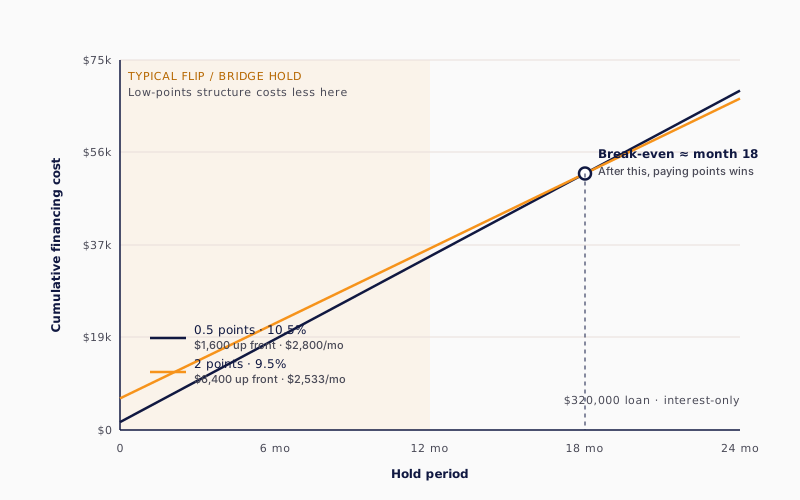
Eighteen months is the hinge. Hold the loan less than 18 months and Option A (low points) costs less in total. Hold it more than 18 months and Option B (rate buy-down) wins. There is no judgment call left — only the question of where your actual hold lands relative to that line.
Why hold period flips the answer
Run both options across realistic hold periods and the pattern is stark:
| Hold | Option A (0.5pt / 10.5%) | Option B (2pt / 9.5%) | Cheaper |
|---|---|---|---|
| 4 months | $12,800 | $16,533 | A by $3,733 |
| 8 months | $24,000 | $26,667 | A by $2,667 |
| 12 months | $35,200 | $36,800 | A by $1,600 |
| 18 months | $52,000 | $52,000 | Tie |
| 24 months | $68,800 | $67,200 | B by $1,600 |
For the overwhelming majority of hard money use cases — a 4-month flip, an 8-month BRRRR acquisition, a 12-month bridge — the loan is paid off long before the break-even. Buying down the rate with points is a losing trade on a short hold, and not by a little: on a 4-month flip, paying for the lower rate costs you nearly $3,700 more, not less.
The intuition runs the opposite of most people's instinct. A lower rate feels like the disciplined, frugal choice. On a short-term loan it is usually the expensive one, because you are pre-paying for savings you will not be around long enough to collect.
When paying points does win
The rate buy-down is not always wrong. It wins in exactly the situations where the hold is long enough to clear the break-even:
- Long ground-up construction. An 18–24 month build can run past the break-even, especially if the interest reserve is funded against the rate. On a long construction loan, a lower rate also stretches the interest reserve further.
- Extended bridge or lease-up holds. A bridge loan on a property that needs 18 months to stabilize before a permanent refinance can justify buying down the rate.
- When the rate buy-down is steep. If a lender offers an unusually large rate cut per point — say a full point of rate for one point of cost — the break-even shortens and the math can favor points even on a 12-month hold. Always recompute; the 18-month figure above is specific to a $267 monthly saving.
The discipline is the same in every case: do not decide by feel. Compute the break-even, compare it to your honest hold period, and let the number choose.
Why APR misleads on short loans
You will see hard money loans quoted with an APR far above the note rate, and it scares borrowers unnecessarily. APR annualizes all up-front costs — points included — over the life of the loan, as if you held it the full term. On a short-term loan, that math is distorting rather than clarifying.
Here is the trap: you pay points exactly once. But APR spreads that one-time cost across however many months the calculation assumes you hold. The shorter the hold, the higher the APR looks, even though the dollar cost of the points has not changed at all.
For any short-term investor loan, ignore APR as the comparison metric and compute total dollar cost over your actual hold, the way the table above does. This is the same lesson the Dutch vs non-Dutch interest article makes from the interest side: the headline rate is not the cost. The structure and the timeline are the cost.
What is actually negotiable
Points are more negotiable than rate on hard money, and knowing your hold period tells you which lever to pull. Three things move the quote:
- Loan size. A lender's fixed cost to originate is spread over more principal on a larger loan, so points often come down as loan amount rises. On a $1M loan, shaving half a point is $5,000 of real negotiating room.
- Repeat borrowing and low leverage. A known borrower with a clean track record and a conservative loan-to-cost is a lower-risk file. That risk reduction is frequently returned as fewer points.
- The points-for-rate trade itself. Because the lender is largely indifferent across the trade-off (they price to a target yield), you can usually ask to move along it. If you are running a short flip, push points down and accept the higher rate — you will never carry the loan long enough for the rate to matter.
One related lever: the prepayment penalty. On a short hold you want low points and no prepay penalty, because your whole plan is to pay off fast. On a long hold you can sometimes trade a prepay penalty (which you do not intend to trigger) for lower points or rate. Match the fee structure to your exit. Send us the deal and your timeline and we will quote the structure that costs you the least over your actual hold — not the one with the lowest headline rate.
Glossary
A one-time fee equal to 1% of the loan amount, paid at closing. Compensates the lender for originating and funding the loan. Hard money typically carries 1–3 points.
The stated annual interest rate on the loan, charged monthly. On an interest-only hard money loan, monthly payment = balance × rate ÷ 12.
The number of months you must hold a loan for the monthly savings of a lower rate to recover the extra up-front cost of the points that bought it. Extra cost ÷ monthly savings.
The annualized total cost of a loan including up-front fees and points spread across the term. Misleading on short-term loans, where one-time points distort the annualized figure.
Paying additional points up front to secure a lower interest rate. Pays off only when the hold period exceeds the break-even.
A fee charged for paying a loan off before a set date. A back-end cost; the mirror image of points, which are a front-end cost. Avoid on short holds.
Frequently asked questions
What is an origination point?
A one-time fee equal to one percent of the loan amount, paid at closing. On a $320,000 loan, one point is $3,200. Points compensate the lender for originating and funding the loan and are charged in addition to, or in trade against, the interest rate. Hard money loans typically carry one to three points. Points are paid up front and not recovered if you pay off early.
Should I pay points to lower my rate?
Only if you will hold the loan past the break-even. Paying extra points to buy down the rate pays off when the monthly interest savings eventually exceed the extra up-front cost. On most fix-and-flip and bridge loans held under 12 months, the break-even is longer than the hold, so buying down the rate loses money. On long construction or extended bridge holds it can win. Run the break-even first.
How do you calculate the break-even?
Divide the extra up-front cost of the higher-point option by the monthly interest savings it buys. The result is the months you must hold to break even. Paying $4,800 more in points to save $267 a month breaks even at about 18 months. Hold less than that and the lower-point, higher-rate option is cheaper in total.
Does paying points lower my monthly payment?
Yes, modestly. Points buy a lower rate, and on an interest-only loan a lower rate lowers the monthly payment. But the monthly savings are small relative to the up-front cost. A full point on a $320,000 loan costs $3,200 and might lower the rate half a percent, saving roughly $133 a month — about two years to recover the point.
Why does APR overstate short-term loan cost?
APR annualizes up-front costs, including points, over the loan term as if you held it fully. On a short hold you pay points once but APR spreads them across only a few months, which inflates the figure. A loan with 2 points held 4 months shows a far higher APR than the same loan held 24 months, even though the dollar cost is identical. Compare total dollar cost over your actual timeline.
Are points negotiable?
Often, more so than rate. Points tend to come down for repeat borrowers, low-leverage deals, and larger loan amounts where the lender's fixed origination cost spreads over more principal. The most common move is trading along the points-for-rate curve. Knowing your hold period tells you which way to push. Ask us to structure the quote around your exit.
Points or a prepayment penalty — which is better?
They solve different problems. Points are an up-front cost; a prepayment penalty is a back-end cost that only applies if you pay off early. On a short-hold flip, want low points and no prepay penalty. On a longer hold, you can tolerate a prepay penalty in exchange for lower points or rate. Match the fee structure to your exit timing.
Want the structure that costs you the least?
Tell us the deal and your honest hold period. We will quote points and rate against your actual timeline — not a headline number designed to look good on paper.