 Private Money Lenders
Read time: 30 seconds
- Recourse answers one question: if the collateral does not cover the debt, what else can the lender reach? Full recourse reaches you. Non-recourse stops at the property.
- Almost no commercial loan is truly non-recourse. The market standard is non-recourse with carve-outs — a guaranty that sits dormant until you do one of a listed set of things.
- Short-term investor loans are full recourse nearly everywhere. Bridge, fix-and-flip, and ground-up construction are underwritten against a forecast value, not a proven one. PML is full recourse on all three.
- Non-recourse is a priced product, not a favor. On stabilized multi-family at $1M+ and 1.20x DSCR, PML prices non-recourse 25 to 50 basis points over the recourse quote.
- The carve-out list matters more than the label. A transfer or encumbrance clause can spring the entire loan to full recourse because you took gap funding — read that paragraph before you sign.
- State law decides what the guaranty is worth. Judicial versus non-judicial foreclosure and deficiency rules vary; consumer anti-deficiency protection generally does not extend to business-purpose investment loans.
What recourse actually means
Recourse is not a loan feature. It is the answer to a question that only matters if things go wrong: when the lender forecloses and the sale proceeds fall short of the payoff, whose money covers the gap?
Every secured loan starts the same way. You pledge the property; the lender records a lien; if you stop paying, the lender takes the property back and sells it. That much is true of a recourse loan and a non-recourse loan alike. The two structures diverge only at the moment the sale closes and the arithmetic comes up short.
Work an actual number. A sponsor borrows $780,000 against a value-add fourplex. The project stalls, the loan defaults, and the property sells at foreclosure for $640,000. Add accrued interest, default interest, legal fees, and the costs of sale, and the total owed at the moment of sale is $838,000.
That $198,000 is the deficiency, and recourse decides who eats it. Under a full-recourse loan, the lender may pursue a deficiency judgment against the guarantor personally — other real estate, brokerage accounts, business interests, future income, subject to whatever the state allows. Under a true non-recourse loan, the lender absorbs it. The borrower’s loss is capped at the equity and the deal.
Which is why non-recourse is never free. You have not removed the $198,000 of risk from the transaction. You have moved it onto the lender’s balance sheet, and the lender charges you for holding it.
The three structures, plainly
Term sheets use the word “recourse” loosely. There are really three structures in the market, and the middle one is where nearly all commercial lending actually lives.
| Structure | What the lender can reach | Who signs | Where you see it |
|---|---|---|---|
| Full recourse | The property, then the guarantor’s personal assets for any deficiency | Borrowing entity + sponsor personal guaranty | Fix-and-flip, bridge, ground-up construction, most small-balance commercial |
| Non-recourse with carve-outs | The property. The guarantor only on listed bad acts — and on some triggers, the whole loan | Borrowing entity + carve-out (“bad-boy”) guaranty | Stabilized multi-family, agency and CMBS-style permanent debt, larger commercial |
| True non-recourse | The property, and nothing else, in any circumstance | Borrowing entity only | Rare. Some institutional and retirement-account lending where the plan structure forbids a guaranty |
When a broker tells you a loan is non-recourse, the useful follow-up is not “are you sure?” It is “send me the carve-out schedule.” That schedule, not the label on the cover page, is the structure you are agreeing to.
Bad-boy carve-outs: where non-recourse ends
A carve-out guaranty is a personal guaranty that starts dormant. Sign it, and you have no exposure to a deficiency caused by a soft market, a bad lease-up, or a rate move. Trigger one of the listed acts and the guaranty wakes up.
The carve-outs themselves split into two very different tiers, and borrowers routinely miss the distinction because both appear in the same paragraph.
Loss carve-outs — you owe the damage
These make the guarantor liable for the losses caused by the act, not for the loan. Standard list:
- Fraud or intentional misrepresentation in the loan application, rent roll, or draw requests.
- Misapplication of funds — rents collected after default, insurance proceeds, condemnation awards, or security deposits diverted rather than applied to the loan.
- Physical waste — letting the asset deteriorate, stripping fixtures, deferring maintenance to the point of damage.
- Unpaid taxes and insurance that the lender has to advance.
- Environmental liability, usually carved out separately and often uncapped.
Springing recourse — the whole loan converts
These do not measure damage. They flip the entire loan to full recourse, retroactively, for the full outstanding balance. There are usually only three or four:
- Voluntary bankruptcy of the borrower, or a collusive involuntary filing.
- Unpermitted transfer of the property or of an interest in the borrowing entity above a stated threshold — which is how a partner buyout or a promote restructure trips a loan nobody thought was at risk.
- Unpermitted encumbrance — recording any additional lien. This is the one that catches investors most often: taking a gap-funding second, a mezzanine piece, or a contractor’s financing arrangement can convert a non-recourse loan to full recourse without a single missed payment.
- Breach of the single-purpose-entity covenants — commingling assets, taking on other business, or letting the entity guarantee someone else’s debt.
A non-recourse loan is a recourse loan with a list of things you promised not to do. Read the list.The whole article in one line
None of these triggers require bad faith. They require inattention. If you are running a non-recourse asset alongside a portfolio of recourse deals, the encumbrance and transfer clauses deserve a calendar reminder, not a skim.
Why short-term investor loans are almost always recourse
Ask a private lender for a non-recourse fix-and-flip loan and the answer is no — not as a negotiating posture, but because the collateral cannot support the structure. Three reasons, and they compound.
The value is a forecast, not a fact. A stabilized apartment building has a rent roll, a trailing twelve, and an occupancy history. A rehab has an after-repair value — an appraiser’s opinion of what the property will be worth after work that has not happened yet, sold into a market twelve months out. Non-recourse asks the lender to accept the property as the sole source of repayment. On a forecast, that is not a loan; it is equity at a debt return.
Construction risk is sponsor risk. On a draw-funded rehab or ground-up, the outcome depends on the sponsor’s execution: budget discipline, contractor management, permitting, timeline. Those are personal capabilities. A guaranty is how the lender prices exposure to them.
The loan is small and short. Negotiating a carve-out schedule, an SPE structure, and non-consolidation opinions costs real legal money. On a $380,000 loan held nine months, that cost exceeds the entire origination fee. The structure only pays for itself at institutional size.
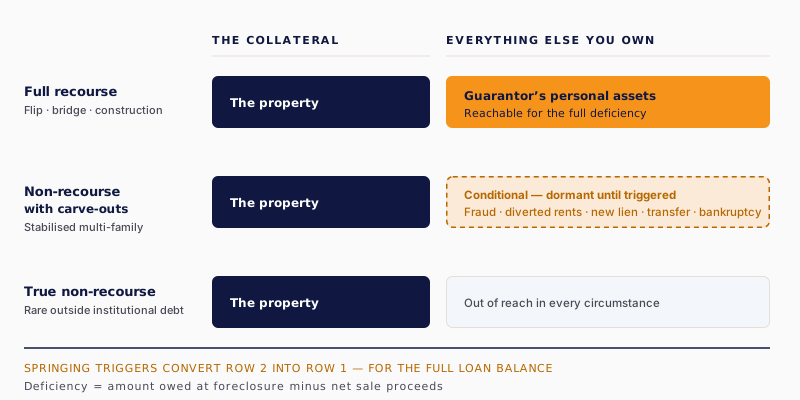
PML follows the market here and says so plainly: bridge, fix-and-flip, and construction loans are typically full recourse with a sponsor personal guaranty. Where non-recourse is available is the stabilized end of the book, and it comes with conditions.
What non-recourse actually costs
Non-recourse is available on PML’s stabilized multi-family track, and the terms are specific rather than aspirational:
Put that adjustment in dollars. On a $2,000,000 loan, 25 to 50 basis points is $5,000 to $10,000 a year in additional interest. Over a five-year term, $25,000 to $50,000 to move a $198,000-scale deficiency risk off your personal balance sheet and onto the lender’s.
Whether that is a good trade is a portfolio question, not a loan question. Two honest tests:
- Concentration. If this asset is 60% of your net worth, the guaranty is the whole ballgame and the premium is cheap insurance. If it is one of fourteen holdings, you are paying a spread to protect against a scenario your balance sheet already survives.
- Outside capital. If you are syndicating, your LPs and your key principal may have views about signing recourse paper that outrank the basis-point math entirely.
The reason the adjustment exists at all is loss severity, not default probability. Non-recourse does not make the borrower more likely to default. It makes each default cost the lender more, because the lender’s only recovery is the asset. That is what the 25 to 50 basis points buys.
State law decides what a guaranty is worth
A personal guaranty is only as strong as the collection remedy behind it, and that remedy is set by the state where the property sits. Three variables move it. None of this is legal advice — it is the vocabulary you need so your counsel’s answer makes sense.
- Judicial versus non-judicial foreclosure. Deed-of-trust states generally allow a trustee’s sale outside of court — faster and cheaper, but in several states electing that route limits or forfeits the right to pursue a deficiency. Mortgage states that require a court foreclosure are slower, and the deficiency claim usually survives.
- Deficiency limits. Some states bar deficiency judgments after a non-judicial sale. Others allow them but cap recovery at the difference between the debt and the property’s fair value as determined by the court, rather than the auction price — which can shrink a claim substantially.
- One-action and security-first rules. A handful of states, California most prominently, require the lender to exhaust the real property security before or instead of suing on the debt, which shapes how the guaranty has to be drafted to survive.
The consumer protections most investors have half-heard about — purchase-money anti-deficiency statutes and similar — generally attach to owner-occupied residential mortgages. A business-purpose loan to an LLC on a non-owner-occupied investment property is usually outside them. Do not assume you are carrying homeowner protections into an investment deal.
PML lends in all 50 states and routes the security instrument and closing to the correct structure for the jurisdiction. The practical implication for you is narrower than it sounds: the guaranty language is the lender’s problem to draft, and the state’s deficiency regime is your counsel’s to explain before you sign it.
Entities, key principals, and who actually signs
Nearly every investor loan is made to an entity — an LLC or LP that owns the property — and then guaranteed by a person. The entity is the borrower; the guaranty is what makes the loan underwritable.
That structure raises questions we field constantly:
- A brand-new LLC is fine. Underwriting looks through the entity to the sponsor behind it. What matters is the guarantor’s investor track record and liquidity, not the entity’s formation date. A new entity plus a first-time sponsor with no reserves is the combination that stalls, and the entity is not the reason.
- Syndications sign through the key principal. In a Reg D 506(b) or 506(c) structure, the KP or sponsor signs the guaranty on recourse loans. The LP investor pool is documented in the file but does not sign and is not guaranteeing anything.
- Multiple guarantors are usually joint and several. Two partners each signing a full guaranty does not mean each carries half. It means the lender may collect the entire deficiency from whichever one has assets, and that partner’s recovery from the other is a matter between them. If your partnership assumes a 50/50 split of downside, put that in your operating agreement — it is not in the loan documents.
- Larger recourse loans carry covenants. Above small-balance size, expect minimum net worth and minimum liquidity tests on the guarantor, tested at close and sometimes annually.
What is actually negotiable
Recourse itself is rarely negotiable on a short-term loan. The terms around it often are, and these are the four asks that get real answers:
- A capped guaranty. Rather than full exposure, a guaranty limited to a stated percentage of the original principal — 25% is a common landing spot on commercial paper. The lender keeps meaningful recourse; you convert an open-ended exposure into a known number.
- Burn-off provisions. The guaranty steps down or terminates once the asset hits a performance test: certificate of occupancy, a stabilized DSCR held for two consecutive quarters, or a lease-up threshold. Common on construction-to-perm and lease-up deals, and worth asking for whenever your business plan has a clean completion milestone.
- Several rather than joint and several. Where multiple sponsors sign, splitting liability by ownership percentage instead of leaving each fully exposed. Harder to get, but not unheard of when each guarantor is independently strong.
- Narrowing the springing triggers. On a carve-out guaranty, negotiating the transfer and encumbrance thresholds so that ordinary partnership activity — an estate transfer, a small member buyout, a permitted equipment lease — does not convert the loan.
What moves these is the same thing that moves points and rate: a clean file, a closed track record, and conservative leverage. Recourse is priced risk. Reduce the risk and the price follows. Send us the deal and the entity structure and we will tell you exactly what the guaranty looks like before you spend a dollar on diligence.
Glossary
The lender’s right to collect from assets beyond the pledged collateral if a foreclosure sale does not cover the debt. Full recourse means the guarantor’s personal assets are reachable.
The shortfall between what is owed at foreclosure — principal, accrued and default interest, fees, costs of sale — and what the sale actually recovers.
A court judgment for the deficiency amount against a borrower or guarantor. Availability and calculation vary by state and by whether the foreclosure was judicial.
A guaranty that is dormant unless the guarantor commits a listed act. Loss carve-outs create liability for the damage caused; springing carve-outs convert the entire loan to full recourse.
A carve-out trigger — typically voluntary bankruptcy, unpermitted transfer, or unpermitted additional lien — that makes the guarantor liable for the full outstanding loan balance rather than for measured damages.
A borrowing entity restricted to owning one asset and prohibited from other business or debt, used to isolate the collateral. Breaching SPE covenants is a common springing-recourse trigger.
The sponsor who signs the guaranty on behalf of a syndicated or multi-member borrowing entity. Passive LP investors do not sign and do not guarantee.
Each guarantor is independently liable for the entire obligation. The lender may collect the whole deficiency from one guarantor regardless of ownership split.
A provision reducing or terminating a guaranty once the asset meets a defined performance test, such as completion or a sustained debt service coverage ratio.
Frequently asked questions
What is the difference between recourse and non-recourse?
Both are secured by the property. They differ only when a foreclosure sale fails to cover the debt. Under full recourse, the lender may pursue the guarantor personally for the shortfall — other real estate, accounts, business interests. Under non-recourse, the lender’s recovery stops at the property and the lender absorbs the gap. Because that shifts loss severity onto the lender, non-recourse is priced higher and generally restricted to stabilized, cash-flowing assets above a minimum loan size.
Are fix-and-flip and bridge loans ever non-recourse?
Almost never, and the reason is the collateral rather than lender preference. A rehab or ground-up project is underwritten against an after-repair value that is a forecast, not an operating history, and the outcome turns on sponsor execution. Non-recourse asks the lender to treat the property as the sole source of repayment — that does not work on a forecast. At PML, bridge, fix-and-flip, and construction loans are typically full recourse with a sponsor personal guaranty.
What are bad-boy carve-outs?
A carve-out guaranty is a personal guaranty that stays dormant unless the guarantor commits a listed act. Loss carve-outs — fraud, misapplication of rents or insurance proceeds, physical waste, unpaid taxes — make the guarantor liable for the damage caused. Springing carve-outs — voluntary bankruptcy, unpermitted transfer, recording an additional lien — convert the entire loan to full recourse for the full outstanding balance. The springing list is the one that deserves a careful read.
Can gap funding trip a non-recourse loan?
Yes — and it is one of the most common ways investors lose non-recourse treatment. Most carve-out schedules include an unpermitted encumbrance trigger: recording any additional lien without lender consent springs the loan to full recourse. Gap funding, a mezzanine piece, or contractor financing secured by the property can all qualify. Read the encumbrance clause and get written consent before adding junior debt.
How much does non-recourse cost?
At PML, non-recourse is available on the stabilized multi-family track at qualifying size ($1M+ aggregate or per asset) and 1.20x+ DSCR, priced 25 to 50 basis points over the standard recourse quote. On a $2M loan that is roughly $5,000 to $10,000 a year. Value-add and repositioning deals are full recourse standard — lender risk on a repositioning loan is materially higher.
Can the lender take my house?
A guaranty makes you liable for the deficiency, and a judgment creditor may pursue assets the state allows it to reach. What is actually reachable depends on state law — homestead exemptions, whether a deficiency judgment is available after the type of foreclosure used, and how the court calculates the deficiency. Consumer anti-deficiency protections generally attach to owner-occupied residential mortgages and do not extend to a business-purpose loan made to an entity on an investment property. Ask your counsel about the specific state before signing.
If my LLC borrows, why do I sign personally?
Because the entity usually holds nothing but the property being financed — a loan to the entity alone would be economically identical to non-recourse. The guaranty is what lets the lender underwrite the sponsor, not just the collateral. It is also why a newly formed LLC is fine: underwriting looks through to the sponsor’s track record and liquidity. In a syndication, the key principal signs; the passive LP pool does not.
Can the guaranty be capped or burned off?
Sometimes. Four asks get real answers: a capped guaranty limited to a stated percentage of original principal; a burn-off that terminates it once the asset hits a performance test such as completion or a sustained DSCR; several rather than joint and several liability where multiple sponsors sign; and narrower springing triggers so ordinary partnership activity does not convert the loan. What moves them is what moves pricing — a clean file, a closed track record, conservative leverage. Ask us before you spend on diligence.
Want to know what the guaranty looks like before you spend on diligence?
Send us the deal and the entity structure. We will tell you whether it is recourse, what the guaranty covers, and what non-recourse would cost if the asset qualifies for it.