 Private Money Lenders
Read time: 30 seconds
- Wholetailing sits between wholesaling and flipping: buy the distressed house, do a clean-out and cosmetic pass, list it on the MLS in weeks rather than months.
- It exists because the 70% rule makes you walk from houses that are not actually bad deals — just bad flips.
- Same house, same $332,000 purchase, same $33,200 of equity: the wholetail nets $45,358 in two months; forcing a flip nets $40,634 in six.
- Per month of capital deployed that is $22,679 against $6,772 — 3.3x, and the flip carries six months of execution risk the wholetail never touches.
- Your buyer pool is the whole risk. A house that will not pass a lender’s condition requirements sells to cash and conventional-with-reserves buyers only.
- Financing detail that matters more than rate: a bridge loan’s three-month minimum interest costs $2,726 more than the fix-and-flip product on a 60-day hold.
What wholetailing actually is
Wholesaling assigns a contract and never takes title. Flipping takes title, renovates for months, and sells a finished house. Wholetailing takes title, spends two or three weeks and a small budget making the property presentable and safe, and lists it on the open market.
The distinction that matters is not the size of the budget. It is who you are selling to.
- A wholesaler sells to an investor, off-market, at an investor price, and captures an assignment fee.
- A flipper sells to a retail buyer, on the MLS, at a fully-renovated price, after carrying the project for six months.
- A wholetailer sells to the retail market too — on the MLS, with photographs, to whoever shows up — but sells a house that still needs work, at a price that reflects it.
That MLS exposure is the entire economic engine. A wholesaler is limited to their buyer list. Putting the same house on the MLS exposes it to every buyer in the market, including owner-occupants who are willing to do their own work and are not underwriting to an investor’s margin. Those buyers pay more than an investor will, and they are the reason the strategy clears.
The typical scope is deliberately minimal: haul-out and disposal, a deep clean, exterior tidy-up and landscaping, paint where it is cheap and transformative, and repairs to anything genuinely unsafe. What you are not doing is a kitchen, a bath, flooring, or anything requiring a permit.
Where the 70% rule leaves money on the table
The 70% rule is a filter for one specific business: buy, renovate, sell at full retail. Inside that business it is sound. Applied as a universal test, it makes you walk away from houses that would make money a different way.
Run it on a real candidate. A structurally sound but tired three-bedroom. Fully renovated it is worth $520,000. Getting it there costs $85,000 of work.
The seller wants $332,000 and has three other offers. As a flipper you are $53,000 out of the running, and correctly so — at $332,000 this is a mediocre flip. The rule did its job.
But the rule answered a question about flipping. It did not answer whether the house is worth buying. Because the wholetail exit skips $85,000 of work and four months of carry, it prices off a different number entirely.
The 70% rule tells you what a house is worth as a renovation project. It says nothing about what it is worth as a two-month trade.Why a failed flip can be a good wholetail
The wholetail arithmetic runs off the as-is-plus resale price, not the renovated ARV. This house, cleaned out and photographed well, realistically sells to the open market at $430,000 — a discount to the $520,000 renovated figure, because buyers price in the work they will be doing. The working offer formula is:
Exactly the seller’s number. The house that was $53,000 out of reach as a flip is precisely at your maximum as a wholetail.
The same house, two exits
Hold the purchase price constant at $332,000 and run both strategies. Financing is the fix-and-flip product in both cases — 100% of the work funded, bound by the 90% loan-to-purchase cap.
| Wholetail | Forced flip | |
|---|---|---|
| Purchase | $332,000 | $332,000 |
| Work budget | $12,000 | $85,000 |
| Project cost | $344,000 | $417,000 |
| Loan (90% of purchase + 100% of work) | $310,800 | $383,800 |
| Sponsor equity | $33,200 | $33,200 |
| Hold | 2 months | 6 months |
| Sale price | $430,000 | $520,000 |
| Less selling costs (6%) | − $25,800 | − $31,200 |
| Less origination (2 pts) | − $6,216 | − $7,676 |
| Less third-party closing | − $2,200 | − $2,200 |
| Less holding cost | − $6,426 | − $21,290 |
| Net profit | $45,358 | $40,634 |
Two things in that table are worth sitting with.
The equity is identical. Both columns require $33,200, and not by coincidence. When the 90% loan-to-purchase cap binds and the work is 100% funded, your equity is simply 10% of the purchase price — regardless of whether the budget is $12,000 or $85,000. Same cash in, two completely different businesses.
The wholetail makes more money in a third of the time. Not marginally more — nearly $4,700 more, on a quarter of the work, with four fewer months of exposure.
And note what the 70% rule got right: the forced flip at $332,000 nets $40,634, where a flip bought properly at $279,000 would have targeted roughly double that. The rule correctly identified a poor flip. It just could not see the second exit.
Velocity is the whole argument
Absolute profit understates the case. The number that runs a business is profit per month of capital deployed.
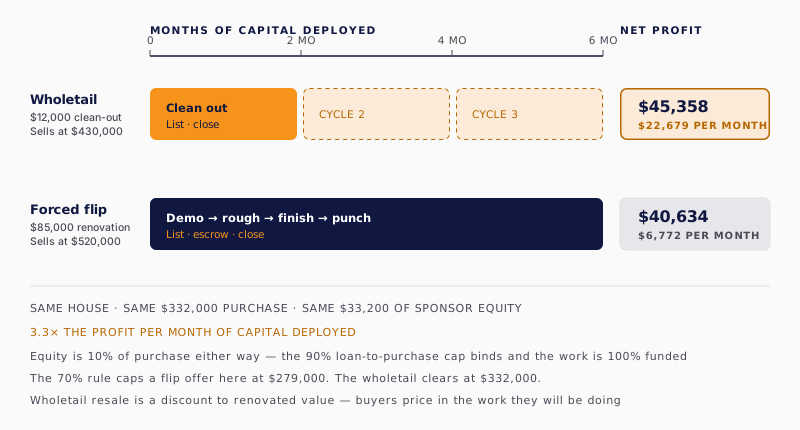
Run the same $33,200 through three wholetails a year and you have done what one flip does, three times over, without ever managing a subcontractor. That is the honest appeal of the strategy, and it is why experienced operators keep a wholetail lane open alongside their renovation pipeline rather than choosing between them.
Risk compounds the comparison in the same direction. Six months of renovation carries scope discovery, contractor failure, structural overruns, permit delay, and market movement. A two-month wholetail carries almost none of it, because there is almost no work to go wrong. Fewer variables, less time, less exposure.
Who actually buys a wholetail
This is where the strategy fails when it fails, and it deserves more attention than the profit table.
You are listing a house that is clean and safe but visibly unrenovated. That narrows your buyer pool in a specific, financing-driven way:
- Cash buyers — investors and a meaningful slice of owner-occupants in competitive markets. No condition constraints at all.
- Conventional buyers with reserves — can generally close on a property needing cosmetic work, provided it is habitable and the appraiser does not call for repairs.
- Government-backed buyers — FHA and VA financing carries minimum property condition standards. Peeling paint on pre-1978 stock, a non-functioning system, an unsafe stair or missing handrail, an active roof leak: any of these can produce a repair call-out that must be cured before closing.
That third group is the trap. In many price bands FHA and VA buyers are a large share of demand, and if your property cannot pass their condition standards you have removed them from your pool without realizing it. The house sits, days on market accumulate, and you take the price cut that erases the margin.
The mitigation is cheap and specific: spend the small money on the items that trigger condition call-outs, not on the items that look good in photographs. Handrails, exposed wiring, active leaks, chipping paint on older stock, a working heat source, functioning plumbing. A few thousand dollars aimed at eligibility widens the buyer pool far more than the same money spent on a nicer paint color.
Ask your agent directly what share of recent sales in that band closed with FHA or VA financing. If it is high, budget for eligibility.
Financing a 60-day hold
Short holds change which loan features matter. Rate barely moves the answer over two months; minimum interest and prepayment terms dominate.
Two PML products can finance this deal, and the difference is not the rate:
| Fix and flip | Bridge | |
|---|---|---|
| Rate from | 8.99% | 9.5% |
| Prepayment | None — sell the day after close | Three-month minimum interest, zero after |
| Minimum loan | $100,000 | $250,000 |
| FICO floor | 600 | 660 |
| Work during term | Funded, drawn weekly | No construction during term |
| Cost over a 60-day hold | $4,656 | $7,382 |
The bridge product costs $2,726 more on this deal despite being a perfectly good loan, entirely because its three-month minimum interest charges you for a month you did not use. On a 60-day trade, a half-point of rate is noise and the minimum-interest clause is the whole decision.
Two more reasons the fix-and-flip product usually fits a wholetail better: the $12,000 of clean-up is funded and drawn rather than paid from your pocket, and there is no restriction on doing work during the term. Bridge explicitly excludes construction during the term, which makes it the wrong instrument the moment your scope stops being purely cosmetic.
The general lesson generalises past this article: on any hold under 90 days, read the prepayment and minimum-interest terms before you read the rate. It is the same lesson the points versus rate break-even teaches from the other direction — short holds are governed by fixed costs, not by annualised ones.
When wholetailing is the wrong call
Four conditions kill it, and three of them are visible before you offer.
- A slow market. Wholetailing depends on retail buyers competing for scarce inventory. Where inventory is plentiful, buyers simply purchase a renovated house instead, and your discount has to widen until the margin disappears. This strategy is materially more market-dependent than flipping.
- A spread that is genuinely large. If the gap between as-is and renovated value is wide relative to the rehab cost, the renovation is creating real value and you should capture it. Wholetailing is for houses where the renovation premium is thin, not for houses where it is fat.
- Condition that cannot be made lendable. A property with a failed roof, no functioning systems, or unpermitted work needing legalisation cannot be cleaned into eligibility. That is a renovation project, and pretending otherwise produces a listing nobody can finance.
- Neighborhoods where finish quality drives price. In some submarkets buyers pay a disproportionate premium for a finished product, and the renovated comp is not just higher but far higher. Read the comps before assuming an 80% as-is ratio holds — it varies enormously by market and price band.
The discipline is to underwrite both exits before you offer, not to pick a strategy and then find houses for it. Price the flip, price the wholetail, and let the numbers choose. Sometimes the answer is that a house you were about to walk away from is a good two-month trade. Send us the address, the as-is comps, and both budgets and we will quote whichever structure the deal actually wants.
Glossary
Taking title to a distressed property, performing a clean-out and minimal cosmetic work, and reselling on the open market in weeks. Sits between wholesaling and full renovation.
Assigning a purchase contract to an investor without taking title, capturing an assignment fee. Limited to an off-market buyer list.
The price a cleaned-out, photographed but unrenovated property achieves on the open market. The basis for wholetail underwriting, distinct from the renovated after-repair value.
The gap between as-is-plus value and fully renovated value, less the cost of the renovation. Wide premiums favor flipping; thin ones favor wholetailing.
Requirements applied by government-backed loan programs covering safety, habitability, and specific hazards. Failing them removes FHA and VA buyers from the pool.
A loan term requiring a stated number of months of interest regardless of actual payoff date. The dominant cost variable on holds shorter than the minimum.
Net profit divided by months of capital deployed. The comparison that makes velocity visible when absolute profit figures look similar.
Frequently asked questions
What is wholetailing?
Taking title to a distressed property, doing a clean-out and minimal cosmetic work over two or three weeks, then reselling on the open market via the MLS. It sits between wholesaling (assign a contract, never take title, sell to an investor list) and flipping (renovate fully over months, sell at retail). The engine is MLS exposure — it reaches owner-occupants who will do their own work and pay more than an investor underwriting to a margin.
How do I calculate a wholetail offer?
Price off the realistic as-is-plus resale price, not the renovated ARV. Target roughly 78–82% of wholetail resale, minus the clean-up budget. On a house that resells cleaned out at $430,000 with a $12,000 budget: 80% of $430,000 is $344,000, less $12,000, so a maximum offer of $332,000. The 78–82% band varies substantially by market and price band — check as-is comps rather than assuming it holds.
Does it make more than flipping?
On the right house, yes — and dramatically more per month of capital. Holding purchase at $332,000 and equity at $33,200 in both cases: a two-month wholetail selling at $430,000 nets $45,358; forcing a six-month flip selling at $520,000 nets $40,634. Per month of capital deployed that is $22,679 against $6,772, about 3.3 to 1 — and the flip carries six months of scope, contractor, and permit risk the wholetail never touches.
Why is the equity the same either way?
Because the binding constraint is the 90% loan-to-purchase cap and the work budget is 100% funded in both cases. The loan is 90% of purchase plus the full budget, so you contribute exactly 10% of the purchase price whether the budget is $12,000 or $85,000 — $33,200 on a $332,000 purchase, either way. That is what makes the two strategies directly comparable on identical capital.
Who buys a wholetail?
Cash buyers — investors and, in competitive markets, a real share of owner-occupants — plus conventional buyers with reserves who can close on cosmetic work provided the house is habitable. The group at risk is government-backed buyers: FHA and VA carry minimum property condition standards. Peeling paint on pre-1978 stock, a dead system, an unsafe stair, or an active leak can each trigger a repair call-out that must be cured before closing — silently removing a large share of demand in many price bands.
What work should I actually do?
Haul-out and disposal, deep clean, exterior tidy-up and landscaping, paint where it is cheap and transformative, and repairs to anything genuinely unsafe. Deliberately skip kitchens, baths, flooring, and anything needing a permit. The highest-value rule: spend the small money on what triggers lender condition call-outs, not on what photographs well — handrails, exposed wiring, active leaks, chipping paint on pre-1978 stock, a working heat source, functioning plumbing. A few thousand aimed at eligibility widens the buyer pool more than the same money spent on finishes.
Which loan fits a 60-day hold?
On holds under 90 days, read the prepayment and minimum-interest terms before the rate. The fix and flip product has no prepayment penalty and no minimum interest, so 60 days on a $310,800 loan at 8.99% costs about $4,656. A bridge loan at 9.5% carries three-month minimum interest, so the same hold costs about $7,382 — $2,726 more for a month you never used. Fix and flip also funds the clean-up through draws and permits work during the term; bridge does not.
When is it the wrong call?
Four conditions. A slow market — the strategy needs retail buyers competing for scarce inventory; where inventory is plentiful they just buy a renovated house. A genuinely wide renovation premium — if the gap between as-is and renovated value is large relative to rehab cost, the renovation is creating real value worth capturing. Condition that cannot be made lendable (failed roof, unpermitted work needing legalisation) — that is a renovation project. And submarkets where finish quality drives price disproportionately, where the as-is ratio assumption breaks.
Underwrite both exits before you offer.
Send us the address, the as-is comps, and both budgets. We will quote whichever structure the deal actually wants — and tell you plainly if the flip is the better trade.