 Private Money Lenders
Read time: 30 seconds
- Two paths, and which one you are on is decided by size and cause. Under 10% of budget and confined to one or two lines is a change order. Structural is a budget modification.
- A change order moves money, not the loan. Budget is reallocated from contingency, the loan amount is unchanged, and nothing re-closes.
- A budget modification raises the loan — up to the original LTV-ARV cap, typically within five business days, at a 25 basis point modification fee, usually with no second appraisal and no re-closing.
- “Up to the original cap” is the whole sentence. If your loan was already ARV-capped at close, there is no headroom and the overrun is your cash.
- On a worked $46,000 foundation surprise: $42,550 of loan increase, $3,450 out of pocket, about $1,500 in fees — against $6,000 to $15,000 if you had to originate a new loan instead.
- Which cap binds at close determines your resilience. An LTC-bound loan has room. An ARV-bound one has none.
Two paths, and the test that sorts them
Every rehab discovers something. The question is never whether you will go over on a line item — it is which of two very different processes your particular overrun triggers, because one of them is a form and the other is an underwriting event.
The sorting test has two parts, and both must hold for the cheap path:
Notice what path one actually is. It is not the lender giving you more money — it is you spending the contingency you already budgeted, with the paperwork updated so the schedule of values still matches reality at the next inspection. The money was always yours. The change order is how the scoring document learns about it.
Path two is different in kind. The total cost of the project has genuinely risen, and the loan is being resized against a larger basis. That is underwriting, not filing — but it is fast underwriting, because the lender already has the file, the appraisal, and a complete draw history on the work performed to date.
What counts as structural
The word does more work than it looks like it should. “Structural” here means an overrun caused by a condition you could not have priced, not merely one that is large.
Qualifying, in practice:
- Discovered foundation work. Settlement, a failed pier, a cracked stem wall — visible only after demo or after a monitoring period.
- Failed sewer lateral or supply line. Frequently invisible until scoped, and non-negotiable once found.
- Permit-driven scope expansion. The building department requires an upgrade you did not scope: a panel, egress windows, a fire separation, seismic strapping. You did not choose it and could not have avoided it.
- Unpermitted prior work discovered mid-project. A converted garage or an added bath that has to be legalised or removed.
- Hazardous material abatement. Asbestos, lead, or buried tanks found during demolition.
Not qualifying, however much you want them to:
- Finish upgrades. Deciding on quartz over laminate, or a better tile, after seeing the space. That is a preference, and preferences come out of contingency or out of pocket.
- Underbidding. A contractor whose number was low is a pricing failure, not a discovery. It will be treated as a budget you got wrong.
- Schedule cost. Running long is real and expensive, but it is carry, not scope, and carry is not funded by a budget modification.
The practical consequence: document the condition the moment it is exposed. Photographs of the open condition, the trade’s written assessment, and the change price. A foundation surprise documented at demo is a five-day modification. The same foundation surprise raised eight weeks later, after it has been buried behind new drywall, is an argument.
The original cap is the ceiling
Here is the sentence that decides whether a modification helps you: the loan can be increased up to the original LTV-ARV cap.
Not up to a new cap based on a new appraisal. Not up to whatever the increased budget implies. Up to the ceiling that was set when the file closed.
Which means your resilience to an overrun was determined at closing, by which of the three caps was binding. Recall how a fix-and-flip loan is sized — the lowest of 92.5% of project cost, 90% of purchase price, and 75% of ARV.
If the ARV cap was binding at close, a budget modification has nowhere to go. The overrun is your cash, in full.Why which cap binds is not an academic question
Two files, identical on the surface, respond to the same surprise in opposite ways:
| File A — LTC-bound | File B — ARV-bound | |
|---|---|---|
| Binding cap at close | Loan-to-cost | Loan-to-ARV |
| Headroom under the ARV cap | $60,000 | $0 |
| Response to a $46,000 structural overrun | Modification absorbs nearly all of it | Entirely sponsor cash |
This is a concrete reason to care about a soft appraisal even when the loan closed fine. A deal that only just cleared its ARV cap is a deal with no shock absorber, and that is worth knowing in month one rather than month four. It is also the strongest practical argument for the comp packet that defends a higher appraised value — the value you defend at close is the headroom you get to spend later.
A $46,000 foundation surprise, priced
A rehab closes at $420,000 purchase and $180,000 of budget — $600,000 of project cost against an $820,000 ARV.
At demo the crew exposes a failed stem wall. Documented remediation: $46,000. That is 25.6% of the budget and unambiguously structural, so it is a modification, not a change order.
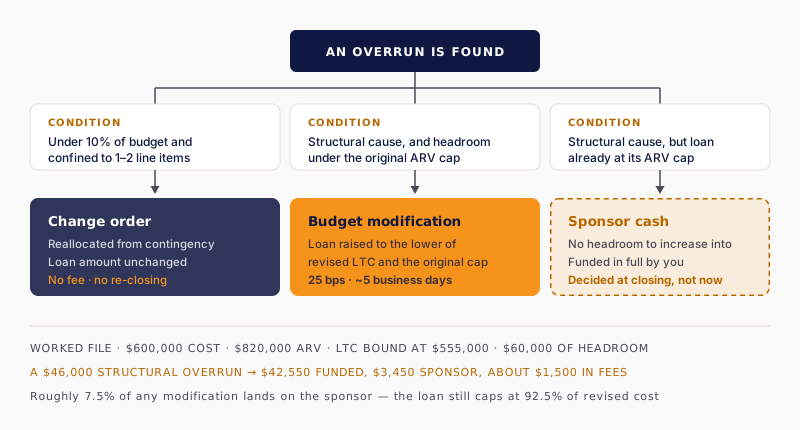
Note that the sponsor still funds $3,450. Because the loan tops out at 92.5% of the revised cost, roughly 7.5% of any modification lands on you by construction. A modification is not a bailout; it is the same leverage applied to a larger number.
What the modification costs
The terms are specific: a 25 basis point modification fee, no second appraisal in most cases, and no re-closing of the loan, typically inside five business days.
Compare that with the alternative, which is what you face if your lender does not offer a modification path and you have to solve the overrun with new debt:
| Budget modification | New financing for the gap | |
|---|---|---|
| Cost | 25 bps — about $1,500 on this file | 1–2.5 points of origination — roughly $6,000 to $15,000 |
| Appraisal | Usually none | Usually required |
| Closing | None — the loan is amended | Full closing, new title work |
| Timeline | ~5 business days | Weeks |
| Lien position | Unchanged | A junior lien — which needs consent |
That last row deserves emphasis, because it is where people get hurt. Solving an overrun by taking a second loan secured against the property is recording an additional encumbrance, and most loan documents prohibit that without written consent. On a loan with a carve-out guaranty it can be a springing recourse trigger. If you are going to bring outside money, bring it as equity or get the consent first — never quietly record a second.
Getting the modification approved the first time
A modification is underwriting, and underwriting responds to files rather than to phone calls. What a clean submission contains:
- Photographs of the exposed condition, dated, with enough context to locate them in the property. This is the evidence that the condition was discovered rather than chosen.
- A written assessment from the trade — the foundation contractor, the plumber, the structural engineer. A number without a diagnosis reads as a re-bid.
- A priced change order against specific schedule-of-values lines, showing what is added and where it lands.
- A revised schedule of values summing to the new total, using the same line naming as the original so the next inspection reconciles cleanly.
- Any permit or inspection correspondence where the scope is authority-driven. A correction notice is the single most persuasive document in this category, because it removes discretion entirely.
- A revised timeline. If the work adds three weeks, say so now — it affects your maturity and your carry, and surfacing it with the modification is far cheaper than surfacing it in month eight.
What slows a modification down is almost never the lender’s appetite. It is a request for more money with no documented cause, which underwriting cannot distinguish from an underbid.
Reducing the odds you need one
Modifications are cheap and routine. Not needing one is cheaper.
- Hold 10–15% contingency, outside the line items. Sized this way, the $9,500 kitchen surprise never becomes a lender conversation at all — it is a change order against money you already have.
- Scope the invisible systems before you close. A sewer scope and a foundation walk cost a few hundred dollars during diligence. They are the two most common structural overruns in the book, and both are findable in advance.
- Pull permits early. Most permit-driven scope expansion surfaces at plan check. Submitting during escrow rather than after closing converts a mid-project surprise into a pre-purchase fact.
- Know your headroom on day one. Ask which cap bound your loan. If it was ARV, you are running without a shock absorber, and your contingency needs to be larger and genuinely liquid.
- Do not spend contingency on finishes. The upgraded tile in month two is the foundation money you do not have in month four.
Discovery is a cost of doing business in older housing stock, and every experienced sponsor budgets for it. What separates a routine five-day modification from a project-threatening event is entirely whether the cause was documented, the contingency was real, and the loan closed with room under its cap. Send us the condition and the trade’s number and we will tell you which path it falls under and what the revised loan looks like.
Glossary
A documented reallocation of budget between line items, funded from contingency, leaving the loan amount unchanged. The path for overruns under 10% of budget confined to one or two lines.
An underwritten increase in the loan amount to fund a structural overrun, bounded by the original loan-to-ARV cap. Priced at 25 basis points, usually with no second appraisal or re-closing.
An overrun caused by a condition that could not have been priced — discovered foundation work, a failed sewer lateral, permit-driven scope expansion — as distinct from a preference change or an underbid.
The maximum loan as a percentage of after-repair value, 75% on fix-and-flip. The hard ceiling on any subsequent increase, fixed at the value established when the loan closed.
The distance between the funded loan amount and the original ARV cap. The amount a budget modification can actually add, and zero on a file that was ARV-bound at close.
Reserve held for discovered conditions, sized at 10–15% of hard costs and held outside the line items so that spending it is visible.
A written requirement issued by a building department during plan check or inspection. The most persuasive documentation for a permit-driven modification, because it removes discretion from the scope question.
Frequently asked questions
What happens if I go over budget?
Two paths. If the overrun is under 10% of the total budget and confined to one or two line items, submit a change order and the budget is reallocated from contingency without changing the loan amount. If it is structural — discovered foundation work, an unforeseen sewer lateral, a permit-driven scope expansion — PML can underwrite an increase to the loan amount up to the original LTV-ARV cap, typically within five business days. The cost is a 25 basis point modification fee, no second appraisal in most cases, and no re-closing.
What counts as structural?
An overrun caused by a condition you could not have priced — not merely a large one. Discovered foundation work, a failed sewer lateral, permit-driven scope expansion, unpermitted prior work found mid-project, and hazardous material abatement all qualify. Finish upgrades chosen after seeing the space do not; those are preferences. Nor does a contractor who underbid, which is a pricing failure rather than a discovery, or schedule overrun, which is carry rather than scope.
How much can the loan increase?
Up to the original LTV-ARV cap — 75% of the after-repair value established when the loan closed, not a new cap from a new appraisal. So your capacity to absorb an overrun was set at closing, by which of the three caps was binding. On the worked example ($420,000 purchase, $180,000 budget, $820,000 ARV), loan-to-cost bound at $555,000 while the ARV cap sat at $615,000 — $60,000 of headroom. A file that closed at its ARV cap has none.
Does the lender fund the whole overrun?
No — and that is structural, not a negotiation. Because the loan caps at 92.5% of revised project cost, roughly 7.5% of any modification lands on you. On the worked $46,000 overrun, the modification funded $42,550 and the sponsor funded $3,450. A modification applies the same leverage to a larger number; it is not a bailout, and reserves still need to exist behind it.
What does a modification cost?
A modification is 25 basis points — about $1,500 on the worked file — usually with no second appraisal, no re-closing, and roughly five business days. New financing for the same gap means 1–2.5 points of origination ($6,000–$15,000), an appraisal, a full closing, and weeks. It also creates a junior lien, which most loan documents prohibit without written consent and which can be a springing recourse trigger on a carve-out guaranty.
What documents does a modification need?
Dated photographs of the exposed condition; a written assessment from the trade or engineer; a priced change order mapped to specific schedule-of-values lines; a revised schedule summing to the new total in the original line naming; any permit or inspection correspondence; and a revised timeline. A building-department correction notice is the most persuasive document available — it removes discretion from the scope question. What slows modifications down is a request for money with no documented cause, which reads as an underbid.
How much contingency should I hold?
10–15% of hard costs, held outside the line items rather than distributed across them, and higher on pre-1960 stock or anywhere you have not opened the walls. Held this way, a moderate surprise never becomes a lender conversation — it is a change order against money you already budgeted. Distributing contingency into every row instead front-loads the whole schedule, fails cost benchmarking, and makes the reserve invisible.
How do I avoid needing one?
Scope the invisible systems in diligence — a sewer scope and a foundation walk cost a few hundred dollars and cover the two most common structural overruns. Pull permits early, since most authority-driven scope surfaces at plan check, and submitting during escrow turns a mid-project surprise into a pre-purchase fact. Hold real contingency outside the line items. And ask which cap bound your loan: a file that closed at its ARV cap has no headroom and needs a larger liquid reserve behind it.
Found something behind the wall?
Send us the condition, the photographs, and the trade’s number. We will tell you which path it falls under and what the revised loan looks like — typically inside five business days.