 Private Money Lenders
Read time: 30 seconds
- A soft inquiry does not affect your score and is visible only to you. A hard inquiry is visible to lenders, sits on the report for two years, and factors into scoring for twelve months.
- An indicative quote needs the address, the scope of work, and your FICO range — self-reported. No hard inquiry runs before you accept terms.
- So shopping four lenders at the quote stage costs zero inquiries. You accept once; one hard pull follows.
- Your score is a pricing tier, not a gate. Below the floor generally means higher rate or lower leverage, not an automatic decline — the deal is the primary underwrite.
- The loan usually never appears on your personal report. Business-purpose debt to an entity is typically not reported as a consumer tradeline — so it neither builds your score nor loads your personal DTI.
- The guaranty is the exception. A default that produces a judgment can reach you personally even though the performing loan never showed up.
Two kinds of inquiry
Almost every credit anxiety in investor lending comes from collapsing two very different events into one word. “They pulled my credit” describes both a thing that costs you nothing and a thing that leaves a mark for two years.
| Soft inquiry | Hard inquiry | |
|---|---|---|
| Effect on score | None | Small, typically under 5 points on a thick file |
| Who can see it | Only you | Any lender pulling your report |
| How long it stays | Roughly 2 years, but invisible to lenders | 2 years on the report; scored for 12 months |
| Requires your permission | Not always — account review, prequalification | Yes — specific authorization |
| Typical trigger | Prequalification, monitoring, an existing lender reviewing you | A formal application you have consented to |
The score effect of one hard inquiry is genuinely minor and widely overestimated. On a file with real history, a single inquiry typically costs a handful of points and fades within months. Inquiries are a small input to a score dominated by payment history and utilization.
What actually causes damage is accumulation. Six hard inquiries across twelve months reads as a borrower seeking credit repeatedly, and on a thin file that pattern can move a score by a meaningful margin. The problem is never the pull. It is the sixth pull.
Where each sits in the process
The sequence matters more than the definitions, because it tells you exactly when you retain control.
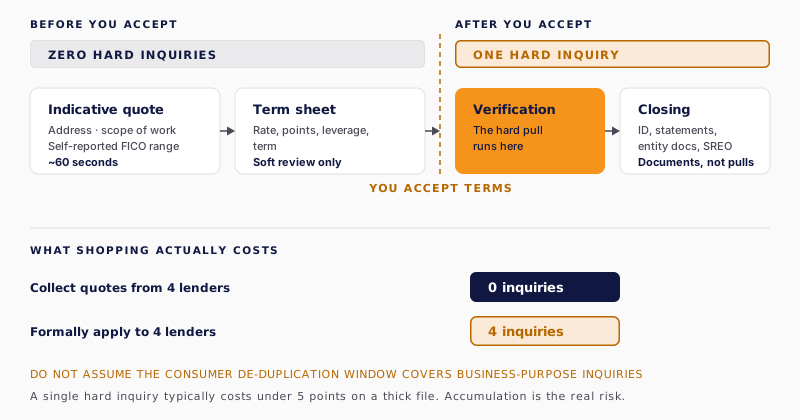
Stage one — the indicative quote. What is required is the property address, the scope of work, and your FICO range. That is it, and it takes about sixty seconds. Your score enters as a self-reported band, not as a pulled figure, which is why no hard inquiry is needed to price a deal.
Stage two — terms. You receive a quote with rate, points, leverage, and term. Still no hard inquiry. Any credit review at this stage is soft, which by definition leaves your score untouched.
Stage three — acceptance. This is the line. Once you accept terms, verification begins in earnest and the hard pull runs. That is the moment you spend an inquiry, and it happens only because you chose to proceed.
Stage four — closing conditions. Government-issued ID, two months of bank statements, entity formation documents, a schedule of real estate owned, and the purchase contract. Documents, not inquiries.
The practical consequence is worth stating plainly, because most borrowers do the opposite:
Shop on quotes, not on applications. Four quotes cost zero inquiries. Four applications cost four.The one habit that protects a score
Be accurate about your range when you self-report it. Quoting yourself a tier you do not occupy produces a term sheet that changes at verification, which wastes a week and starts the relationship badly. An honest range gets you a quote that survives the pull.
Why business-purpose lending pulls differently
The structural reason your credit matters less here than on a consumer mortgage is that you are not the borrower. The borrower is an entity — an LLC that owns the property. Your credit enters through the personal guaranty, which is why it is examined at all.
That produces a different underwriting hierarchy. On a consumer mortgage the applicant is the asset: income, debt-to-income ratio, employment stability, and score do the work. On a business-purpose investor loan the property is the asset, and the guarantor is a secondary consideration checked for competence and character rather than scored for capacity.
Which is why an investor loan asks for a schedule of real estate owned but not for tax returns, and why the primary questions are about the deal:
- Leverage — loan-to-cost, loan-to-purchase, and loan-to-ARV, and which of the three caps binds.
- Experience — closed deals in the last 36 months, which drives the tier far harder than score does.
- Exit — whether the takeout is a sale or a refinance, and whether it is realistic.
- Liquidity — reserves behind the down payment, verified.
Score sits alongside those, not above them.
What your score actually controls
It sets a pricing tier and a leverage band. It rarely operates as a switch.
Most hard money lenders run a soft credit pull, but the focus is the deal rather than the score. Credit below the program floor generally means higher rates or lower leverage, not an automatic decline. The strongest pricing arrives at 720 and above. Below 600 narrows your options sharply, and below 580 most lenders pass.
Floors themselves vary by product, so check the specific program page for the current figure rather than assuming a single number covers the whole book.
The more useful observation is about relative weight. Compare what moves your rate:
| Lever | Typical effect on pricing | How fast you can move it |
|---|---|---|
| Experience tier | A full point of rate, plus 12.5 points of leverage | Deals, not months |
| Leverage requested | Meaningful — lower LTC prices better | Immediately, with more equity |
| Credit score band | Real but smaller, within a tier | Months |
| A single hard inquiry | Effectively none | — |
An investor who obsesses over a five-point inquiry while accepting an extra 5% of leverage has optimized the wrong variable by an order of magnitude. Closing a third deal moves your terms further than any credit tactic available to you.
Does the loan appear on your credit report?
Usually not, and the consequences run in both directions.
Business-purpose loans made to an entity are generally not furnished to the consumer credit bureaus as tradelines. Commercial and business lending largely reports to commercial bureaus, where it reports at all. So the typical pattern for a performing investor loan is: the hard inquiry from your acceptance appears, and the loan itself does not.
What you lose. A hard money loan paid perfectly for eighteen months across three projects builds no personal payment history. Your track record lives in your schedule of real estate owned and your lender relationships — not in your FICO.
What you gain, and it is larger. The debt does not load your personal debt-to-income ratio. An investor carrying three project loans is not carrying three mortgage payments against their consumer profile, which is precisely what makes it possible to run a project pipeline and still qualify for a personal residence.
The exception that matters. You signed a personal guaranty. If a loan defaults and the lender obtains a deficiency judgment against you, that judgment is a personal matter and can appear in public records and affect your ability to borrow. The performing loan is invisible; the failed one is not. This is one more reason to understand what the guaranty actually covers before you sign it.
Reporting practice varies between lenders, so confirm it rather than assuming — particularly if you are counting on either the invisibility or the credit-building.
Rate shopping without shredding your score
Consumer borrowers rely on de-duplication: scoring models treat multiple mortgage or auto inquiries inside a 14-to-45-day window as a single event, so shopping a home loan does not compound.
Do not assume that protection extends to investor lending. Whether a business-purpose loan inquiry is coded so that it de-duplicates with other mortgage inquiries depends on how the lender pulls and how it is furnished. It may cluster. It may not. Treating de-duplication as guaranteed is how a sponsor ends up with four standalone inquiries.
Fortunately you do not need the protection, because the structure of the process already solves it:
- Collect quotes on a self-reported range. Address, scope, FICO band. As many lenders as you like, zero inquiries.
- Compare on total dollar cost over your actual hold, not on headline rate — the method in the points versus rate article.
- Accept once. One acceptance, one hard pull.
- If you must formally apply with more than one, compress it. Same week, not spread over two months, to maximize whatever clustering does apply.
A useful sanity check before you shop: pull your own report from the free annual sources. That is a soft inquiry, it costs nothing, and it means you self-report a range you can actually document.
Running a pipeline without stacking inquiries
An investor closing four deals a year faces a question a consumer never does: does every project cost an inquiry?
Broadly yes, since each accepted loan is a separate credit decision. Three practices keep that from compounding:
- Consolidate into one facility. A cross-collateralized facility is one closing, one set of documents, and one credit decision covering several concurrent projects — instead of one per asset. For a sponsor running three or more at a time, that is the single largest reduction in credit friction available, before counting the pricing benefit.
- Stay with one lender. A repeat borrower is an existing relationship. Re-underwriting a known guarantor is a lighter exercise than a first file, and some lenders will rely on a recent pull rather than running a fresh one. Ask before assuming, and note that terms older than about ninety days generally do warrant a re-pull.
- Sequence around your personal borrowing. If a personal residence purchase or refinance is on the horizon, do it first. Investor-loan inquiries, and any tradelines that do get furnished, complicate a consumer file at exactly the wrong moment. Six months of clean personal credit before a primary-residence application is worth more than any investor-side optimization.
The summary is undramatic, which is the point: the process is built so the expensive event happens only after you have decided to proceed. Quote freely, accept deliberately, and put your effort into the experience tier and the leverage — those move your terms by amounts a credit score never will. Send us the address, the scope, and your FICO range and you will have a real quote without an inquiry.
Glossary
A credit check that does not affect your score and is visible only to you. Used for prequalification, monitoring, and account review.
A credit check tied to a formal credit decision you authorized. Visible to lenders, remains on the report about two years, and factors into scoring for twelve months.
A priced term indication based on the property address, scope of work, and a self-reported FICO range. Requires no hard inquiry.
An individual credit account reported to a bureau. Business-purpose loans made to an entity are generally not furnished as consumer tradelines.
The period during which scoring models treat multiple same-purpose inquiries as one event. Reliable for consumer mortgages; not guaranteed for business-purpose investor loans.
A listing of the properties a guarantor holds, with values and debt. The investor-lending equivalent of the track record a credit score cannot show.
Pricing and leverage band set by closed deals in the last 36 months. Moves terms substantially further than a credit score band does.
Frequently asked questions
Does getting a quote hurt my credit?
No. An indicative quote needs only the property address, the scope of work, and your FICO range — self-reported, about sixty seconds, no hard inquiry. Any credit review before you accept terms is a soft pull, which does not affect your score and is visible only to you. The hard inquiry runs after acceptance, so shopping several lenders at the quote stage costs zero inquiries.
Soft pull vs hard pull?
A soft inquiry does not affect your score, is visible only to you, and does not always need specific permission — prequalification, monitoring, account review. A hard inquiry requires authorization, is visible to any lender pulling your report, stays about two years, and is scored for twelve months. A single hard inquiry typically costs under five points on a thick file and fades within months. Damage comes from accumulation, not from any one pull.
What score do I need?
Most hard money lenders run a soft pull, but the focus is the deal rather than the score. Below a program floor generally means higher rate or lower leverage, not an automatic decline. The strongest pricing arrives at 720+. Below 600 narrows options sharply; below 580 most lenders pass. Floors differ by product, so check the specific program page for the current figure.
Does the loan show up on my report?
Usually not. Business-purpose loans to an entity are generally not furnished to consumer bureaus as tradelines, so the inquiry from your acceptance appears and the loan does not. That cuts both ways: a perfectly performing loan builds no personal payment history, so your track record lives in your schedule of real estate owned rather than your FICO — but the debt also does not load your personal debt-to-income ratio, which is what lets you run several projects and still qualify for a personal residence. Practice varies; confirm with your lender.
Can it ever damage my personal credit?
Yes — through the personal guaranty rather than the loan. A performing loan is generally invisible on a consumer report. But if it defaults and the lender obtains a deficiency judgment against the guarantor, that is a personal matter which can appear in public records and affect future borrowing. The performing loan is invisible; the failed one is not. One more reason to understand what the guaranty covers before signing.
Can I shop several lenders safely?
Yes — shop on quotes, not applications. Collect indicative quotes from as many lenders as you like on address, scope, and a self-reported range (zero inquiries), compare on total dollar cost over your actual hold rather than headline rate, then accept once. Do not rely on the consumer de-duplication window that treats multiple mortgage inquiries in 14–45 days as one event — whether a business-purpose inquiry clusters that way depends on how it is pulled and furnished. If you must formally apply with more than one, compress it into a single week.
Does every deal cost an inquiry?
Broadly yes — each accepted loan is its own credit decision — but three practices limit it. A cross-collateralized facility gives one closing, one set of docs, and one credit decision across several concurrent projects instead of one per asset. Staying with one lender means a known guarantor is re-underwritten more lightly, and some will rely on a recent pull rather than a fresh one, though terms older than about 90 days generally warrant a re-pull. And sequence around any personal borrowing.
Investor loan or personal mortgage first?
Personal first. Investor-loan inquiries, and any tradelines that do get furnished, complicate a consumer mortgage file at exactly the wrong moment — and consumer underwriting is far more sensitive to both than investor underwriting is. Six months of clean personal credit before a primary-residence application is worth more than any optimization available on the investor side, where the deal carries most of the underwriting weight anyway.
Get a real quote without an inquiry.
The property address, the scope of work, and your FICO range. About sixty seconds, no hard pull, and no application fee at any point.